Have you ever wondered if it’s okay to keep your portable power station plugged into the wall while it powers your devices at the same time? If so, you’re asking about pass-through charging, one of the most useful—and often misunderstood—features found in modern portable power stations.
Whether you’re backing up a Wi-Fi router during outages, running a CPAP overnight, or powering a Starlink Mini while camping, pass-through charging can provide continuous electricity without constantly switching cables. However, many users worry that using this feature will wear out the battery or damage the power station.
In this guide, you’ll learn what pass-through charging is, how it works, when it’s safe to use, and the best practices for maximizing battery lifespan.
Quick Answer
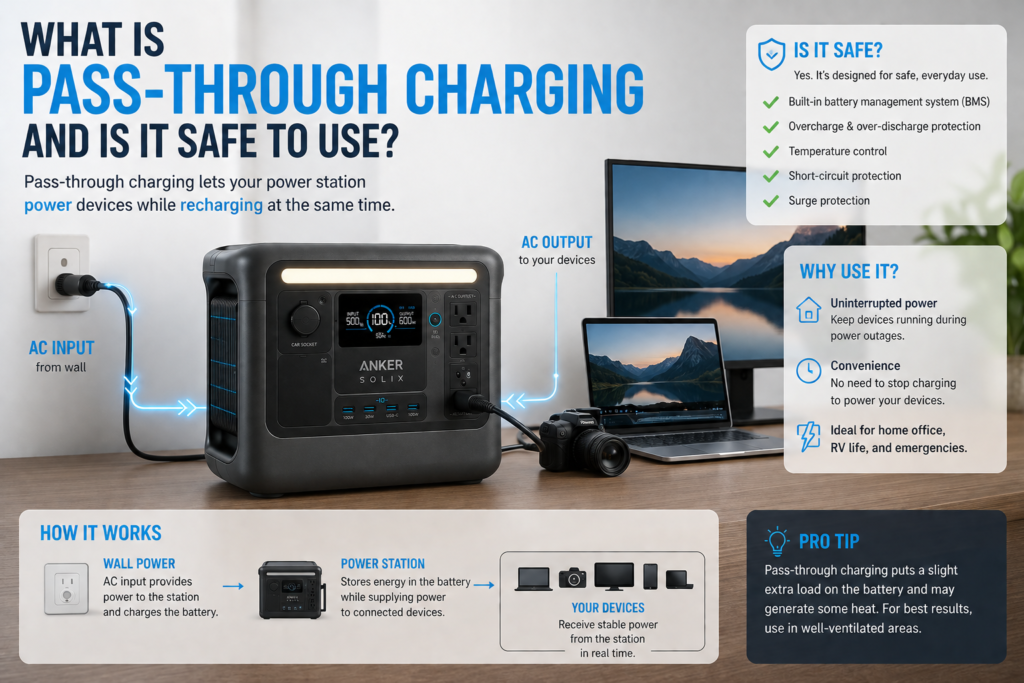
Pass-through charging allows a portable power station to charge its internal battery while simultaneously supplying power to connected devices.
Modern lithium power stations from reputable manufacturers are generally designed to support this feature safely. In many newer models, incoming AC power can bypass much of the battery when sufficient wall power is available, reducing unnecessary battery cycling. However, performance and behavior vary by manufacturer, so it’s important to follow the product’s specifications.
What Is Pass-Through Charging?
Pass-through charging is a feature that enables a battery-powered device to receive power and deliver power at the same time.
Instead of waiting for the battery to finish charging before plugging in your electronics, you can connect both simultaneously.
For example:
- Plug the power station into a wall outlet.
- Connect your laptop to the AC outlet.
- Connect your phone to a USB-C port.
- Continue charging the power station while using both devices.
To you, everything works as if the power station were both a charger and a battery backup.
This makes pass-through charging especially valuable during long power outages, remote work, camping trips, and emergency preparedness.
How Pass-Through Charging Works
Although every manufacturer uses a slightly different power management system, the basic process is similar.
Step 1: External Power Is Connected
The power station receives electricity from:
- An AC wall outlet
- Solar panels
- A vehicle’s 12V outlet
- A generator
Step 2: Intelligent Power Management
The internal electronics determine how to distribute incoming energy.
Depending on the model, power may:
- Go directly to connected devices.
- Recharge the internal battery.
- Split between both tasks.
Many premium portable power stations automatically prioritize powering connected loads before sending excess energy to recharge the battery.
Step 3: Battery Protection
Modern battery management systems (BMS) continuously monitor:
- Temperature
- Voltage
- Current
- Charging speed
- Cell balance
If unsafe conditions occur, the BMS can reduce charging speed or temporarily stop charging to protect the battery.
Is Pass-Through Charging Safe?
Yes—when the manufacturer explicitly supports it.
Older battery packs sometimes struggled with heat buildup or accelerated battery wear during simultaneous charging and discharging.
Today’s high-quality portable power stations are much more sophisticated.
Many include:
- Smart battery management
- Temperature monitoring
- Over-current protection
- Over-voltage protection
- Short-circuit protection
- Automatic cooling fans
As a result, occasional or even daily pass-through charging is generally considered safe when used within the unit’s rated limits.
However, safe operation still depends on several factors.
When Pass-Through Charging Is Safe
Pass-through charging is generally safe when:
- You use the original charging cable.
- Ventilation openings remain unobstructed.
- Total output stays within the power station’s rated capacity.
- The unit operates in normal ambient temperatures.
- Firmware is kept up to date.
If you’re considering a high-performance model, our guide on Anker SOLIX C1000 Gen 2 Review: Is It Worth Buying in 2026? explains how one popular power station handles continuous charging, UPS functionality, and real-world backup performance.
When You Should Avoid It
Avoid pass-through charging if:
- The manufacturer specifically warns against it.
- The unit becomes unusually hot.
- The battery shows warning messages.
- You’re using damaged charging cables.
- Airflow is blocked.
- The power station has a known hardware issue.
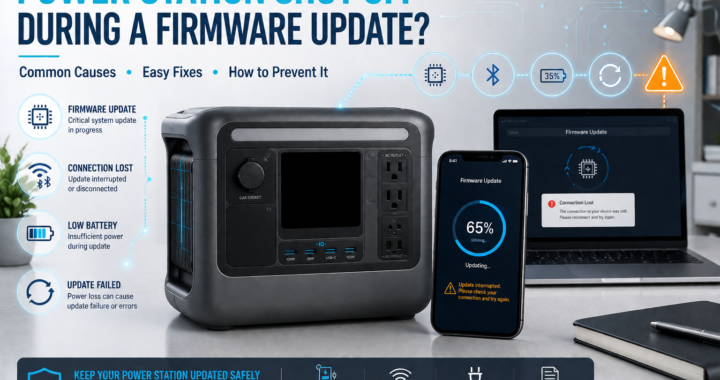
If your device behaves unexpectedly during software updates, see Why Does My Portable Power Station Turn Off During a Firmware Update? for troubleshooting steps before assuming pass-through charging is the cause.
Benefits of Pass-Through Charging
Continuous Power
The biggest advantage is uninterrupted electricity.
Instead of stopping work while recharging the power station, your devices continue running normally.
This makes it ideal for:
- Wi-Fi routers
- Security cameras
- Desktop computers
- Medical devices
- Starlink systems
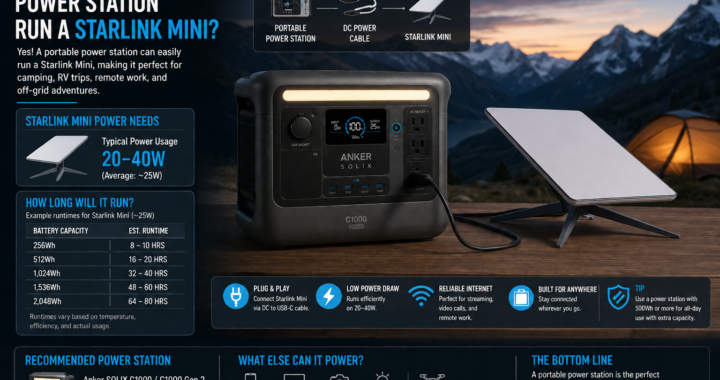
If you’re planning to power satellite internet, you may also like Can a Portable Power Station Run a Starlink Mini?
Great for Emergency Backup
Many homeowners leave a portable power station connected between the wall outlet and essential electronics.
If utility power fails, supported models can switch to battery power almost instantly.
Some premium units offer transfer times around 10 milliseconds, making them suitable for sensitive electronics such as networking equipment and home office setups.
Better Solar Utilization
When camping or living off-grid, solar panels can provide energy during the day while connected devices consume power.
Instead of wasting sunlight after charging finishes, many systems intelligently distribute available solar energy where it’s needed most.
Convenient Daily Charging
You don’t have to remember separate charging schedules.
Simply leave compatible devices connected and let the power station manage charging automatically.
Does Pass-Through Charging Damage the Battery?
This is probably the most common question.
The answer is not necessarily.
Battery lifespan depends far more on:
- Heat
- Charge cycles
- Charging speed
- Storage conditions
- Depth of discharge
Modern lithium iron phosphate (LiFePO₄) batteries are designed for thousands of charge cycles.
In many premium power stations, AC input can partially bypass the battery while connected devices draw power, reducing unnecessary cycling compared with older designs.
However, constantly operating at maximum charging speed while powering heavy appliances may increase internal temperatures.
Higher temperatures generally accelerate battery aging more than pass-through charging itself.
Best Practices for Safe Pass-Through Charging
Follow these recommendations to maximize performance and battery longevity.
Keep the Unit Cool
Always place the power station on a hard, flat surface.
Avoid:
- Direct sunlight
- Closed cabinets
- Blankets
- Carpet that blocks vents
Proper airflow helps cooling fans work efficiently.
Don’t Overload the Inverter
Every portable power station has a maximum continuous output.
Running appliances beyond this limit can trigger overload protection or automatic shutdown.
Always calculate the combined wattage of connected devices.
Update Firmware Carefully
Manufacturers regularly improve charging logic, battery management, and stability through firmware updates.
However, avoid relying on the power station for critical internet equipment while updating if the manufacturer recommends disconnecting loads.
Use Quality Power Sources
Stable AC outlets, properly configured solar arrays, and compatible charging accessories reduce stress on the charging system.
Using undersized extension cords or damaged cables can cause unnecessary heat and voltage drops.
Pass-Through Charging vs. UPS Mode
Many people confuse these two features, but they serve different purposes.
| Pass-Through Charging | UPS Mode |
|---|---|
| Charges battery while powering devices | Automatically switches to battery during outages |
| Focuses on simultaneous charging and output | Focuses on uninterrupted backup power |
| Useful for everyday charging | Useful for emergency backup |
| Available through AC, solar, or vehicle charging | Usually works only with AC input |
Many premium portable power stations support both features.
Common Myths About Pass-Through Charging
Myth: It Always Damages the Battery
False.
Modern battery management systems are specifically designed to protect lithium batteries during normal operation.
Myth: It Always Uses the Battery First
Not necessarily.
Many newer power stations intelligently route incoming power directly to connected devices whenever possible.
Myth: It’s Only Useful During Emergencies
Not at all.
Many users rely on pass-through charging every day for remote work, camping, home networking, and backup internet.
Frequently Asked Questions
Is pass-through charging safe for portable power stations?
Yes. If the manufacturer supports the feature and you operate the unit within its specifications, pass-through charging is generally safe.
Can I leave my power station plugged in all the time?
Many modern models allow continuous connection. However, it’s best to follow the manufacturer’s storage and charging recommendations to maximize battery lifespan.
Does pass-through charging reduce battery life?
Not significantly under normal conditions. Excessive heat, deep discharges, and constant high-power operation usually have a greater impact on battery longevity.
Can I use solar panels with pass-through charging?
Yes. Many portable power stations support solar pass-through charging, allowing solar panels to recharge the battery while powering connected devices.
Does pass-through charging work with sensitive electronics?
Yes, provided the power station delivers a pure sine wave output. Learn more in What Is Pure Sine Wave Output and Why Does It Matter?
Is pass-through charging the same as UPS mode?
No. Pass-through charging powers devices while charging the battery, whereas UPS mode automatically switches to battery power during an outage.
Final Verdict
Pass-through charging is one of the most valuable features available on modern portable power stations. It allows you to recharge the battery while keeping your devices powered, making it ideal for home backup, camping, remote work, and emergency preparedness.
When supported by the manufacturer, pass-through charging is generally safe thanks to advanced battery management systems, thermal protection, and intelligent power routing. Following simple best practices—such as keeping the unit cool, avoiding overloads, and using compatible charging accessories—will help maximize both performance and battery lifespan.
As portable power stations continue to evolve, pass-through charging is becoming a standard feature that offers greater convenience, improved efficiency, and dependable backup power whenever you need it.