
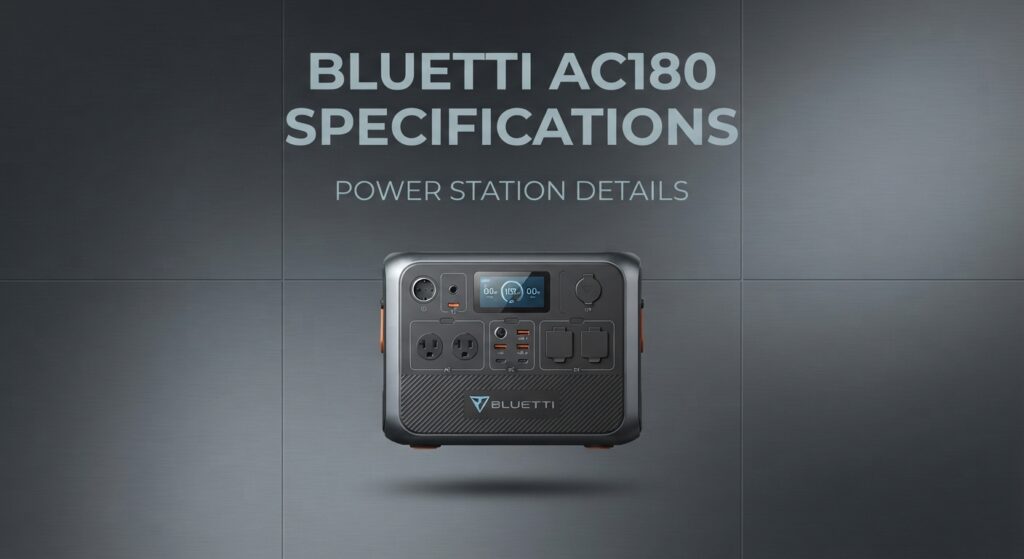
If you’re trying to figure out how many amp hours is a BLUETTI AC180, the answer is 36Ah according to BLUETTI’s specifications. However, that number can be confusing because the AC180 is usually advertised by its 1,152Wh capacity, not amp hours.
So, how do 36Ah and 1,152Wh describe the same battery? And does the AC180 have 36Ah at 12 volts? Not exactly. The important point is that amp hours only make sense when you know the voltage. In this guide, we’ll explain the AC180’s 36Ah rating, show the calculation, compare it with 12V batteries, and explain what the number means for real-world use.
Quick Answer: How Many Amp Hours Is a BLUETTI AC180?
The BLUETTI AC180 is rated at 36Ah, with a total battery capacity of 1,152Wh. BLUETTI lists the battery as LiFePO₄ and specifies more than 3,500 cycles to 80% of its original capacity.
The basic relationship between watt-hours, amp hours, and voltage is:
Wh = Ah × V
Therefore:
Ah = Wh ÷ V
Using the AC180’s specifications:
1,152Wh ÷ 36Ah = 32V
This gives a nominal battery voltage of approximately 32V for the calculation.
For comparison, the AC180 also has a regulated 12V/10A car-style DC output, but that does not mean its internal battery is a 12V, 96Ah battery.
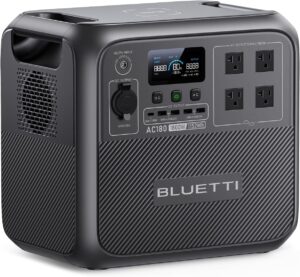
Why Does the BLUETTI AC180 Use 36Ah Instead of 96Ah?
This is where many people get confused.
A common assumption is:
1,152Wh ÷ 12V = 96Ah
The mathematics is correct. But this does not mean the AC180’s internal battery is a conventional 12V 96Ah battery.
Battery capacity in amp hours depends on voltage. The U.S. Department of Energy explains the same basic relationship: battery energy in watt-hours is calculated from amp-hour capacity multiplied by voltage.
For example:
| Battery Voltage | Equivalent Capacity for 1,152Wh |
|---|---|
| 12V | 96Ah |
| 24V | 48Ah |
| 32V | 36Ah |
| 48V | 24Ah |
| 120V | 9.6Ah |
Therefore, 36Ah is the appropriate figure when describing the AC180’s battery at its nominal internal voltage.
Meanwhile, 96Ah would be a 12V equivalent. It can be useful for comparing energy storage with a 12V battery bank, but it should not be confused with the AC180’s manufacturer-rated Ah specification.
How to Calculate the BLUETTI AC180 Amp Hours
The calculation is straightforward.
BLUETTI gives the AC180 a capacity of 1,152Wh and lists its battery capacity as 36Ah.
Using the standard formula:
Ah = Wh ÷ V
We can rearrange the specifications:
1,152Wh ÷ 36Ah = 32V
So:
BLUETTI AC180 = 36Ah at approximately 32V nominal
This is also why comparing power stations purely by amp hours can be misleading. A 100Ah battery is not automatically larger than a 36Ah battery. You must compare the voltage as well.
For example, a 12V 100Ah battery stores about 1,200Wh under the simple nominal calculation. That’s very close to the AC180’s 1,152Wh capacity.
Victron Energy also explains that energy storage is calculated as amp hours multiplied by voltage, making watt-hours a more useful way to compare batteries operating at different voltages.
What Does 1,152Wh Mean in Real Use?
The 1,152Wh rating is generally more useful than the 36Ah figure when you’re trying to estimate runtime.
For example, if a device consumes 100W continuously:
1,152Wh ÷ 100W = 11.52 hours
That’s a theoretical calculation before accounting for conversion losses and other power consumption.
When using the AC outlets, the battery’s stored DC energy has to pass through the AC inverter. As a result, you should not expect to get exactly 1,152Wh of usable AC energy.
This distinction matters when estimating runtime for refrigerators, computers, fans, and other AC appliances.
For example, if you’re interested in refrigerator runtime, our guide on running a refrigerator from the AC180 explains why actual runtime can differ substantially from a simple watt-hour calculation.
How Does 36Ah Compare With a Typical 12V Battery?
Suppose you have a traditional 12V 100Ah LiFePO₄ battery.
Its nominal energy is:
12V × 100Ah = 1,200Wh
The AC180 has:
1,152Wh
So the two batteries have broadly similar energy storage on paper.
However, they are very different products.
The AC180 combines its battery with an inverter, battery-management system, charging electronics, multiple DC outputs, USB ports, AC outlets, and other controls. BLUETTI rates the AC output at 1,800W, with a 2,700W surge capability.
Therefore, comparing only amp hours doesn’t tell you which system is more capable.
For portable power stations, watt-hours are usually the better starting point for comparing total stored energy.
Does the 12V Output Mean the AC180 Has a 12V Battery?
No.
The AC180 provides a regulated 12V/10A DC output, but this is an output supplied by the station’s internal electronics.
That means you should not calculate the AC180’s internal capacity by simply looking at its 12V car outlet.
If you did:
1,152Wh ÷ 12V = 96Ah
you would get a 12V-equivalent capacity, not the manufacturer’s actual 36Ah rating.
This distinction becomes particularly important when comparing the AC180 with RV batteries, marine batteries, car batteries, and standalone LiFePO₄ batteries.
How Many Amp Hours Are Actually Available to Your Devices?
The answer depends on what output you use.
With DC loads, conversion losses can be different from those experienced through the AC inverter. With AC appliances, the inverter consumes some energy while converting the battery’s DC electricity into household AC power.
Therefore, you shouldn’t expect a 36Ah rating to translate directly into a fixed number of amp hours at every output.
The same principle applies to runtime calculations. A 500W appliance does not simply consume a fixed number of amp hours from the AC180 because the battery voltage, inverter efficiency, and operating conditions all matter.
Think of 1,152Wh as the main energy-storage number, while 36Ah describes the battery capacity at its nominal voltage.
Does the AC180 Have Enough Capacity for High-Power Appliances?
Yes, but power and capacity are two different things.
The AC180 is rated for 1,800W of continuous AC output, while its battery capacity is 1,152Wh.
That means it can operate a high-power appliance, but a high-wattage appliance will consume the stored energy quickly.
For example, ignoring losses:
- 100W load → about 11.5 hours
- 500W load → about 2.3 hours
- 1,000W load → about 1.15 hours
- 1,500W load → about 46 minutes
- 1,800W load → about 38 minutes
These are theoretical calculations, not guaranteed runtimes.
Actual runtime will be shorter because of inverter losses, the device’s changing power consumption, and the AC180’s own operating requirements.
If you’re considering the AC180 against another portable power station, our comparison of the EcoFlow DELTA 3 Classic and BLUETTI AC180 is a useful next step.
What About the AC180’s Battery Chemistry?
The AC180 uses LiFePO₄ (lithium iron phosphate) battery chemistry. BLUETTI rates it for more than 3,500 cycles to 80% of its original capacity.
LiFePO₄ is common in modern portable power stations because it can provide a long cycle life when operated within the manufacturer’s limits.
However, battery chemistry doesn’t change the basic Wh-to-Ah calculation.
The relationship remains:
Watt-hours = Amp hours × Voltage
So the AC180 remains a 1,152Wh / 36Ah power station regardless of whether you’re calculating its capacity for camping, backup power, or portable work equipment.
A Common Mistake When Calculating AC180 Runtime
One of the biggest mistakes is assuming:
1,152Wh ÷ appliance wattage = guaranteed runtime
That equation gives you a useful theoretical starting point, but real-world results can differ.
For example, an AC load requires the inverter to operate. Low-power loads can also be disproportionately affected by the power station’s own consumption.
In addition, refrigerators and other compressor-based appliances don’t necessarily draw their rated wattage continuously. They cycle on and off.
For more information about one of the AC180’s important power-saving features, see the AC180 Eco Mode guide .
Frequently Asked Questions
How many amp hours is a BLUETTI AC180?
The BLUETTI AC180 is rated at 36Ah, with a total battery capacity of 1,152Wh. BLUETTI lists these specifications together on its product information.
Is the BLUETTI AC180 a 12V 36Ah battery?
No. The AC180’s 36Ah rating corresponds to its internal battery’s nominal voltage, while its external car-style output is a regulated 12V output.
How many amp hours is the BLUETTI AC180 at 12V?
As a theoretical 12V equivalent, 1,152Wh ÷ 12V equals 96Ah. However, the AC180 itself is officially specified as 36Ah, so 96Ah should only be used as a comparison with a 12V battery.
How many watt hours is the BLUETTI AC180?
The BLUETTI AC180 has a rated capacity of 1,152Wh.
Can I compare the AC180 to another battery using amp hours?
Yes, but you must compare batteries at the same voltage or convert them to watt-hours first. Wh is usually the better comparison metric when battery systems have different voltages.
Is 1,152Wh enough for a refrigerator?
It can be, depending on the refrigerator’s actual energy consumption, cycling pattern, and inverter losses. For a more detailed calculation, see our AC180 refrigerator runtime guide
Is the BLUETTI AC180 worth considering?
It can be a strong option if you need a portable power station with 1,152Wh of storage and 1,800W of AC output. For a broader assessment, see our BLUETTI AC180 review .
Final Verdict
So, how many amp hours is a BLUETTI AC180? The official answer is 36Ah.
The more important figure for most buyers, however, is its 1,152Wh total energy capacity. Amp hours alone can be misleading because capacity depends on voltage. In the AC180’s case, the 36Ah specification corresponds to its internal battery configuration, while 96Ah is simply the theoretical equivalent at 12V.
Therefore, when comparing the AC180 with other portable power stations or standalone batteries, use watt-hours first, then consider voltage, output power, and inverter losses.
That approach gives you a much more accurate picture of what the AC180 can actually power and for how long.


