
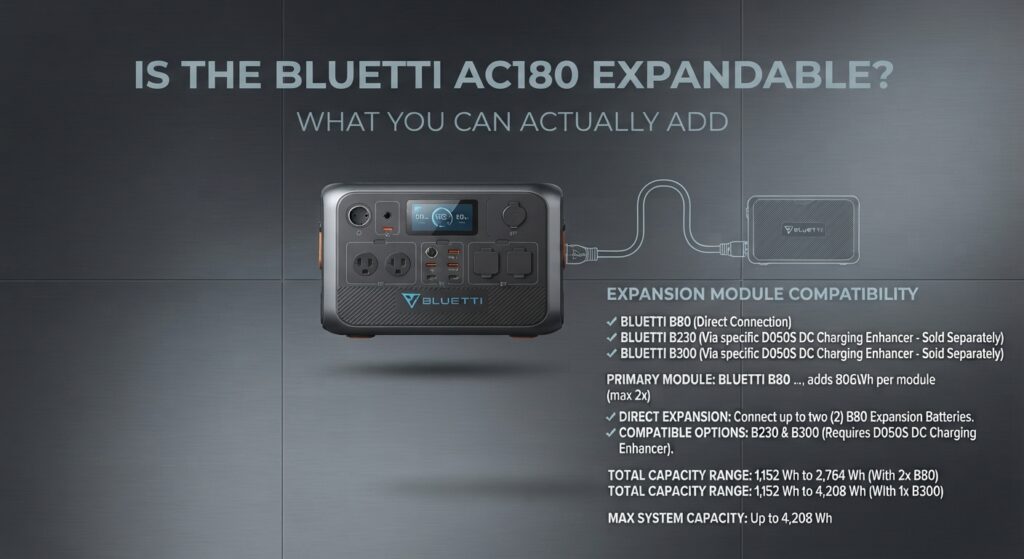
If you’re wondering is the BLUETTI AC180 expandable, the answer is yes, but not in the same way as BLUETTI power stations with dedicated expansion-battery ports. This distinction is important before buying an extra battery.
The AC180 has a 1,152Wh built-in battery, but it does not have a dedicated battery expansion port that lets you permanently combine an external B230 or B300 with the internal battery. Instead, BLUETTI documents a method where compatible expansion batteries can be used in Power Bank Mode to recharge the AC180.
Therefore, if your goal is a larger integrated battery bank, the AC180 is not the ideal platform. However, if you simply want additional stored energy available when needed, there is a useful workaround.
Is the BLUETTI AC180 Expandable?
The BLUETTI AC180 is not directly expandable like the AC200L, AC300, or AC500.
BLUETTI’s current documentation says the AC180 can be charged from expansion batteries through Power Bank Mode, rather than connecting those batteries directly to the AC180 as an integrated expansion pack.
This means there are two different meanings of “expandable”:
- Direct capacity expansion: No.
- Using an external BLUETTI battery to recharge the AC180: Yes.
- Replacing the internal battery with a larger one: No.
- Adding more usable energy during a trip: Yes, with the appropriate external battery setup.
So don’t interpret “expandable” as turning the AC180 into a permanently larger 3,000Wh or 4,000Wh power station.
Which Expansion Batteries Can Be Used With the AC180?
BLUETTI’s documentation mentions the B80, B230, and B300 as batteries that can be used to charge the AC180 through Power Bank Mode. The required cable depends on the battery.
Here is the basic comparison:
| Expansion battery | Capacity | Can provide energy to AC180? |
|---|---|---|
| BLUETTI B80 | 806Wh | Yes, via Power Bank Mode |
| BLUETTI B230 | 2,048Wh | Yes, via Power Bank Mode |
| BLUETTI B300 | 3,072Wh | Yes, via Power Bank Mode |
However, these batteries do not simply add their capacity to the AC180’s internal 1,152Wh battery as one combined battery pack.
That is the key distinction.
BLUETTI itself states that the AC180 does not support direct capacity expansion with these batteries in the conventional sense, while its product pages describe using them as an external energy source.
How Does the AC180 Expansion Work?
The basic idea is simple.
The external expansion battery stores additional energy. You then use the battery’s output to recharge the AC180.
For example, imagine you have:
AC180 = 1,152Wh
and:
B80 = 806Wh
The B80 does not become an additional 806Wh section permanently attached to the AC180. Instead, you can use the B80 as an external power source to put energy back into the AC180.
BLUETTI specifically says the B80 can be connected using an Aviation-to-DC7909 cable, while the B230/B300 use the appropriate P090D cable.
Therefore, the setup is better thought of as:
External battery → AC180 → your appliances
rather than:
AC180 + external battery → one combined battery management system
That difference matters for runtime calculations and how you plan your backup system.
Can You Add a B80 to the BLUETTI AC180?
Yes, the B80 is the most straightforward option for the AC180.
The B80 has an 806Wh capacity, and BLUETTI specifically lists it as an expansion battery that can be used with the AC180 in Power Bank Mode.
BLUETTI’s current product information says an AC180 paired with a B80 can provide a continuous power source of up to 1,958Wh under its stated configuration.
That figure comes from:
1,152Wh + 806Wh = 1,958Wh
However, don’t assume you will get exactly 1,958Wh of usable AC output to your appliances. Conversion losses occur when energy is transferred between the batteries and when the AC180’s inverter converts DC power into AC power.
The 1,958Wh figure is a stored-energy comparison, not a guaranteed usable AC runtime.
Can You Use a B230 or B300 With the AC180?
BLUETTI documentation also references the B230 and B300 with the AC180 through Power Bank Mode.
The B230 contains 2,048Wh, while the B300 contains 3,072Wh.
However, buying a huge B300 simply because it has more capacity does not turn the AC180 into an AC300-style expandable system.
Instead, you’re carrying an external battery that can be used to replenish the AC180.
This may make sense if you already own a compatible BLUETTI battery. But if you’re building a system from scratch and know you will eventually need several kilowatt-hours of storage, a power station designed around dedicated expansion batteries may be a better choice.
Can You Replace the AC180’s Internal Battery?
No.
This is another important limitation.
BLUETTI’s FAQ explicitly states that the AC180’s built-in battery cannot be replaced by the user. If the internal battery fails, BLUETTI advises contacting customer service.
Therefore, you should not buy an AC180 expecting to upgrade its internal 1,152Wh battery later.
The external-battery method is the practical way to add more stored energy around the AC180.
What About the AC180’s Solar Input?
Solar panels are different from expansion batteries.
The AC180 supports up to 500W of solar input, with a total open-circuit voltage requirement of 12–60V and MC4 connectors.
Adding larger or additional solar panels does not increase the AC180’s battery capacity.
Instead, solar allows you to replenish the 1,152Wh internal battery faster or keep it charged during extended off-grid use.
Therefore:
More solar = potentially faster/more frequent recharging.
Expansion battery = more stored energy available externally.
Direct expansion battery port = integrated larger battery system.
The AC180 offers the second option, but not the third.
Is the AC180 Good for Long Backup Runtime?
It can be, but the answer depends on what you’re powering.
The AC180’s 1,152Wh capacity and 1,800W continuous AC output make it capable of running demanding appliances, but high-power devices can consume the battery quickly.
For example, a theoretical 1,000W load would consume 1,000Wh in roughly one hour before accounting for conversion losses.
For a refrigerator, however, the calculation is different because the compressor cycles rather than continuously drawing its maximum rated power.
If you’re considering the AC180 for refrigerator backup, our guide on BLUETTI AC180 refrigerator runtime goes deeper into that calculation.
Meanwhile, if you’re comparing the AC180 with another power station, see EcoFlow DELTA 3 Classic vs BLUETTI AC180 .
Is an Expandable Battery Worth It for the AC180?
That depends on how you use the power station.
An external battery can make sense if you:
- Already own a compatible BLUETTI battery.
- Need additional stored energy while camping.
- Want to recharge the AC180 without relying on a wall outlet.
- Need longer periods between charging opportunities.
- Prefer keeping the AC180 relatively portable.
However, it may not make sense if you want a single integrated battery system.
For that use case, choosing a BLUETTI model specifically designed for direct expansion is generally cleaner.
BLUETTI’s expansion-battery lineup shows that models such as the AC200P, AC200MAX, AC300, and AC500 are designed around different expansion configurations.
What Is the Biggest Limitation?
The biggest limitation is the lack of a dedicated expansion-battery connection that integrates the external battery directly with the AC180.
That means you need to think of the external battery as a separate energy reservoir.
This can also add complexity because you’re dealing with another battery, cables, charging, and conversion losses.
If simplicity is your priority, the AC180’s built-in 1,152Wh battery is the system you should evaluate. If you need significantly more storage, choose a power station designed for direct expansion rather than assuming an AC180 plus B300 behaves like a single 4,000Wh unit.
For another important AC180 consideration, see our guide to AC180 Eco Mode .
Frequently Asked Questions
Is the BLUETTI AC180 expandable?
Not through direct battery expansion. The AC180 can use compatible BLUETTI expansion batteries as external power sources through Power Bank Mode, but they do not function as a permanently integrated expansion battery.
Can I add a B80 to the BLUETTI AC180?
Yes. BLUETTI specifically supports using the 806Wh B80 with the AC180 in Power Bank Mode using the appropriate cable.
Can the BLUETTI AC180 use a B230?
Yes, BLUETTI’s documentation describes using the B230 as an external battery to charge the AC180 through Power Bank Mode. However, it does not become a directly integrated expansion battery.
Can I add a B300 to the BLUETTI AC180?
The B300 can be used as an external power source for the AC180 through the documented Power Bank Mode arrangement. It does not turn the AC180 into a single integrated 4,224Wh system.
Can I replace the BLUETTI AC180 battery?
No. BLUETTI says the built-in battery is not user-replaceable.
How much capacity does the BLUETTI AC180 have?
The AC180 has a 1,152Wh built-in battery. With a B80 used as an external energy source, BLUETTI states a combined stored-energy figure of up to 1,958Wh under its specified setup.
Is the BLUETTI AC180 good for long-term backup?
It can be useful for short-term home backup, camping, and emergency loads. However, if you need several kilowatt-hours of integrated storage, a BLUETTI model designed for direct battery expansion may be a better fit.
Final Verdict: Is the BLUETTI AC180 Expandable?
The BLUETTI AC180 is expandable only in a limited sense.
You cannot replace its internal battery or directly attach a B80, B230, or B300 to create one larger integrated battery pack. Instead, compatible external batteries can be used in Power Bank Mode to recharge the AC180.
The B80 is particularly relevant because BLUETTI specifically documents its use with the AC180 and gives a potential stored-energy total of up to 1,958Wh.
Therefore, buy the AC180 for its 1,152Wh internal capacity and treat an expansion battery as an external energy source—not as a permanent battery upgrade.
If you need a genuinely expandable system that can grow into several kilowatt-hours of integrated storage, look at BLUETTI models built around dedicated expansion batteries instead.


