If you’re wondering what solar panels are compatible with Anker SOLIX C1000, the good news is that you are not limited to Anker-branded panels. The C1000 can work with compatible third-party solar panels as long as their electrical specifications stay within the station’s solar input limits.
That distinction matters. A panel advertised as 400W or 500W is not automatically compatible just because its wattage looks reasonable. Voltage, current, connector type, and the way multiple panels are wired together all matter.
In this guide, you’ll learn the C1000’s solar input requirements, which Anker panels are recommended, whether third-party panels can work, how to connect multiple panels, and what to check before buying.
Quick Answer: What Solar Panels Work With the Anker SOLIX C1000?
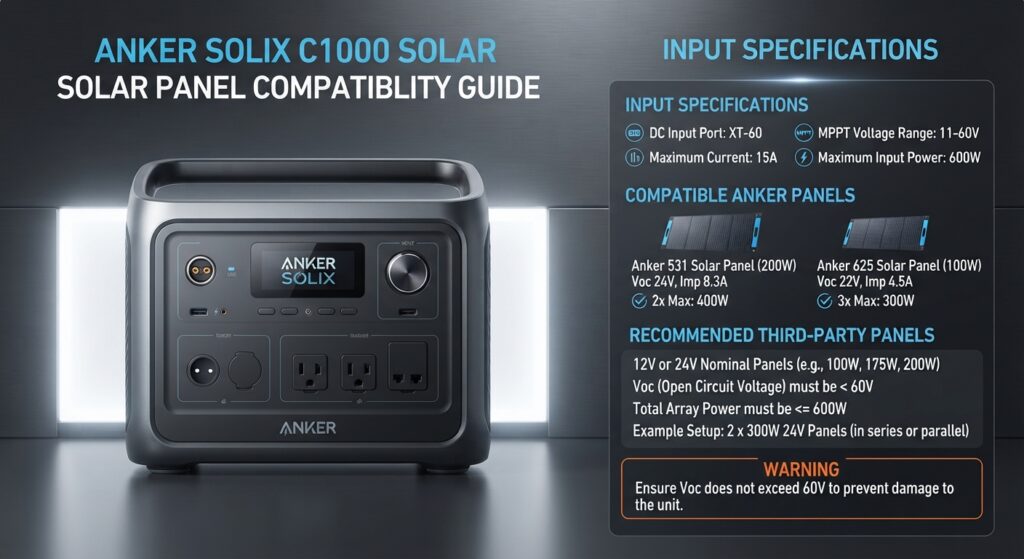
The original Anker SOLIX C1000 supports solar input from 11V to 60V through an XT-60 connector. Anker states that its recommended compatible solar-panel series include the Anker 625, Anker 531, and Anker SOLIX PS400.
The key limits are:
- Solar input voltage: 11–60V
- 11–32V: up to 10A
- 32–60V: up to 12.5A according to Anker’s C1000 compatibility guidance
- Maximum solar charging power: up to 600W
- Solar connector: XT-60
- Recommended Anker panels: 625, 531, and PS400
Therefore, a compatible third-party panel can work, but you should check its electrical specifications before connecting it.
Which Anker Solar Panels Are Compatible With the C1000?
Anker specifically recommends several of its solar-panel series for the C1000.
Anker 625 Solar Panel — 100W
The Anker 625 100W panel is a smaller option for people who prioritize portability rather than maximum charging speed.
It makes sense for camping, occasional emergency charging, and situations where you don’t need to refill the C1000 quickly.
However, one 100W panel is well below the C1000’s 600W solar input capability. Therefore, charging will be considerably slower than with a larger solar array.
Anker 531 Solar Panel — 200W
The Anker 531 200W panel is a more balanced choice. Anker lists an open-circuit voltage of 57.6V, an operating voltage of 48V, and operating current of 4.17A.
That puts its operating voltage within the C1000’s 60V maximum.
A single 200W panel is therefore an attractive setup if you want a relatively simple portable system without carrying a large 400W panel.
Anker SOLIX PS400 — 400W
If your priority is faster solar charging, the Anker SOLIX PS400 400W is the more powerful option.
Anker lists the PS400 as a 400W portable solar panel and supplies it with an MC4-to-XT60 adapter, making it suitable for connecting to compatible Anker power stations.
The C1000 itself can accept up to 600W of solar input, so a 400W panel is comfortably below that maximum.
For many users, this is the simplest high-power configuration: one large panel, one compatible connection, and no complicated panel wiring.
Can You Use Third-Party Solar Panels With the Anker SOLIX C1000?
Yes, you can use third-party solar panels, provided the panel or solar array stays within the C1000’s electrical input specifications.
The important numbers are more than the advertised wattage.
First, check the panel’s open-circuit voltage (Voc). The C1000 accepts solar input from 11V to 60V, so the array must not exceed the station’s maximum voltage.
Next, check the current. Anker specifies different current limits depending on the voltage range. Therefore, two panels with the same wattage can behave differently if their voltage and current ratings differ.
Finally, check the connector. The C1000’s solar input uses an XT-60 connection. If your panel uses MC4 connectors, you may need an appropriate MC4-to-XT60 solar cable or adapter.
For example, Anker’s PS400 includes an MC4-to-XT60 adapter.
Do not choose a panel based on watts alone.
How Many Watts of Solar Panels Can the C1000 Handle?
The original C1000 supports up to 600W of solar charging input. Anker states that the station can fully recharge using solar power in approximately 1.8 hours under suitable conditions.
That does not mean you should simply connect any combination of panels totaling 600W.
The electrical configuration must remain within the C1000’s voltage and current limits.
For example:
- 100W panel: compatible, but relatively slow
- 200W panel: good portable option
- 400W panel: excellent for faster charging
- 600W array: potentially the best use of the input capacity, but the exact series/parallel configuration must stay within the voltage and current limits
In addition, rated panel wattage is a laboratory maximum. Real solar production changes with sunlight, temperature, panel angle, shading, and other conditions.
Can You Connect Two 200W Solar Panels?
Potentially, yes—but how you connect them matters.
Two 200W panels can theoretically provide a 400W array, but wiring them in series increases voltage while wiring them in parallel increases current.
Because the C1000 has a 60V maximum solar-input voltage, series connections require particular care.
For example, Anker’s 200W 531 panel has a listed open-circuit voltage of 57.6V.
Connecting two such panels in series would push the theoretical open-circuit voltage far beyond the C1000’s 60V limit.
Therefore, you should not assume that two 200W panels can simply be connected in series.
If you are building a multi-panel setup, check the actual Voc and Imp/Isc specifications and make sure the resulting array remains within the C1000’s limits.
What Is the Best Solar Panel Size for the C1000?
For most buyers, the best choice depends on how you intend to use the power station.
Choose 100W if portability is your priority
A 100W panel is useful for lightweight camping and maintaining battery charge during trips. However, expect slower charging.
Choose 200W for a balanced setup
A 200W panel provides a useful compromise between portability, charging speed, and setup simplicity.
Choose 400W for faster charging
A 400W panel is the better choice if the C1000 is being used for emergency backup, longer off-grid trips, or frequent daily solar charging.
Aim toward 600W if maximum solar input matters
The C1000 can accept up to 600W of solar input. However, reaching that figure requires a properly designed array that stays inside the voltage and current limits.
More panel wattage is not automatically better if the electrical configuration exceeds the power station’s limits.
Important Mistakes to Avoid
Before connecting solar panels to your C1000, avoid these common mistakes.
Do not exceed 60V. This is one of the most important specifications.
Do not calculate compatibility using wattage alone. A 400W panel can have very different voltage and current characteristics from another 400W panel.
Do not blindly connect panels in series. Series wiring increases voltage and can quickly exceed the C1000’s limit.
Check the connector. The C1000 uses an XT-60 solar input, so an MC4-to-XT60 connection may be required.
Remember that rated wattage is not guaranteed output. Clouds, shading, heat, panel orientation, and sunlight intensity can significantly reduce actual charging power.
Finally, check the exact C1000 model you own. The newer C1000 Gen 2 has its own specifications, including a 600W maximum solar input and a 60V maximum voltage.
Frequently Asked Questions
What solar panels are compatible with Anker SOLIX C1000?
The C1000 is compatible with solar input from 11V to 60V through an XT-60 connector. Anker recommends its 625, 531, and PS400 solar-panel series.
What is the maximum solar panel wattage for Anker SOLIX C1000?
The original C1000 supports up to 600W of solar charging input. Actual charging power depends on sunlight and the electrical characteristics of the connected panels.
Can I use a 400W solar panel with Anker SOLIX C1000?
Yes. Anker specifically recommends the SOLIX PS400, a 400W portable solar panel, for compatible power stations.
Can I use non-Anker solar panels with the C1000?
Yes, provided the panel or array meets the C1000’s voltage, current, and connector requirements. Always check Voc and current before connecting a third-party panel.
Can I connect two 200W solar panels to the C1000?
It can be possible, but the configuration must remain within the C1000’s voltage and current limits. In particular, avoid series configurations that could push the array above 60V.
Does the C1000 need an Anker solar panel?
No. Anker recommends several of its own panels, but the C1000’s electrical input specifications allow compatible third-party solar panels as well.
Is a 600W solar panel better than a 400W panel?
Not necessarily. The C1000 can accept up to 600W, but a 400W panel may provide an easier and simpler setup. The panel’s voltage and current specifications are just as important as its wattage.
Final Verdict: What Solar Panel Should You Buy for the C1000?
If you want the simplest answer, the Anker SOLIX PS400 400W is one of the strongest choices for the original C1000 because it provides substantially more solar input than a 100W or 200W panel while remaining below the station’s 600W maximum.
For lighter camping, a 100W or 200W panel makes more sense. Meanwhile, users who want to maximize solar charging can consider a larger array, but they must carefully calculate voltage and current before connecting multiple panels.
The most important point is this: the answer to what solar panels are compatible with Anker SOLIX C1000 is not simply “anything under 600W.” The panel or array must also stay within the C1000’s 11–60V solar-input range, current limits, and XT-60 connection requirements.
If you’re using the C1000 for emergency backup, solar charging can also complement its fast AC recharge capability. For medical backup applications, see our comparison of the Anker SOLIX C1000 Gen 2 and Jackery Explorer 1000 V2 for CPAP backup. If you’re comparing the C1000 against another power station, our EcoFlow DELTA 3 Classic vs. Anker SOLIX C1000 Gen 2 comparison can help.