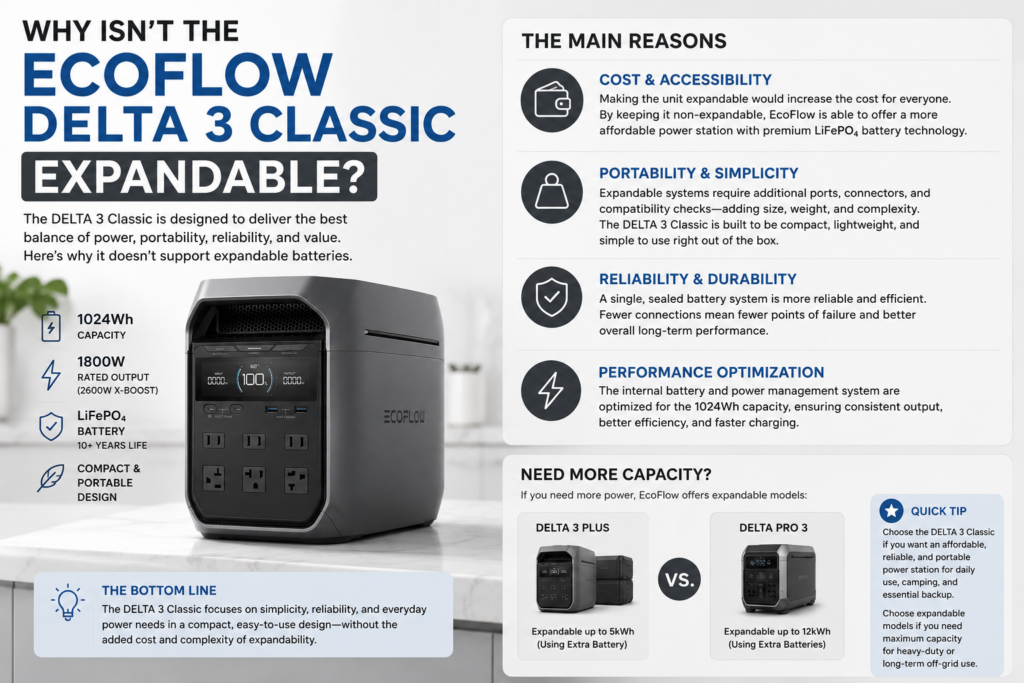
One of the most common questions buyers ask before purchasing the EcoFlow DELTA 3 Classic is why it doesn’t support expansion batteries like some other EcoFlow power stations. At first glance, this limitation can be confusing because the DELTA 3 Classic shares many features with the DELTA 3 series, including fast charging, a LiFePO4 battery, powerful AC output, and excellent UPS performance.
However, the lack of expandability isn’t an oversight—it’s a deliberate design choice. EcoFlow created the DELTA 3 Classic for users who prioritize portability, simplicity, and value over future battery upgrades. In this guide, we’ll explain why the Classic isn’t expandable, what that means in real-world use, and whether it’s the right portable power station for your needs.
Quick Answer
The EcoFlow DELTA 3 Classic isn’t expandable because it was designed as a lower-cost, lightweight, all-in-one portable power station. Unlike the DELTA 3 and other premium EcoFlow models, it lacks the internal hardware and battery management system needed to communicate with external expansion batteries.
For many buyers, this isn’t a disadvantage. If your power needs fit within its 1,024Wh capacity, the Classic delivers outstanding value while avoiding the added cost and complexity of an expandable system.
Why Isn’t the EcoFlow DELTA 3 Classic Expandable?
It’s Designed as a Standalone Power Station
The biggest reason is product positioning.
EcoFlow offers several portable power stations aimed at different customers. Rather than making every model expandable, the company intentionally created the DELTA 3 Classic as a complete, self-contained solution.
This approach allows EcoFlow to:
- Reduce manufacturing costs
- Keep the unit more compact
- Lower overall weight
- Simplify setup and operation
- Offer a more affordable entry point
Instead of paying for expansion features you may never use, you’re buying only the hardware necessary for everyday backup power.
The Internal Electronics Are Different
Battery expansion requires much more than simply plugging in another battery.
Expandable systems need additional components such as:
- Dedicated expansion ports
- Advanced Battery Management System (BMS) communication
- Firmware capable of balancing multiple battery packs
- Safety monitoring for charging and discharging
- Power distribution between connected batteries
The DELTA 3 Classic simply wasn’t engineered with this hardware.
Because of that, adding expansion support through a firmware update isn’t possible.
EcoFlow Needed Product Separation
Another important reason is product differentiation.
If every DELTA model offered identical capabilities, customers would have little reason to purchase higher-end models.
Instead, EcoFlow separates its lineup like this:
| Model | Expandable | Best For |
|---|---|---|
| EcoFlow DELTA 3 Classic | ❌ No | Home backup, camping, beginners |
| EcoFlow DELTA 3 | ✅ Yes | Growing energy needs |
| EcoFlow DELTA 3 Plus | ✅ Yes | Heavy users and off-grid living |
If you’re unsure which model better matches your needs, read our comparison of EcoFlow DELTA 3 Classic vs DELTA 3: Which One Should You Buy? to understand where the additional cost provides real benefits.
Likewise, our detailed guide on EcoFlow DELTA 3 Classic vs DELTA 3 Plus: What’s the Difference? explains when battery expansion becomes worthwhile.
Does the Lack of Expansion Matter?
For many buyers, surprisingly little.
Customer feedback consistently shows that most owners purchased the DELTA 3 Classic for:
- Home emergency backup
- Storm preparedness
- Camping
- RV weekends
- Tailgating
- Portable office power
- Medical equipment backup
- Remote work
These applications rarely require more than the built-in 1,024Wh LiFePO4 battery.
Customers especially praise:
- Extremely fast charging (about one hour)
- Quiet cooling fans
- Reliable UPS functionality
- High-quality construction
- Excellent portability
- Strong inverter performance
In other words, many owners never reach the point where an additional battery would significantly improve their experience.
When the Lack of Expansion Can Be a Problem
Although many buyers are satisfied, battery expansion becomes important if your power needs grow over time.
Examples include:
Long-Term Home Backup
During multi-day outages, larger battery capacity means you can power refrigerators, communication devices, lights, and medical equipment for much longer without recharging.
Off-Grid Living
People living in cabins or tiny homes often increase their battery storage as their solar systems expand.
Since the DELTA 3 Classic cannot accept extra batteries, you’ll need to recharge more frequently using AC power or solar panels.
Van Life
Many van owners eventually add:
- Larger solar arrays
- Refrigerators
- Starlink
- Portable induction cooktops
- Additional electronics
Expandable battery systems offer greater flexibility for these evolving setups.
Future-Proofing
One recurring customer regret is assuming the Classic could be upgraded later.
Many reviewers said they eventually wished they had purchased an expandable model from the beginning after realizing their energy needs had increased.
If you expect your requirements to grow, the additional upfront investment in an expandable model may save money in the long run.
Is the EcoFlow DELTA 3 Classic Still Worth Buying?
For many households, yes.
If you primarily need reliable backup power for:
- Internet equipment
- Laptops
- CPAP machines
- Oxygen concentrators
- Refrigerators during short outages
- Phones and tablets
- Camping trips
- Weekend RV travel
…the DELTA 3 Classic remains one of the strongest values in its class.
Its combination of:
- 1,024Wh LiFePO4 battery
- 1,800W continuous AC output
- 3,600W surge capability
- Approximately one-hour AC recharge
- Less than 10ms UPS switchover
- Quiet operation
makes it an excellent all-in-one solution without requiring additional batteries.
If budget is your primary concern, you may also find our comparison EcoFlow DELTA 3 Classic vs DELTA 2: Which Is the Better Value? helpful, especially if you’re considering an older expandable model.
Recommended Accessories
To get the most from the DELTA 3 Classic, consider these compatible accessories:
- EcoFlow DELTA 3 Classic
- 220W Bifacial Solar Panel
- EF ECOFLOW 400W Portable Solar Panel

- XT60i Solar Cable

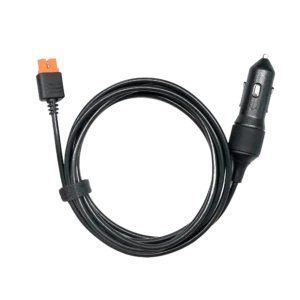
- Car Charging Cable
- Heavy-Duty Extension Cord

Pros and Cons of the EcoFlow DELTA 3 Classic
No portable power station is perfect, and the EcoFlow DELTA 3 Classic is no exception. Understanding its strengths and limitations will help you decide whether its non-expandable design is a deal-breaker.
Pros
- Excellent value for the price compared to expandable models.
- Ultra-fast AC charging, reaching a full charge in about an hour.
- Reliable UPS functionality with a transfer time of less than 10 ms, making it suitable for computers, networking equipment, and many medical devices.
- 1,800W continuous output (3,600W surge) can power a wide range of household appliances.
- Long-lasting LiFePO4 battery rated for thousands of charge cycles.
- Compact and portable design that’s easier to transport than larger expandable systems.
- Quiet operation, even under moderate loads.
- Solar charging support for off-grid and emergency use.
Cons
- No support for expansion batteries, limiting future capacity upgrades.
- Some accessories are sold separately, including the XT60i solar cable and car charging cable.
- No alternator charging support, which may disappoint some van-life users.
- The EcoFlow app requires an account, and some settings depend on internet access.
- Not ideal for extended off-grid living, where expandable battery systems provide greater flexibility.
Common Misconceptions
Because several DELTA models share similar names, many buyers assume they have identical features. Here are some of the most common misunderstandings.
“All DELTA 3 models are expandable.”
False. Only certain models in the DELTA lineup support expansion batteries. The DELTA 3 Classic is intentionally designed as a standalone unit.
“A firmware update could add expansion.”
Unfortunately, no. Expansion requires dedicated hardware and battery communication electronics, not just software.
“The Classic is an inferior product.”
Not at all. It simply targets a different audience. Many users never need more than its built-in battery capacity, making the Classic a smarter purchase than paying extra for features they’ll never use.
“More battery always means a better purchase.”
Not necessarily.
If you only experience occasional power outages or go camping on weekends, paying for expandable hardware may provide little real-world benefit.
Buying Advice
The EcoFlow DELTA 3 Classic is the right choice if you:
- Need dependable emergency backup power.
- Want one of the fastest-charging portable power stations available.
- Prefer a compact, lightweight design.
- Plan to use it for camping, RV trips, tailgating, or short outages.
- Don’t expect your energy storage needs to grow significantly.
You may want to consider the DELTA 3 or another expandable model if you:
- Plan to build a larger solar power system.
- Need backup power for multiple days without frequent recharging.
- Live off-grid or spend extended time in a camper or van.
- Want the flexibility to increase battery capacity in the future.
Frequently Asked Questions
Why isn’t the EcoFlow DELTA 3 Classic expandable?
The DELTA 3 Classic was designed as a cost-effective, all-in-one portable power station. It lacks the hardware required to communicate with external expansion batteries, which helps reduce cost, weight, and complexity.
Can I add an expansion battery to the EcoFlow DELTA 3 Classic later?
No. Expansion batteries are not compatible with the DELTA 3 Classic. This limitation is built into the hardware and cannot be changed through a software update.
Is the EcoFlow DELTA 3 Classic still worth buying?
Yes. If your typical power needs fit within its 1,024Wh capacity, it offers an excellent combination of fast charging, portability, reliable UPS performance, and durable LiFePO4 battery technology.
Which EcoFlow model should I buy if I want expansion?
If future battery upgrades are important, consider the EcoFlow DELTA 3 or another expandable model rather than the Classic.
Does the EcoFlow DELTA 3 Classic support solar charging?
Yes. It supports solar charging with compatible solar panels and the appropriate connection accessories, making it suitable for camping, RV travel, and emergency preparedness.
Is battery expansion necessary for most users?
Not always. Most homeowners, campers, and weekend RV users can comfortably operate within the DELTA 3 Classic’s built-in capacity. Expansion becomes more valuable for long-term off-grid living or prolonged power outages.
Final Verdict
So, why isn’t the EcoFlow DELTA 3 Classic expandable? The answer is simple: EcoFlow intentionally designed it as an affordable, lightweight, and easy-to-use portable power station rather than a modular energy storage system.
For users who need reliable backup power for home emergencies, camping, remote work, or medical devices, the built-in 1,024Wh LiFePO4 battery is more than sufficient. Combined with rapid charging, a powerful inverter, and excellent UPS performance, the DELTA 3 Classic delivers impressive real-world value.
However, if you anticipate expanding your power needs in the future, investing in an expandable model from the start may be the better long-term decision. Carefully matching the power station to your expected usage today—and tomorrow—will ensure you get the best return on your investment.