

Camping doesn’t have to mean sacrificing comfort. With a well-planned Jackery Explorer 1000 V2 camping setup, you can keep food cold, enjoy fresh coffee every morning, charge your devices, and light your campsite—all without relying on noisy gas generators.
The key isn’t simply bringing a portable power station. It’s knowing how to manage energy from the moment you arrive until you pack up three days later. By combining smart solar charging, efficient appliances, and good battery habits, the Jackery Explorer 1000 V2 can comfortably support a long weekend off the grid.
In this guide, you’ll learn exactly how to organize your campsite, position your solar panels, schedule charging, conserve battery power, and choose accessories that maximize every watt.
Quick Answer
For a successful three-day camping trip:
- Charge the Jackery Explorer 1000 V2 to 100% before leaving.
- Keep solar panels in direct sunlight throughout the day.
- Run your portable fridge from DC whenever possible.
- Charge phones, cameras, and power banks during peak solar production.
- Use LED lighting instead of high-power floodlights.
- Avoid unnecessary AC appliances during the evening.
Following this routine allows most campers to finish a three-day trip with plenty of reserve power.
Why the Jackery Explorer 1000 V2 Is Ideal for Camping
Unlike traditional generators, the Jackery Explorer 1000 V2 is:
- Quiet
- Lightweight
- Fast charging
- Easy to carry
- Safe inside tents and campers
- Powered by a long-life LiFePO4 battery
Its 1,070Wh capacity is large enough for most camping essentials while remaining portable enough for car camping and overlanding.
If you’re still deciding whether it’s the right power station, read our Jackery Explorer 1000 v2 Review: Is It Worth Buying in 2026?
Before Leaving Home
Preparation starts before your trip.
Make sure you:
- Fully charge the Jackery using AC power.
- Update firmware if available.
- Test every cable.
- Freeze food before placing it inside the portable fridge.
- Download offline maps.
- Pack extension cables separately.
A small cable organizer makes setup much faster once you arrive.
Gear You’ll Need
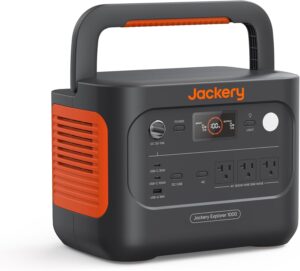
Jackery Explorer 1000 V2 Portable Power Station
The power station is the center of your entire campsite.
Jackery SolarSaga 200W Folding Solar Panel
Solar charging lets you replenish energy every day without needing shore power.

Other useful accessories include:
- 12V Portable electric fridge (e.g., BougeRV or BODEGA 12V Portable Fridge)
- USB rechargeable tent fan (e.g., OPOLAR or Geek Aire Rechargeable USB Fan)
- LED camping lanterns (e.g., Goal Zero Lighthouse 600 or Streamlight Siege)
- Folding camping table (e.g., KingCamp or ALPS Mountaineering Camp Table)
- Camping power strip (e.g., Anker Surge Protector Power Strip with USB Ports)
- Folding solar panel stand
- Cable organizer (e.g., BAGSMART Cable Organizer Case)
- Manual coffee maker (e.g., AeroPress Go, Stanley French Press, or Wacaco Nanopresso)
Day 1: Arriving at Camp
The first hour determines how smoothly the rest of the trip will go.
Step 1: Choose the Right Campsite
Look for:
- Morning sunlight
- Afternoon shade
- Flat ground
- Wind protection
- Nearby cooking area
Ideally, place your tent under partial shade while leaving an open area for the solar panels.
Step 2: Set Up Your Power Station
Never place the Jackery directly on dirt.
Instead:
- Put it on a folding aluminum camping table.
- Keep it shaded.
- Leave several inches around the vents.
- Protect it from rain.
The cooler operating temperature helps maximize battery efficiency.
Step 3: Position the Solar Panels
Solar production changes dramatically depending on angle.
For best results:
- Face panels toward the sun.
- Tilt approximately 30–45 degrees.
- Reposition every few hours.
- Avoid even small shadows.
A folding solar panel stand makes these adjustments much easier.
Step 4: Connect Your Portable Fridge
A 12V portable fridge is one of the best camping upgrades because it eliminates melting ice.
Instead of running through the AC inverter, connect through the DC output whenever possible for higher efficiency.
If you’re unsure how long a refrigerator can run, see our guide on How long will a 1000Wh power station run a fridge?
Afternoon Charging Strategy
Between 11 AM and 3 PM, solar production is highest.
This is the best time to charge:
- Phones
- Tablets
- Camera batteries
- Drones
- Power banks
Charging during daylight allows solar energy to power your devices directly instead of draining the battery overnight.
Meanwhile, let the portable fridge continue operating without interruption.
Evening Setup
As the sun sets:
- Disconnect solar panels.
- Turn off unused outputs.
- Switch lanterns to medium brightness.
- Charge only essential electronics.
LED camping lanterns provide plenty of light while consuming very little power.
Avoid leaving decorative lighting on all night.
Cook Efficiently
Rather than using a high-powered electric hot plate, cook with a propane camping stove.
Then use the Jackery only for small electrical appliances like:
- Phone charging
- Coffee grinder
- Electric kettle (briefly)
- Portable blender
For coffee lovers, manual brewers such as an AeroPress or French press consume almost no electricity while still producing excellent coffee.
Day 2: Maximize Solar Charging and Enjoy Camp Comfort
By the second morning, your routine should revolve around replacing yesterday’s energy use with fresh solar power. Fortunately, the Jackery Explorer 1000 V2 supports fast solar charging when paired with compatible SolarSaga panels.
Morning Routine (7:00–9:00 AM)
Start your day by:
- Moving the solar panels toward the rising sun.
- Checking battery percentage before using high-power devices.
- Making breakfast on a camp stove instead of an electric cooker.
- Brewing coffee with a manual coffee maker or French press.
Using manual brewing methods saves valuable battery capacity for appliances that truly need electricity.
Midday Charging Schedule (10:00 AM–3:00 PM)
This is your highest solar production window.
Run or charge energy-intensive devices during this period:
- Camera batteries
- Drone batteries
- Laptops
- Tablets
- Rechargeable lanterns
- Portable power banks
Meanwhile, continue running your portable fridge so most of its power comes directly from incoming solar energy instead of stored battery power.
Keep the Power Station Cool
Although the Jackery Explorer 1000 V2 is designed for outdoor use, batteries perform better when kept out of direct sunlight.
A simple setup works best:
- Solar panels in full sun
- Jackery under a canopy or table
- Extension cable between panels and power station
This arrangement improves charging efficiency while helping extend battery life.
To get optimal solar charging, use a 14 AWG DC8020 extension cable to bridge the gap between your setup and the sun. This allows you to keep your Jackery Explorer 1000 V2 cool in the shade while placing your SolarSaga panels in full, direct sunlight
Cooking Without Draining Your Battery
One of the biggest mistakes new campers make is relying on electric cooking appliances.
Instead, divide your cooking tasks wisely.
Use Gas or Propane For
- Breakfast
- Lunch
- Dinner
- Boiling water
- Frying food
Use the Jackery For
- Small coffee maker
- Blender
- Phone charging
- Electric knife
- Food scale
This strategy dramatically reduces daily power consumption.
Stay Comfortable at Night
Comfort doesn’t require huge amounts of electricity.
A typical evening setup includes:
- One LED lantern near the table
- One lantern inside the tent
- USB tent fan running on low speed
- Phone charging before bed
LED lanterns consume very little power while producing excellent campsite lighting.
Likewise, a rechargeable USB fan provides airflow without significantly impacting battery capacity.
Day 3: Conserving Power Before Heading Home
By the final day, your goal changes from maximizing comfort to finishing the trip with reserve power.
Morning Checklist
- Recharge devices one last time.
- Keep the fridge running until departure.
- Disconnect anything not in use.
- Fold solar panels after their final charging session.
If your battery remains above 40%, you’ve managed energy efficiently throughout the trip.
Pack Your Gear Efficiently
Packing is easier when every cable has its place.
A travel cable organizer helps separate:
- USB-C charging cables
- Solar connectors
- Car charging cable
- Extension cords
- Power strip
- Adapters
Organized gear also reduces setup time on your next adventure.
Common Mistakes to Avoid
Leaving Solar Panels in the Shade
Even partial shade can significantly reduce charging performance.
Move the panels every few hours to follow the sun.
Running Everything Through AC
Whenever possible, use USB or DC outputs.
AC power introduces inverter losses that reduce overall runtime.
Using High-Watt Appliances
Hair dryers, electric heaters, and induction cooktops can quickly deplete your battery.
Stick to camping-friendly appliances instead.
Forgetting Compatibility
If you’re using older Jackery accessories, remember that the Explorer 1000 V2 uses the newer DC8020 charging port.
If you’re having compatibility issues, read Jackery Explorer 1000 V2 DC8020 Port Not Working With Your Old Cables? Here’s the Fix.
Similarly, if your panels aren’t charging correctly, our guide Jackery Explorer 1000 V2 Not Charging From Solar? Panel Compatibility Fix explains the most common causes.
Recommended Gear
Jackery Explorer 1000 V2 Portable Power Station
The heart of your off-grid setup, offering reliable power for lights, refrigeration, and charging.
Jackery SolarSaga Folding Solar Panel
Designed to recharge the Explorer 1000 V2 efficiently throughout the day.
12V Portable Camping Fridge
Keeps food fresh for days without the hassle of ice.
Other recommended accessories:
- Rechargeable USB Tent Fan
- Dimmable LED Camping Lantern
- Solar String Lights
- Portable Camp Shower
- Heated Camping Blanket
- Gravity Water Filter
- Smokeless Fire Pit
- Inline DC Watt Meter
- Folding camping table
- Camping power strip
- Folding solar panel stand
- Cable organizer
- Manual coffee maker
Frequently Asked Questions
Is the Jackery Explorer 1000 V2 enough for a 3-day camping trip?
Yes. With moderate energy use and daily solar charging, it can comfortably power a portable fridge, lights, fans, and personal electronics throughout a three-day trip.
How many solar panels should I use with the Jackery Explorer 1000 V2?
Two compatible SolarSaga panels provide faster daytime charging and help recover most of the energy used overnight.
Can the Jackery Explorer 1000 V2 run a portable fridge continuously?
Yes. Most efficient 12V compressor fridges draw relatively little power, especially when connected through the DC output.
Should I leave the Jackery Explorer 1000 V2 in direct sunlight?
No. Keep the power station in the shade while placing the solar panels in full sun for the best performance.
What can a Jackery Explorer 1000 V2 power while camping?
It can power portable refrigerators, LED lights, USB fans, phones, tablets, cameras, drones, laptops, CPAP machines, and many other small appliances. For a full breakdown, see What Can a 1000Wh Power Station Run?
Is a 1000Wh power station enough for camping?
For most couples and small families, a 1000Wh power station is ideal for weekend camping when paired with efficient appliances and solar charging.
Final Verdict
A well-planned Jackery Explorer 1000 V2 camping setup makes three days off-grid surprisingly comfortable. By combining smart solar panel placement, efficient appliances, and good energy habits, you can enjoy cold food, reliable lighting, fresh coffee, and fully charged devices without the noise or fuel costs of a traditional generator.
The biggest secret isn’t carrying more battery capacity—it’s using the power you have wisely. Charge devices during peak sunlight, prioritize DC outputs over AC whenever possible, and avoid unnecessary high-wattage appliances. With this approach, the Jackery Explorer 1000 V2 becomes a dependable power source for relaxing weekends, overlanding adventures, and family camping trips.


