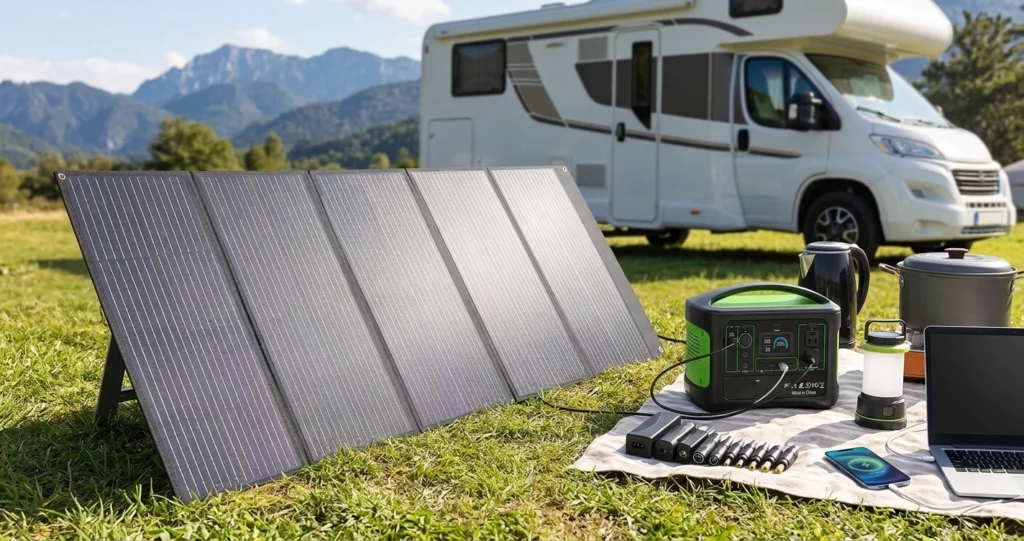
If you want serious solar charging power without permanently mounting rigid panels on your RV, camper, or off-grid setup, a 1000 Watt Solar Panel sounds like an exciting option. The product reviewed here is a 1000W Portable Solar Panel, 72V Foldable Solar Panel with 25.8% High Efficiency, IP68 Waterproof Protection, a 10ft 4-in-1 Cable, and 10 DC Adapters.
At first glance, the combination of 1,000 watts of rated power, a foldable design, high-efficiency monocrystalline cells, and broad connector compatibility makes this panel particularly interesting for people who rely on portable power stations.
But there is an important question: can a portable 1000 watt solar panel actually deliver the performance buyers expect, and is it practical for camping and RV use?
In this review, I’ll break down its design, specifications, portability, compatibility, expected performance, advantages, limitations, and overall value so you can decide whether this panel solar 1000 watts is the right choice for your setup.
Important note: The specifications discussed below are based on the manufacturer’s/product listing information. Solar output varies considerably depending on sunlight, temperature, orientation, shading, and the power station’s solar-input limits. The advertised 1,000W rating should therefore be viewed as a maximum rated output rather than a guaranteed real-world output.
Who Is This 1000 Watt Solar Panel For?
This 1000 Watt Solar Panel is mainly aimed at people who need substantially more solar charging capacity than a typical 100W or 200W portable panel can provide.
It could be a good fit for:
- RV and camper owners
- Off-grid travelers
- Van-life setups
- Emergency backup power users
- Camping enthusiasts with large power stations
- People who want portable rather than permanently installed solar
- Users who need to recharge larger-capacity power stations more quickly
The product is particularly interesting if you already own a compatible high-capacity power station from brands such as EcoFlow, BLUETTI, Jackery, Anker SOLIX, or similar manufacturers.
However, this isn’t necessarily the best choice for everyone. If you only need to charge phones, tablets, cameras, or small battery banks, a 1,000W solar setup could be excessive. You also need to check your power station’s maximum solar input voltage, current, and wattage before buying.
A panel capable of producing 1,000W does not mean every power station can accept 1,000W of solar input.
1000 Watt Solar Panel: Product Overview
| Feature | Details |
|---|---|
| Product | 1000W Portable Foldable Solar Panel |
| Rated Power | Up to 1,000W |
| Voltage | 72V |
| Efficiency | Up to 25.8% |
| Cell Type | Monocrystalline |
| Water Resistance | IP68-rated |
| Cable | 10ft 4-in-1 cable |
| Adapters | 10 × DC adapters |
| Design | Foldable and portable |
| Main Uses | Camping, RV, emergency power, off-grid use |
| Connector | MC4/adapter-based compatibility |
| Price | Check current Amazon price |
| Rating | ★★★★★ 5/5 |
Appearance & Design
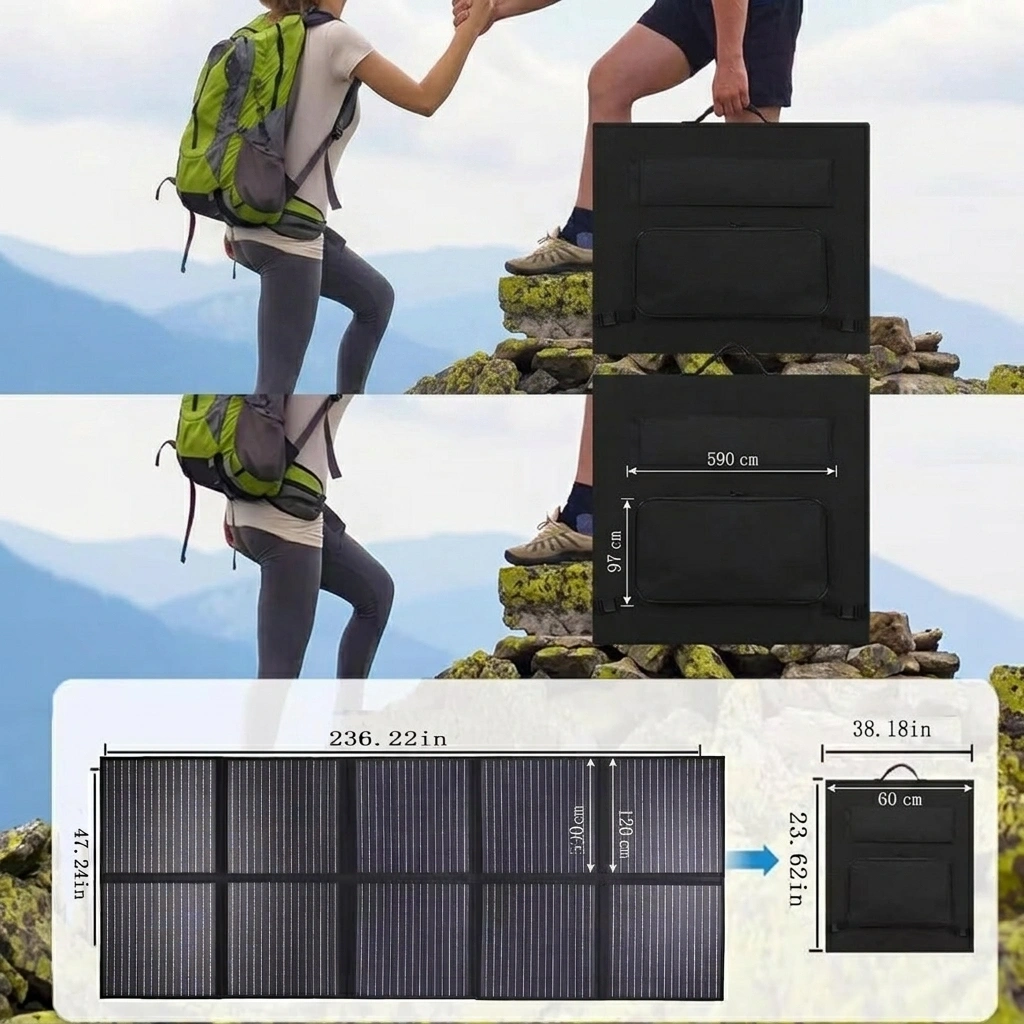
One of the biggest attractions of this 1000 Watt Solar Panel is its foldable design.
Traditional rigid solar panels can be awkward to transport. They’re excellent for permanent RV roofs, homes, sheds, and fixed installations, but they aren’t particularly convenient when you want to move your solar setup between locations.
This panel takes a different approach.
The foldable construction is designed to make a large solar array easier to transport and store. According to the product listing, the panel uses monocrystalline solar cells with an ETFE surface, giving it a design intended for outdoor use.
The large surface area is necessary because generating up to 1,000 watts requires considerably more solar-cell area than smaller portable panels.
When unfolded, the panel is therefore much larger than the compact appearance might initially suggest. That’s worth remembering if you’re planning to use it at a campsite.
You will need enough open space to position the panel toward the sun.
Foldable Design Is a Major Advantage
For RV owners, the foldable format makes a lot of sense.
You can store the panel during travel, take it out when you arrive at camp, position it in the sun, and pack it away when you’re ready to leave.
That’s much more flexible than permanently mounting panels to an RV.
The trade-off is that a 1,000W panel is still a substantial piece of equipment. “Foldable” doesn’t mean tiny.
Performance & Features
The headline feature is obviously the 1,000W maximum rated power.
That’s significantly more solar capacity than common portable 100W, 200W, or 400W panels. For someone running a large power station, that extra capacity can potentially reduce charging time considerably.
The product also advertises 25.8% conversion efficiency. Higher conversion efficiency can be useful when space is limited because the panel can theoretically generate more power from a given surface area than lower-efficiency cells.
The product listing also specifies monocrystalline cells and ETFE construction.
72V Solar Configuration
The advertised 72V specification is another important consideration.
Higher-voltage solar configurations can be useful for compatible power stations because they allow substantial solar power to be delivered without requiring extremely high current.
However, this is also where buyers need to pay close attention.
Do not assume that every portable power station can accept this panel simply because the connectors physically fit.
Before purchasing, compare:
- Maximum solar input voltage
- Maximum solar input current
- Maximum solar charging wattage
- Required connector
- Minimum and maximum operating voltage
- Whether an adapter is required
Electrical compatibility is more important than the number printed on the panel.
IP68 Waterproof Protection
Another appealing feature is the advertised IP68 waterproof rating.
For an outdoor solar product, weather resistance is extremely important. Camping and RV equipment can encounter rain, dust, dirt, and changing weather conditions.
The product listing describes an IP68-rated construction designed for outdoor conditions.
Still, waterproof protection shouldn’t be interpreted as “leave it outside indefinitely in every weather condition.”
Proper care, storage, and following the manufacturer’s instructions remain important for long-term reliability.
1000 Watt Solar Panel Kit for RV Use
For RV owners, the idea of a 1000 watt solar panel kit for RV use is particularly appealing.
A large portable solar array can be useful when you want to recharge a high-capacity power station while camping away from electrical hookups.
For example, an RV setup might use a portable power station to run:
- Refrigerators
- Fans
- Lights
- Electronics
- Laptops
- Cameras
- Small kitchen appliances
- Other low-to-medium-power equipment
The advantage is flexibility.
Instead of installing a permanent solar system on the RV roof, you can keep the panel stored while driving and deploy it when you arrive.
However, you should calculate your actual energy requirements before buying.
A 1,000W panel doesn’t mean you’ll continuously receive 1,000W. Clouds, morning/evening sunlight, heat, panel angle, shading, and conversion losses can all reduce actual production.
User-Friendliness
The basic concept is straightforward: unfold the panel, position it toward the sun, connect the appropriate cable or adapter to a compatible power station, and monitor the charging input.
The included 10ft 4-in-1 cable and multiple DC adapters are useful because they can reduce the need to purchase separate connectors.
That said, the large number of adapters could initially be confusing for beginners.
If you’re new to portable solar, take the time to identify exactly which connector your power station requires.
The easiest setup is always one where the solar panel and power station are electrically compatible without unnecessary adapters.
Positioning Matters
Getting good performance isn’t simply a matter of putting the panel on the ground.
For maximum solar production, try to:
- Position the panel toward the strongest available sunlight
- Avoid shadows from trees, vehicles, buildings, or people
- Adjust the angle as the sun moves
- Keep the panel surface reasonably clean
- Avoid placing it where airflow is completely blocked if heat becomes an issue
Even a small shadow can have a noticeable effect on solar production.
Durability & Quality
The combination of monocrystalline cells, ETFE construction, and IP68-rated protection gives this panel a promising specification sheet for outdoor use.
The ETFE surface is particularly relevant for portable solar equipment because the panel needs protection from the conditions encountered during outdoor use.
Still, portability introduces another potential source of wear: folding and unfolding.
A rigid solar panel generally stays in one position. A portable folding panel is repeatedly handled, folded, transported, unfolded, and stored.
That means users should avoid dragging it across rough surfaces, sharply bending sections, stepping on the panel, or repeatedly stressing cables and connectors.
For the best long-term results, treat it as electrical equipment rather than something that can be handled like ordinary camping gear.
Value for Money
The value proposition depends heavily on the current selling price and, more importantly, whether your power station can actually use the panel’s available capacity.
A 1,000W panel can make sense if you have a large power station with a sufficiently high solar-input limit.
It makes considerably less sense if your power station can only accept 300W or 400W.
In that situation, you’re paying for solar capacity that your equipment cannot fully utilize.
The multiple adapters and included cable also add practical value because you may not need to immediately purchase additional connector accessories.
Compared with building a large solar setup from several smaller panels, a single foldable solution can also simplify transportation and deployment.
However, buyers should compare the total system cost, not just the panel price.
A solar setup may also require:
- A compatible power station
- Additional extension cables
- Mounting or positioning equipment
- Adapters
- Storage space
- Potential replacement accessories
How Does It Compare With a Brand-Name Alternative?
One alternative worth considering is the Jackery SolarSaga system.
Jackery’s SolarSaga 200W panel, for example, is a much smaller panel rated at 200W, with a 24.3% conversion efficiency on the current model listed by Jackery. The company also provides established compatibility information for its own power stations and offers warranties on its solar products.
The difference is straightforward:
Choose the 1000W foldable panel if:
You prioritize maximum portable solar capacity and want a high-output solution for a compatible large power station.
Choose a smaller branded panel if:
You prefer a more established ecosystem, simpler compatibility, easier portability, or don’t need 1,000W of solar input.
Jackery’s official specifications, for example, show that its SolarSaga 200W panel produces 200W peak power and has defined voltage/current specifications.
For someone building an RV solar system, multiple smaller panels may also be easier to position than one very large portable panel.
1000 Watt Solar Panel Kit: Pros & Cons
Pros
- High 1,000W rated output for compatible power stations
- 25.8% advertised efficiency
- Foldable design makes a large solar array easier to transport
- IP68-rated waterproof protection
- Monocrystalline solar cells
- 10ft 4-in-1 cable included
- 10 DC adapters increase connector flexibility
- Useful for camping, RVs, and off-grid applications
- Can potentially recharge large power stations much faster than smaller panels
Cons
- Large when fully unfolded
- Actual solar output will normally be below the advertised 1,000W maximum
- Compatibility must be checked carefully
- Not necessary for users with small power stations
- Multiple adapters can be confusing for beginners
- Portable folding construction requires careful handling
- Current Amazon price may vary
Frequently Asked Questions
Is a 1000 Watt Solar Panel really capable of producing 1,000 watts?
It is rated for a maximum output of 1,000W under suitable conditions. Real-world output is usually lower because solar production depends on sunlight intensity, panel orientation, temperature, shading, and other factors.
Can I use this 1000 watt solar panel kit for RV camping?
Potentially, yes. Its portable and foldable design makes it suitable for RV and camping applications, provided your power station supports the panel’s voltage, current, connector, and maximum solar input.
Will it work with every portable power station?
No. Connector compatibility alone isn’t enough. Always check the power station’s solar-input voltage, current, wattage, and connector requirements before connecting the panel.
Is a 1000 watt solar panel better than several smaller panels?
Not necessarily. A single large panel can simplify deployment and provide high rated capacity, but several smaller panels can be easier to position, transport, replace, or configure depending on your system.
Is the panel waterproof?
The product is advertised with an IP68 waterproof rating. However, users should still follow the manufacturer’s instructions regarding water exposure, storage, connectors, and long-term outdoor use.
Final Verdict: Is This 1000 Watt Solar Panel Worth It?
After looking at the specifications and intended use, this 1000 Watt Solar Panel is an interesting option for RV owners, campers, and off-grid users who need a lot of portable solar capacity.
Its strongest selling points are the 1,000W rated output, 25.8% advertised efficiency, foldable design, IP68 protection, 10ft cable, and multiple DC adapters.
The biggest thing I would emphasize before purchasing is compatibility.
A panel this powerful isn’t automatically better for every power station. Your equipment must be able to accept the panel’s electrical output. If your power station has a lower solar-input limit, a smaller and less expensive panel may actually be the smarter choice.
For users with a compatible high-capacity power station, however, the concept makes a lot of sense. A portable panel solar 1000 watts can provide substantially more charging potential than traditional small portable panels while remaining easier to transport than a permanent rooftop installation.
Overall Rating: ★★★★★ 5/5
Best for: RV owners, campers, van-life users, emergency backup, and off-grid enthusiasts with compatible high-input power stations.
Bottom line: If you need high portable solar capacity and your power station supports the panel’s 72V configuration and 1,000W-class input, this is a compelling option to consider. If portability, simplicity, or low cost matters more than maximum output, a smaller branded panel may be a better fit.
Before you buy, check the current Amazon price, customer reviews, and—most importantly—the solar-input specifications of your power station.
👉 Check the latest price on Amazon and see whether this 1000 watt solar panel kit is the right match for your RV, camping, or off-grid setup.