
Imagine you are sitting at home during a blackout, and suddenly the refrigerator stops humming, the Wi-Fi goes offline, and your phone battery is nearly dead.
You start wondering how long the outage will last. Will the food spoil? Will your medical equipment keep running? Can you stay connected to work or family?
This is exactly why many people invest in a portable power station. But before buying one, the most important question is simple: what can a 1024Wh power station actually run in real life?
The answer can mean the difference between peace of mind and disappointment during an emergency. In this article, you’ll learn exactly what a 1024Wh power station can realistically power, how long it can run common devices, and where its limits begin.
Quick Answer
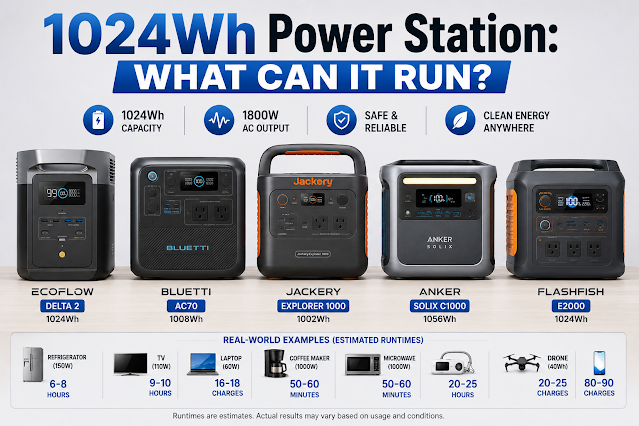
A 1024Wh power station can run most essential household electronics and many appliances, including refrigerators, CPAP machines, routers, laptops, lights, televisions, fans, mini fridges, oxygen concentrators, and small power tools.
Real-world user reports show that a 1024Wh battery can power:
- A full-size refrigerator for approximately 12–15 hours
- A CPAP machine for several nights
- A 310W oxygen concentrator for about 3–3.5 hours
- Lights, laptops, and small electronics for roughly 19 hours
- Fans and mini fridges for extended periods
If you’re still deciding whether a 1024Wh model is the right fit for your budget, see our Best Portable Power Stations Under $1,000 guide to compare the top-performing models across different capacities and features before making a purchase.
However, high-power devices such as electric heaters drain the battery much faster and may only run for around 30 minutes.
Why This Matters in Real Life
Battery capacity numbers can be confusing.
Many people see “1024Wh” and have no idea whether that means two hours of power or two days of power.
The reality is that battery capacity directly affects your ability to keep essential devices running during:
- Power outages
- Storm emergencies
- Camping trips
- RV travel
- Medical situations
- Remote work interruptions
Knowing what a 1024Wh power station can realistically handle helps you avoid buying a system that’s too small—or paying for more capacity than you actually need.
How a 1024Wh Power Station Solves Backup Power Problems
The biggest advantage of a 1024Wh power station is its balance between portability and useful runtime.
Unlike small battery packs designed only for phones and tablets, a 1024Wh unit stores enough energy to operate real household equipment.
Users commonly rely on this capacity for:
- Refrigerator backup
- Home internet backup
- CPAP machines
- Oxygen concentrators
- Laptop charging
- Lighting during outages
- Television and entertainment devices
- Camping equipment
- Mini fridges and coolers
Many users who previously relied on traditional UPS systems found that a 1024Wh power station provided significantly longer backup time.
Common Problems Users Mentioned and How a 1024Wh Power Station Helps
Short Backup Time From Traditional UPS Systems
Many people discovered that conventional UPS units only kept devices running for a short period.
A 1024Wh power station offers a much larger energy reserve, allowing critical equipment to stay powered significantly longer during outages.
Poor Battery Performance From Older Power Stations
Some users switched from older portable power systems that suffered from weak performance and disappointing battery life.
The larger battery capacity allowed them to run more devices for longer periods without constantly recharging.
Reliable CPAP Backup Was Needed
Several users needed dependable overnight power for CPAP therapy.
A 1024Wh power station provided enough energy for multiple nights of CPAP use, reducing dependence on bulky battery packs.
Emergency Power for Medical Equipment
Medical devices are often among the highest priorities during an outage.
Users successfully powered oxygen concentrators and CPAP machines when utility power was unavailable.
Keeping Refrigerators Running
Food spoilage is one of the most common concerns during blackouts.
Multiple users reported successfully using a 1024Wh power station to keep refrigerators operating for many hours.
Step-by-Step Guide
Check the Device Wattage
Look at the label on the appliance or consult the owner’s manual.
Every device has a wattage rating that determines how quickly it uses battery power.
Compare Wattage to the Power Station’s Output
Most 1024Wh power stations can handle many common household devices, but every unit has a maximum output rating.
Verify that your appliance falls within that limit.
Estimate Runtime
A simple estimate is:
Runtime (hours) = Battery Capacity (Wh) ÷ Device Wattage (W)
For example:
- 1024Wh ÷ 100W = about 10 hours
- 1024Wh ÷ 300W = about 3.4 hours
Actual results are usually lower because of inverter losses and real-world operating conditions.
Prioritize Essential Devices
During an outage, powering fewer devices often dramatically increases runtime.
Many users focus on:
- Refrigerators
- Medical equipment
- Routers
- Lights
- Phones
- Laptops
Recharge When Possible
Most modern power stations can be recharged through:
- Wall outlets
- Solar panels
- Vehicle charging systems
Recharging extends usefulness during prolonged outages.
Runtime or Performance Estimates
Actual performance varies depending on device efficiency, inverter losses, temperature, battery age, and power usage patterns.
Based on real-world user experiences, a 1024Wh power station achieved approximately:
| Device | Runtime |
|---|---|
| Full-size refrigerator | 12–15 hours |
| 310W oxygen concentrator | 3–3.5 hours |
| Heated CPAP machine | Several nights |
| Lights, laptop, and small electronics | About 19 hours |
| Fan and mini fridge | About 5 hours with roughly 50% battery remaining |
| 1200W heater | About 30 minutes |
| 1500W heater | About 30 minutes |
| Electric grill and fan | 2–3 hours with more than 50% battery remaining |
These examples demonstrate that a 1024Wh battery performs best when powering moderate and low-power loads rather than energy-hungry heating appliances.
Pros and Cons Based on Real Reviews
Pros
- Can power refrigerators during outages
- Supports CPAP machines for multiple nights
- Can operate oxygen concentrators
- Suitable for home emergency backup
- Useful for camping and RV travel
- Runs routers, laptops, and networking equipment
- Can power multiple small devices simultaneously
- Supports lights and entertainment devices during blackouts
Cons
- Runtime drops quickly with high-power appliances
- Not ideal for all-night heater operation
- May not run certain heavy-duty equipment
- Some devices with large startup demands may exceed capabilities
- Battery capacity cannot be increased on some models
Who This Solution Is Best For
A 1024Wh power station is an excellent choice for:
- Homeowners preparing for blackouts
- Emergency preparedness planning
- CPAP users
- Oxygen concentrator users
- Campers
- RV travelers
- Remote workers
- Families wanting refrigerator backup
- Anyone needing reliable power for electronics and communication devices
When You May Need a Larger or Alternative Solution
A 1024Wh power station may not be sufficient if you need:
- Whole-home backup
- Overnight heating from electric heaters
- Large well pumps
- Heavy workshop equipment
- Multiple high-power appliances running simultaneously
In those situations, a larger-capacity power station may be a better investment.
Frequently Asked Questions
Can a 1024Wh power station run a refrigerator?
Yes. Real-world users reported approximately 12–15 hours of runtime for a full-size refrigerator.
Can a 1024Wh power station run a CPAP machine?
Yes. Users reported powering heated CPAP machines for several nights.
Can a 1024Wh power station run an oxygen concentrator?
Yes. One reported example achieved approximately 3–3.5 hours of runtime for a 310W oxygen concentrator.
Can a 1024Wh power station power a television?
Yes. Televisions are among the devices commonly powered during outages and emergencies.
Can a 1024Wh power station run a heater?
Yes, but runtime is usually short because heaters consume large amounts of energy. Users reported roughly 30 minutes of operation for 1200–1500W heaters.
Is a 1024Wh power station enough for emergency preparedness?
For many households, yes. It can keep essential devices such as refrigerators, lights, routers, phones, laptops, and medical equipment running during typical outages.
Final Verdict
A 1024Wh power station hits a practical sweet spot between portability and useful backup power.
Real-world experiences show that it can successfully power refrigerators, CPAP machines, oxygen concentrators, routers, lights, laptops, televisions, fans, and many other essential devices during outages and emergencies.
While it is not designed for long-term operation of power-hungry appliances such as electric heaters, it provides enough stored energy to cover the devices that matter most when the grid goes down.
For many households, campers, RV travelers, and emergency-preparedness planners, a 1024Wh power station offers enough capacity to keep essential equipment running without stepping up to a much larger and heavier system.


