PrismoPicks synthesizes verified user reports, manufacturer specifications, and publicly available owner data. We do not conduct hands-on hardware testing. All analysis is our own.
👤 Reported by: Multiple owners — Reddit, Amazon reviews, owner forums
🕐 Issue type: Solar input / array configuration limitation
📊 Frequency: Moderate — appears repeatedly across owner reportsWe kept running into the same wall: our solar panels worked fine individually, but the moment we tried wiring them together the system stopped accepting charge. Even setups that “should” be within range suddenly failed to connect. It felt like the more solar we added, the less usable it became. Nobody expected a 60V limit to completely reshape how the entire array has to be built.
🔧 Answered by: PrismoPicks Research Team
📅 Last verified: June 2026
✔️ Status: Solved
ROOT CAUSE
What Is Actually Happening
1. Hard MPPT Voltage Ceiling (60V Input Limit)
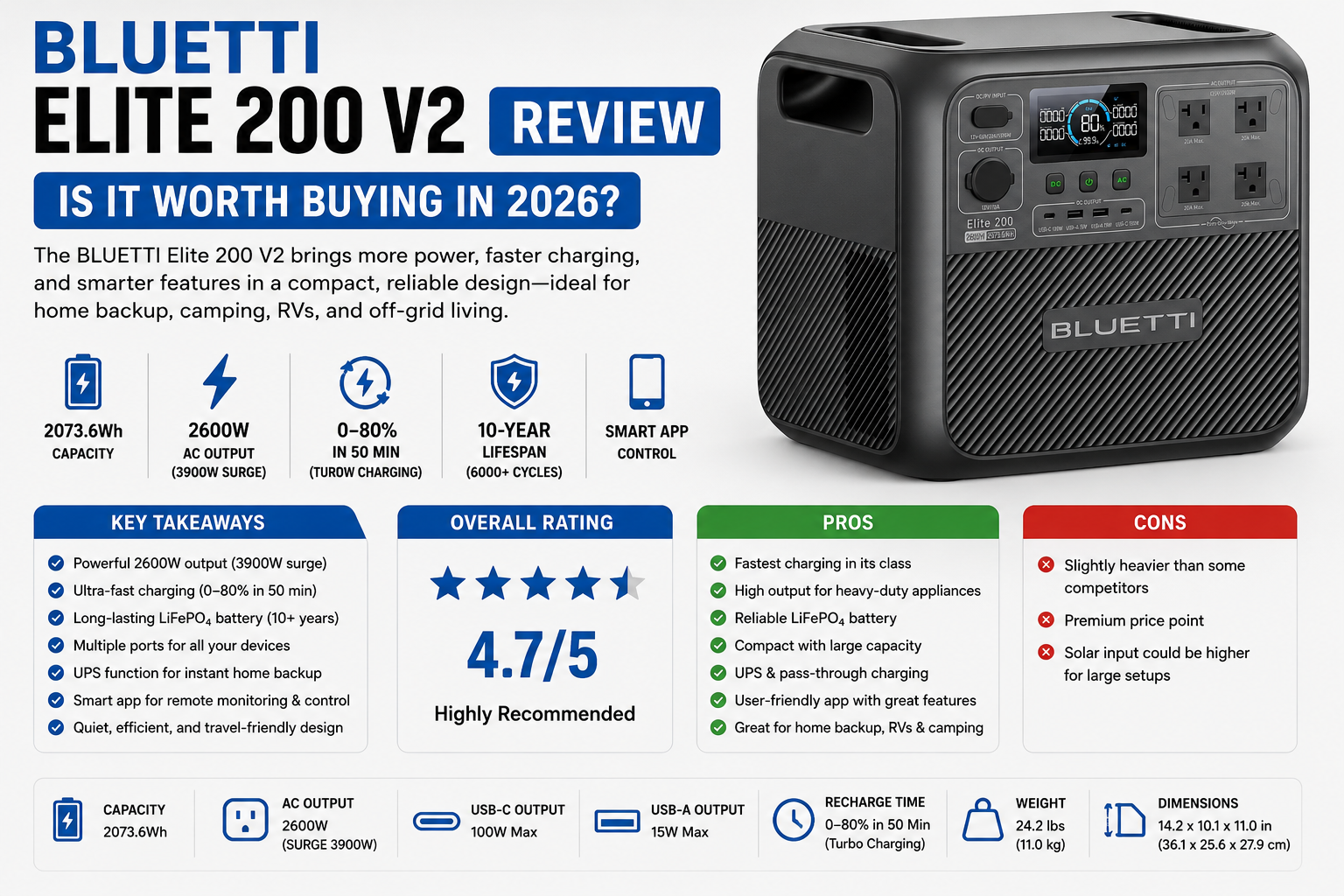
The BLUETTI Elite 200 V2 uses an internal MPPT controller with a strict ~60V maximum solar input ceiling. This is not a “recommended range” — it is a hard cutoff. Once exceeded, the unit will reject input or stop charging entirely.
2. Series Wiring Multiplies Voltage
Most compatibility failures come from series-connected panels.
Example behavior observed from owner setups:
- 2 × 24V panels in series → ~48V (works)
- 3 × 24V panels in series → ~72V (fails / shutdown risk)
Cold weather increases Voc further, often pushing borderline systems over the limit without users realizing it.
3. Hidden Cold-Weather Voltage Spike
User reports consistently show that winter mornings cause unexpected failures even when “math says it should work.” This happens because open-circuit voltage rises in low temperatures, silently pushing arrays beyond 60V.
THE FIX
What Owners Did to Solve It
1. Rewire solar arrays in parallel instead of series
This is the most consistent fix across user reports. Parallel wiring keeps voltage within the 60V ceiling while increasing current, which the Elite 200 V2 can safely accept.
Recommended products (MC4 parallel branching):
- BougeRV MC4 Branch Connectors (2-to-1 / 3-to-1 sets)
- ALLPOWERS MC4 Parallel Connector Kit (weather-resistant version)
These are widely used in RV and portable solar setups because they allow multiple panels to feed one input without stacking voltage.
2. Select panels with safe Voc headroom (below real-world 60V max)
Owners who avoided issues consistently checked Voc (open-circuit voltage), not just wattage. The key is staying under 60V even in cold weather (where Voc rises).
Common compatible panel examples:
- Renogy 100W 12V Monocrystalline Solar Panel (Voc ~21V each, safe in parallel builds)
- Jackery SolarSaga 100W (Voc ~23V, commonly used in parallel configurations)
- BLUETTI PV120 / PV200 panels (native ecosystem compatibility, lowest setup risk)
Rule used by owners: keep total cold-weather Voc under ~55V for safety margin.
3. Use a solar combiner box for multi-panel systems
For more than 2–3 panels, users move away from simple branch connectors and use a combiner box to stabilize wiring, protect inputs, and simplify scaling.
Recommended products:
- Renogy 4-Way Solar Combiner Box (with fuses, MC4 input support)
- ECO-WORTHY Solar Combiner Box (budget-friendly RV/off-grid setups)
These help prevent uneven current flow and make troubleshooting easier in larger arrays.
4. Measure real open-circuit voltage before plugging in
A significant number of “it doesn’t charge” cases were resolved immediately after testing Voc — especially in cold mornings or mixed-panel setups.
Recommended tools:
- Klein Tools MM400 Digital Multimeter (reliable mid-range option)
- AstroAI Digital Multimeter TRMS 6000 counts (budget-friendly, widely used in solar DIY setups)
Users typically check voltage before every major configuration change or seasonal adjustment.
5. Avoid mixing series strings into a single high-voltage input chain
This is more of a system design correction than a product fix. Owners who failed often had “legacy RV wiring” where panels were pre-wired in series for 100–150V systems.
What replaced it:
- Split panels into independent parallel groups
- Feed each group through MC4 branch connectors or a combiner box
- Keep all input lines within a single low-voltage MPPT-safe range
This redesign is what ultimately makes the Elite 200 V2 stable under solar load.