
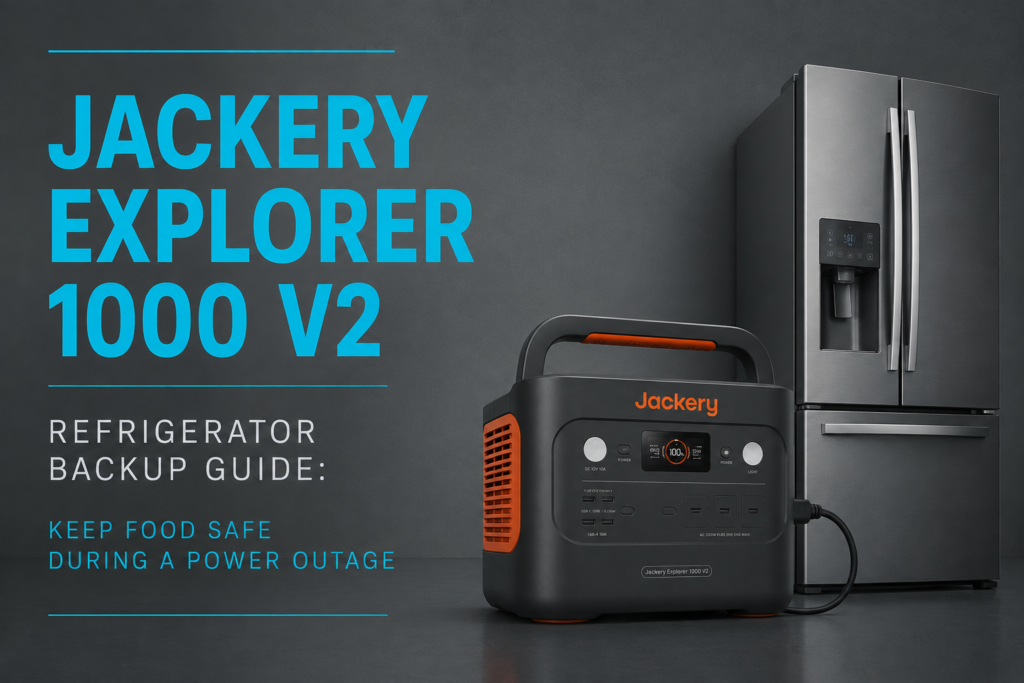
Power outages never seem to happen at a convenient time. Whether they’re caused by storms, hurricanes, grid failures, or unexpected utility work, one of the biggest concerns is keeping your refrigerator cold enough to prevent food from spoiling. That’s where the Jackery Explorer 1000 V2 refrigerator backup guide becomes essential. With a 1,070Wh LiFePO4 battery, a 1,500W pure sine wave inverter, and fast charging, the Explorer 1000 V2 is designed to keep critical household appliances running during emergencies.
However, simply plugging your refrigerator into the power station isn’t enough to maximize runtime. Preparation, proper timing, and a few inexpensive accessories can easily extend backup time by several hours while helping keep food within safe temperatures.
In this guide, you’ll learn exactly how to prepare before an outage, when to connect your refrigerator, how to reduce energy consumption, monitor food safety, and get the most from your Jackery Explorer 1000 V2.
Quick Answer
Yes, the Jackery Explorer 1000 V2 can power many modern refrigerators during a power outage, but actual runtime depends on:
- Refrigerator size
- Compressor efficiency
- Ambient temperature
- Door openings
- Starting surge
- Average running wattage
A typical ENERGY STAR refrigerator consuming around 50–90 watts on average can often operate for many hours when managed correctly. Larger or older refrigerators with higher compressor demand will shorten runtime.
If you’re unsure whether your refrigerator is compatible, read How long will a 1000Wh power station run a fridge? before testing your setup.
Why Prepare Before the Power Goes Out?
Most people wait until the lights go out before thinking about backup power.
That’s a mistake.
Preparing in advance can easily save several hours of battery runtime while reducing food waste.
Before storm season arrives:
- Fully charge the Jackery Explorer 1000 V2.
- Test your refrigerator’s power consumption.
- Freeze bottles of water to add thermal mass.
- Keep extension cords ready.
- Store essential accessories together.
- Practice connecting everything before an emergency.
These small steps make a huge difference when every watt-hour counts.
Step 1: Measure Your Refrigerator’s Actual Power Consumption
Many refrigerator labels only list maximum power.
That isn’t what the fridge uses all day.
Compressors constantly cycle on and off, meaning average power is much lower.
The easiest way to find your real consumption is with a plug-in watt meter.
Recommended Tool
⚡ Plug-in Watt Meter
P3 International Kill A Watt Electricity Usage Monitor
or
Why it’s essential
A watt meter shows:
- Real-time wattage
- Compressor startup spikes
- Daily energy consumption
- Total kWh usage
Knowing these numbers allows you to estimate how long your Jackery battery will actually last instead of guessing.
Tech Check
- 120V AC
- 15A pass-through
- Compatible with 1,500W Jackery AC outlets
- Displays real-time watts and cumulative energy use
Step 2: Fully Chill Your Refrigerator Before the Outage
A refrigerator already sitting at the proper temperature needs much less energy than one trying to cool warm food.
The FDA recommends keeping:
- Refrigerator below 40°F (4°C)
- Freezer at 0°F (-18°C)
Before severe weather arrives:
- Turn the refrigerator slightly colder.
- Freeze reusable ice packs.
- Fill empty space with water bottles.
- Avoid placing warm groceries inside.
Every degree matters.
Essential Accessory
🌡️ Refrigerator Thermometer
Taylor Precision Stainless Steel Refrigerator Thermometer
Unlike digital displays built into many refrigerators, an independent thermometer continues working without electricity.
It confirms your food stays within safe temperatures even if the refrigerator loses power.
Tech Check
- Mechanical operation
- No batteries
- Zero power draw
- Waterproof stainless-steel body
Step 3: Connect the Refrigerator at the Right Time
One common misconception is that the refrigerator must stay connected continuously.
That’s not always necessary.
If the refrigerator has remained closed after losing utility power, the interior can stay cold for several hours.
The USDA notes that an unopened refrigerator generally keeps food cold for about 4 hours, while a full freezer can maintain safe temperatures much longer.
Instead of immediately draining your battery:
- Keep the refrigerator doors closed.
- Wait until internal temperature begins rising.
- Then connect the Jackery Explorer 1000 V2.
This strategy often saves valuable battery capacity for later in the outage.
Use a Surge Protector for Added Safety
Although the Jackery produces clean pure sine wave electricity, sudden utility restoration or unstable grid conditions can create voltage fluctuations.
A refrigerator surge protector adds another layer of protection for the compressor.
Recommended Product
🔌 Refrigerator Surge Protector
Bitechnology Refrigerator Voltage Protector
or
Ortis Refrigerator Voltage Protector
These devices automatically delay compressor restart for about three minutes after power returns, reducing wear caused by rapid cycling.
Tech Check
- 15A rating
- 1800W maximum load
- 3-minute compressor delay
- Fully compatible with Jackery Explorer 1000 V2
Step 4: Place the Jackery Safely
Portable power stations generate heat while operating.
For best performance:
- Keep vents unobstructed.
- Avoid direct sunlight.
- Place on a dry surface.
- Maintain airflow around the cooling fans.
- Never cover the unit while charging or discharging.
If the refrigerator is far away, avoid using thin household extension cords.
Recommended Heavy-Duty Extension Cord
🧵 Heavy-Duty Appliance Extension Cord
Iron Forge Cable 10 ft Heavy-Duty Appliance Extension Cord
Thin 16- or 18-gauge cords create voltage drop and unnecessary heat.
A properly sized 12 AWG or 14 AWG grounded extension cord safely carries the refrigerator’s load with minimal energy loss.
Tech Check
- 12 AWG copper wire
- 15A grounded
- 1875W rated
- Three-prong appliance cord
Understanding Real Refrigerator Runtime
Many buyers expect a 1,070Wh battery to run a refrigerator for an entire day.
Real-world testing shows that’s not always the case.
Actual runtime depends on:
- Compressor cycles
- Room temperature
- Frost buildup
- Door openings
- Refrigerator age
- Inverter losses
Customer experiences in the reviews show that some users powered refrigerators successfully for several hours during outages, while others found runtime shorter than expected depending on refrigerator size and usage patterns. Several reviewers emphasized measuring actual wattage first rather than relying on estimates.
For a detailed explanation of battery calculations, inverter efficiency, and realistic expectations, see What Can a 1000Wh Power Station Run?
Reduce Refrigerator Power Consumption and Extend Runtime
Even the most efficient refrigerator will eventually drain a portable power station if it’s forced to run continuously. Fortunately, a few simple habits can significantly reduce power consumption and help your Jackery Explorer 1000 V2 last much longer during an outage.
Keep the Doors Closed
Every time you open the refrigerator, cold air escapes and warm air enters. The compressor must then work harder to restore the set temperature.
To minimize unnecessary cycling:
- Decide what you need before opening the door.
- Retrieve everything in one trip.
- Close the door immediately.
- Avoid checking the temperature by opening the door repeatedly.
Tip: Keep drinks in a cooler if people are opening the refrigerator frequently.
Freeze Ice Packs Ahead of Time
Reusable ice packs act as thermal batteries.
They absorb heat while reducing how often the refrigerator compressor needs to turn on.
This is especially helpful during long outages.
Recommended Product
🧊 High-Density Freezer Ice Packs
Cooler Shock Reusable Ice Packs (XL)
These high-density gel packs remain cold much longer than ordinary ice packs and help stabilize internal temperatures.
Tech Check
- Food-safe materials
- Reusable
- Leak-resistant
- No power required
Avoid Adding Warm Food
Adding groceries that haven’t been pre-cooled forces the refrigerator to remove extra heat.
During a blackout:
- Avoid cooking large meals.
- Let leftovers cool before refrigerating.
- Don’t place warm beverages inside.
Every unnecessary cooling cycle uses battery power.
Monitor Food Temperature Without Opening the Door
One of the biggest mistakes during a blackout is opening the refrigerator simply to “check if it’s still cold.”
Instead, monitor the temperature remotely.
Recommended Product
📶 Wireless Refrigerator Temperature Monitor
AcuRite Digital Wireless Fridge and Freezer Thermometer (Model 00986M)
Place the wireless sensors inside the refrigerator and freezer while keeping the display outside.
This allows you to monitor temperatures without releasing valuable cold air.
Tech Check
- Dual wireless sensors
- Audible temperature alarms
- Battery powered
- Zero power draw from the Jackery
Because the monitor runs on its own batteries, it doesn’t reduce your power station’s runtime.
Use Solar Panels for Multi-Day Outages
If the outage lasts longer than one day, solar charging becomes one of the biggest advantages of owning the Explorer 1000 V2.
Instead of waiting for grid power to return, you can recharge during daylight hours and continue running your refrigerator overnight.
Recommended Product
☀️ Jackery SolarSaga 100W or 200W
The Explorer 1000 V2 supports up to 400W of solar input using its dual DC8020 input ports.
With good sunlight, daytime charging can dramatically extend emergency operation.
Tech Check
- Up to 400W combined solar input
- Dual DC8020 charging ports
- Plug-and-play with Jackery SolarSaga panels

If you’re planning to use third-party panels, our guide Jackery Explorer 1000 V2 Not Charging From Solar? Panel Compatibility Fix explains which adapters you may need.
Automate Cooling Cycles
Many refrigerators don’t need continuous power to keep food safe.
In some situations, cycling power can greatly extend battery life.
For example:
- Run the refrigerator for 45–60 minutes.
- Turn it off for 1–2 hours.
- Repeat while monitoring internal temperature.
Important: Always verify food temperatures with a thermometer rather than relying on time alone.
Recommended Product
⏱️ Mechanical Plug-in Timer
BN-LINK 24-Hour Heavy Duty Mechanical Timer
Tech Check
- 15A rated
- Grounded outlet
- Mechanical operation
- No Wi-Fi or app required
Use Efficient Lighting Instead of the Refrigerator Light
Opening the refrigerator repeatedly to find food wastes far more energy than using a small external light.
A USB-powered LED light connected directly to the Explorer 1000 V2 uses only a fraction of the power required by the AC inverter.
Recommended Product
💡 USB Emergency Light
Jackery Portable LED Camping Lantern
or
Baseus USB-C Magnetic LED Light
Tech Check
- USB-A or USB-C powered
- Extremely low power consumption
- Ideal for kitchens during outages
Common Mistakes to Avoid
Avoid these common errors if you want the longest possible runtime:
- Plugging in a warm refrigerator after it’s already heated up.
- Opening the doors every few minutes.
- Using thin 16 AWG or 18 AWG extension cords.
- Guessing runtime without measuring actual wattage.
- Running unnecessary appliances from the same battery.
- Ignoring food temperature and relying only on appearance.
- Waiting until the power fails to test your setup.
Several reviewers also noted that actual runtime varied widely depending on refrigerator size, compressor efficiency, and usage habits. Testing your own refrigerator before an emergency provides much more reliable expectations than marketing estimates.
Frequently Asked Questions
Can the Jackery Explorer 1000 V2 run a refrigerator overnight?
It depends on your refrigerator’s average power consumption. Efficient modern models may run for many hours, while older or larger units may require careful power management or periodic operation.
How do I calculate refrigerator runtime?
Measure the refrigerator’s average wattage with a plug-in watt meter, then estimate runtime using the usable battery capacity while accounting for inverter losses.
Should I keep the refrigerator plugged in the entire outage?
Not necessarily. Keeping the doors closed and only powering the refrigerator when needed can extend battery life significantly.
What temperature should my refrigerator stay below?
Food safety guidelines recommend keeping the refrigerator below 40°F (4°C) and the freezer at 0°F (-18°C).
Is a surge protector necessary with the Jackery Explorer 1000 V2?
While the Explorer 1000 V2 provides clean pure sine wave output, a refrigerator surge protector can help guard against voltage fluctuations and compressor restart issues when utility power returns.
Can I recharge the Jackery Explorer 1000 V2 with solar panels during an outage?
Yes. Pairing it with compatible SolarSaga panels allows daytime recharging, making it much more practical for extended outages.
What accessories are most important for refrigerator backup?
A refrigerator thermometer, watt meter, surge protector, heavy-duty extension cord, and wireless temperature monitor provide the best combination of safety and efficiency.
Final Verdict
The Jackery Explorer 1000 V2 refrigerator backup guide isn’t just about connecting a refrigerator to a portable power station—it’s about using your available energy wisely.
By measuring your refrigerator’s real power consumption, keeping doors closed, monitoring temperatures, adding thermal mass with ice packs, using heavy-duty cables, and recharging with solar when possible, you can dramatically improve food safety and battery runtime during a power outage.
If you’re still deciding whether this power station fits your needs, Jackery Explorer 1000 v2 Review: Is It Worth Buying in 2026? offers a complete overview, while 10 Jackery Explorer 1000 v2 Problems You Should Know Before Buying highlights the limitations and trade-offs reported by owners.


