Power outages rarely happen at a convenient time. One moment everything is running normally, and the next you’re wondering how long your refrigerator, internet, lights, or medical equipment can stay powered. That is why many homeowners ask the same question: Is 1000Wh enough for home backup?
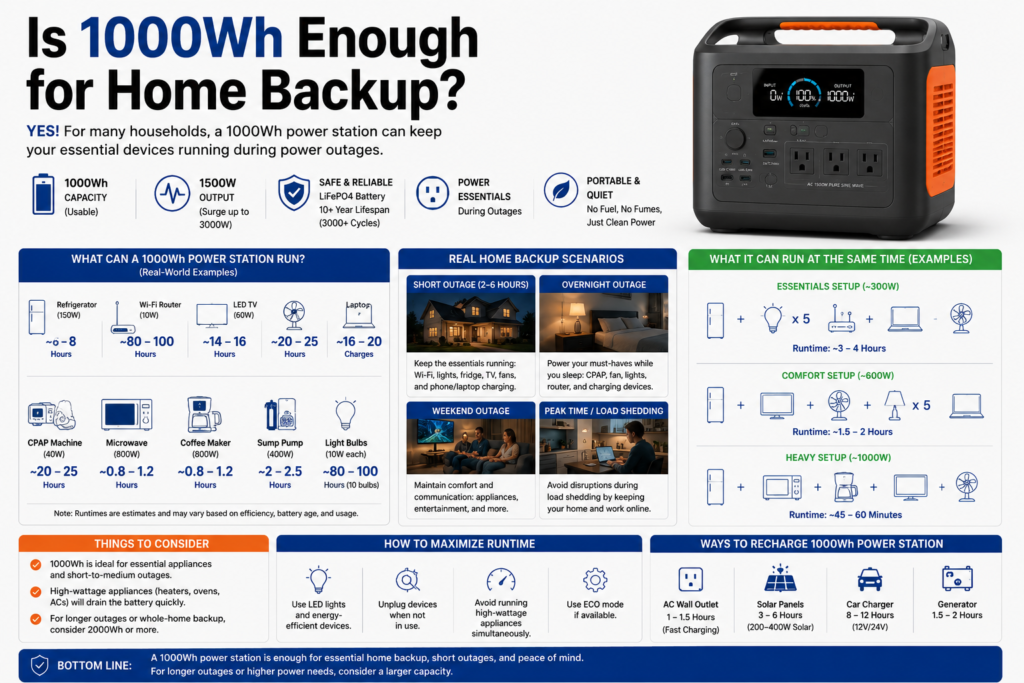
The short answer is yes—for many essential devices and short outages. A 1000Wh portable power station can keep critical electronics running for several hours or even days depending on what you power. However, it is not designed to run whole-home systems, electric heaters, large air conditioners, or other high-demand appliances for extended periods.
In this guide, you’ll learn exactly what a 1000Wh battery can power, real-world runtime expectations, common limitations, and whether a 1000Wh power station is the right emergency backup solution for your home.
Quick Answer: Is 1000Wh Enough for Home Backup?
For most households, 1000Wh is enough for essential backup power during short outages.
A typical 1000Wh power station can usually power:
- Wi-Fi router and modem
- Smartphones and tablets
- Laptops
- LED lighting
- CPAP machines
- Televisions
- Small refrigerators
- Starlink systems
- Medical devices with moderate power requirements
However, it is generally not enough for overnight heating, large air conditioners, electric water heaters, or whole-home backup systems.
Because inverter losses reduce usable capacity, most users see around 800–900Wh of real usable energy.
What Does 1000Wh Mean?
A watt-hour (Wh) measures stored energy.
A 1000Wh battery can theoretically provide:
- 100 watts for 10 hours
- 200 watts for 5 hours
- 500 watts for 2 hours
- 1000 watts for 1 hour
In practice, power stations lose some energy during conversion from battery power to AC power. Therefore, real-world usable capacity is usually about 80%–90% of the rated capacity.
For example, a 1024Wh power station often delivers around 820–920Wh of usable energy.
Why 1000Wh Home Backup Matters
Power outages are becoming more common because of:
- Severe storms
- Grid failures
- Wildfires
- Ice storms
- Utility maintenance
- Emergency shutdowns
As a result, homeowners increasingly rely on portable power stations to keep essential devices running.
Unlike gasoline generators, battery power stations operate:
- Quietly
- Indoors safely
- Without fuel storage
- With minimal maintenance
In addition, many models support solar charging, allowing extended use during prolonged outages.
Real-World Runtime Examples for a 1000Wh Power Station
The best way to determine whether 1000Wh is enough for home backup is to look at actual runtime examples.
Router and Modem
Typical consumption:
- 10–20W
Estimated runtime:
- 40–80 hours
Many users successfully power internet equipment through multi-day outages.
CPAP Machine
Typical consumption:
- 30–60W
Estimated runtime:
- 2–5 nights
Using DC power adapters instead of AC often extends runtime significantly.
Refrigerator
Typical consumption:
- 60–150W cycling load
Estimated runtime:
- 7–15 hours
Real-world testing commonly shows refrigerators consuming around 50% of a 1000Wh battery over roughly 7 hours.
Starlink Internet
Typical consumption:
- 30–60W
Estimated runtime:
- 15–30 hours
This makes a 1000Wh station popular among remote workers and emergency preparedness enthusiasts.
Laptop and Electronics
Typical consumption:
- 30–80W
Estimated runtime:
- 10–25 hours
Therefore, a 1000Wh battery can often support an entire workday or longer.
Oxygen Concentrator
Typical consumption:
- 300W+
Estimated runtime:
- Approximately 3–4 hours
Always verify actual power consumption before relying on battery backup for medical equipment.
How Long Will a 1000Wh Battery Last During a Power Outage?
The answer depends entirely on your load.
Here are realistic examples:
| Devices Running | Approximate Runtime |
|---|---|
| Router + Modem | 40–80 hours |
| CPAP Machine | 2–5 nights |
| Refrigerator | 7–15 hours |
| TV + Router + Lights | 8–15 hours |
| Laptop + Router | 12–20 hours |
| Space Heater | Less than 1 hour |
| Microwave | Minutes of usage |
Meanwhile, high-power appliances can drain a 1000Wh battery surprisingly fast.
A 1500W electric heater can consume about half the battery in roughly 30 minutes.
Common Limitations of 1000Wh Home Backup
Although 1000Wh is useful, it has limits.
Not Suitable for Electric Heating
Space heaters typically draw:
- 1200–1500W
As a result, battery capacity disappears quickly.
Limited for Large Appliances
Some appliances may exceed inverter limits:
- Well pumps
- Large air compressors
- Central air systems
- Electric dryers
Always check startup surge requirements.
Conversion Losses
Many buyers assume they receive the full rated capacity.
However, inverter losses reduce usable energy.
A 1024Wh battery often provides closer to:
- 800–900Wh usable capacity
Extended Outages Require Recharging
A single charge may not be enough during multi-day outages.
Therefore, many users combine portable power stations with:
- Solar panels
- Vehicle charging
- Backup generators
Comparing Popular 1000Wh Power Stations
Anker Solix C1000
The Anker Solix C1000 is known for:
Pros
- Extremely fast charging
- Up to 600W solar input
- UPS capability
- Pass-through charging
- Strong performance for CPAP, refrigerators, and networking equipment
Cons
- Non-expandable battery
- Occasional firmware issues
- Bluetooth connectivity complaints
- Heavy for frequent carrying
It is particularly attractive for users who prioritize rapid recharge times.
EcoFlow Delta 3 Classic
The EcoFlow Delta 3 Classic offers:
Pros
- Fast charging
- Quiet operation
- UPS functionality
- Strong refrigerator runtime
- Reliable emergency backup performance
Cons
- No battery expansion support
- Some UPS-related complaints
- Limited runtime for heating appliances
It is well suited for home backup and emergency preparedness.
Jackery Explorer 1000 v2
The Jackery Explorer 1000 v2 focuses on simplicity and portability.
Pros
- Excellent for home backup
- Good CPAP performance
- Strong app monitoring
- Reliable for camping and RV use
Cons
- Proprietary solar connector
- Missing accessories on some purchases
- Connectivity complaints
- Customer service concerns
It remains a popular option for homeowners seeking straightforward backup power.
Best Practices for Using a 1000Wh Power Station
First, Prioritize Essential Devices
Focus on:
- Refrigerators
- Medical equipment
- Internet equipment
- Phones
- Lighting
Next, Avoid High-Power Heating Loads
Heating appliances are the fastest way to drain your battery.
Use DC Outputs When Possible
DC power often reduces inverter losses and extends runtime.
For example, CPAP users frequently see longer runtimes when using DC adapters.
Monitor Real Power Consumption
Many users overestimate runtime because appliance wattage varies.
Use a power meter or monitor usage through the station’s app.
Add Solar for Longer Outages
Solar charging can dramatically increase outage resilience.
Even moderate solar input can recover meaningful battery capacity during daylight hours.
Common Mistakes to Avoid
Assuming Rated Capacity Equals Usable Capacity
Always account for inverter losses.
Ignoring Appliance Startup Surges
Some devices require much higher startup power than running power.
Waiting Until an Emergency
Test all critical devices before an outage occurs.
Depending on One Battery for Multi-Day Outages
Extended outages often require solar charging or a secondary backup source.
Is 1000Wh Enough for Home Backup During a Blackout?
For most short blackouts, the answer is yes.
A 1000Wh power station can comfortably power:
- Internet equipment
- Phones
- Laptops
- Lights
- CPAP machines
- Refrigerators
However, it cannot replace a whole-home generator.
If your goal is to maintain comfort rather than simply keep essentials running, you may need 2000Wh, 3000Wh, or expandable battery systems.
Related Reading
- What Can a 1000Wh Power Station Run?
- How Long Will a 1000Wh Power Station Run a Fridge?
- What Can a 2000Wh Power Station Run? Real Uses
Frequently Asked Questions
Is 1000Wh enough for home backup overnight?
Yes. A 1000Wh power station can often power essential devices overnight, including routers, lights, CPAP machines, and some refrigerators.
How long will a refrigerator run on a 1000Wh battery?
Most refrigerators run approximately 7–15 hours depending on compressor cycles, temperature, and efficiency.
Is 1000Wh enough for a CPAP machine?
Yes. Many users achieve multiple nights of backup power, especially when using DC adapters.
Can a 1000Wh power station run a microwave?
Yes, but only briefly. Microwaves consume large amounts of power and drain batteries quickly.
Is 1000Wh enough for home backup during a multi-day outage?
Not by itself. Solar charging or additional backup power is usually needed for extended outages.
What is the best use for a 1000Wh power station?
Emergency backup for refrigerators, internet equipment, medical devices, lights, laptops, and communication devices.
Can a 1000Wh battery power a heater overnight?
No. Most electric heaters consume too much energy and will deplete the battery within a short period.
Final Verdict: Is 1000Wh Enough for Home Backup?
For most households, 1000Wh is enough for home backup when the goal is to keep essential devices running during short outages. It can power refrigerators, routers, CPAP machines, laptops, lights, and communication equipment for hours or even days depending on usage.
However, a 1000Wh power station is not designed for whole-home backup or energy-hungry appliances like electric heaters and large air conditioners. Therefore, understanding your actual power requirements is critical before choosing a backup solution.
If you want affordable emergency preparedness, reliable backup for critical devices, and portable energy storage, a quality 1000Wh power station remains one of the best investments available.