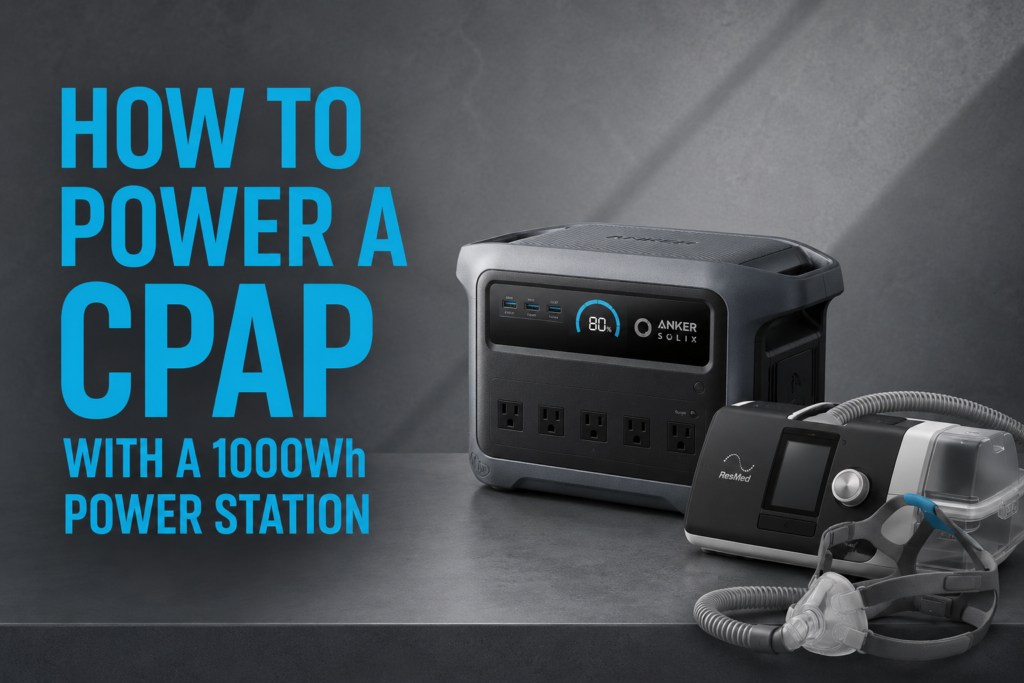
For people who depend on CPAP therapy, a power outage is more than an inconvenience—it can disrupt sleep and affect health. Whether you’re preparing for emergencies, camping off-grid, or traveling in an RV, knowing how to power a CPAP with a 1000Wh power station can provide valuable peace of mind.
The good news is that most modern CPAP machines consume relatively little power. As a result, a quality 1000Wh portable power station can often run a CPAP for multiple nights on a single charge. However, runtime depends on factors such as humidifier settings, heated tubing, and whether you’re using AC or DC power.
In this guide, you’ll learn exactly how to connect a CPAP to a 1000Wh power station, how long it can run, and the best ways to maximize battery life.
Quick Answer
Yes, a 1000Wh power station is usually enough to power a CPAP machine for 2–5 nights on a single charge.
Typical CPAP power consumption:
- Standard CPAP: 30–60W
- CPAP with humidifier: 50–90W
- Heated hose enabled: 60–100W+
Most users achieve the longest runtime by using a direct DC connection instead of the AC inverter.
Why Use a 1000Wh Power Station for CPAP Backup?
CPAP users choose portable power stations because they offer several advantages over traditional generators.
Benefits
- Safe for indoor use
- No gasoline required
- Silent operation
- Portable and travel-friendly
- Suitable for camping and RVs
- Fast recharging
- Can be paired with solar panels
In addition, many modern power stations include UPS functionality, allowing automatic switchover during outages.
How Long Will a 1000Wh Power Station Run a CPAP?
The exact runtime depends on your machine’s power consumption.
Typical Runtime Estimates
| CPAP Power Draw | Estimated Runtime |
|---|---|
| 20W | 40+ hours |
| 30W | 25–30 hours |
| 40W | 20–24 hours |
| 60W | 13–16 hours |
| 80W | 10–12 hours |
Since most people sleep 7–8 hours per night, a 1000Wh power station can often support:
- 2–5 nights of CPAP therapy
- Longer runtime when humidifiers are disabled
- Additional runtime when using DC power
For a broader look at battery capabilities, see What Can a 1000Wh Power Station Run?
Step 1: Check Your CPAP Power Requirements
Before connecting any backup battery, determine your CPAP’s actual power consumption.
Check:
- User manual
- Power adapter label
- Manufacturer specifications
Important details include:
- Voltage
- Maximum wattage
- DC compatibility
Because manufacturers often list maximum power draw, actual overnight consumption is usually lower.
Step 2: Choose the Correct Connection Method
Option 1: Direct DC Connection (Recommended)
This is the most efficient setup.
Benefits include:
- Lower energy losses
- Longer runtime
- Less battery drain
- Improved efficiency
Many CPAP manufacturers sell dedicated DC cables.
Option 2: AC Power Adapter
This method works with virtually all CPAP machines.
However:
- The inverter consumes additional energy.
- Runtime is shorter.
- Efficiency decreases slightly.
Therefore, DC operation is generally the preferred option whenever available.
Step 3: Disable Features That Increase Power Consumption
Several CPAP features can significantly reduce runtime.
Heated Humidifier
The humidifier is often the largest power consumer.
Turning it off may double runtime.
Heated Tubing
Heated hoses improve comfort but require additional energy.
During emergencies, consider disabling this feature.
Auto Climate Functions
Many machines automatically increase heating output.
Reducing these settings can dramatically extend battery life.
As a result, users frequently gain an extra night of operation from the same battery.
Best 1000Wh Power Stations for CPAP Backup
Several popular 1000Wh-class power stations are commonly used by CPAP owners.
Anker Solix C1000
Strengths:
- Extremely fast charging
- Reliable CPAP runtime
- UPS capability
- Pass-through charging
Real-world users report approximately 17% battery usage per night with certain CPAP setups, allowing multiple nights of operation.
EcoFlow Delta 3 Classic
Strengths:
- Fast charging
- Quiet operation
- Strong UPS performance
- Excellent emergency backup capability
It is frequently used for CPAP and medical-device backup during outages.
Jackery Explorer 1000 v2
Strengths:
- Proven emergency backup performance
- Easy operation
- Excellent portability
- Popular among campers and RV users
Many users recommend using DC adapters whenever possible to maximize CPAP runtime.
Real-World CPAP Backup Example
Consider a CPAP machine drawing approximately 40W.
Sleep duration:
- 8 hours
Nightly energy use:
- 320Wh
Usable battery capacity:
- Approximately 850Wh
Expected runtime:
- About 2–3 nights
Meanwhile, disabling humidification may reduce nightly consumption significantly, potentially extending runtime to 4–5 nights.
Common Problems and Solutions
CPAP Won’t Start
Possible causes:
- Incorrect voltage
- Wrong cable
- Insufficient inverter output
Solution:
- Verify compatibility with the manufacturer’s specifications.
Runtime Is Shorter Than Expected
Possible causes:
- Heated humidifier enabled
- Heated hose enabled
- AC inverter losses
Solution:
- Use a DC adapter and disable heating features.
Battery Drains Quickly
Possible causes:
- Additional devices connected
- High inverter losses
- Older battery
Solution:
- Dedicate the power station to CPAP use during emergencies.
Best Practices for CPAP Backup Power
First, Test Your Setup
Never wait for a power outage.
Run your CPAP on battery power before relying on it.
Next, Use DC Power When Available
This simple change often delivers the biggest runtime improvement.
Keep the Battery Charged
Many users maintain a full charge year-round for emergency preparedness.
Monitor Consumption
Most modern power stations provide real-time wattage data through displays or mobile apps.
Consider Solar Charging
If outages last several days, solar panels can replenish battery capacity during daylight hours.
When Is a 1000Wh Power Station Not Enough?
Although a 1000Wh power station is ideal for CPAP backup, there are situations where larger batteries may be necessary.
Examples include:
- Multiple CPAP users
- CPAP plus refrigerator backup
- Extended outages
- Medical equipment combinations
In these situations, a larger battery may be more appropriate.
Read What Can a 2000Wh Power Station Run? Real Uses to see how much additional runtime and appliance support a larger system provides.
Frequently Asked Questions
Can a 1000Wh power station run a CPAP all night?
Yes. Most CPAP machines consume far less than 1000Wh overnight and can run for multiple nights on a single charge.
How many nights can a 1000Wh power station power a CPAP?
Typically 2–5 nights, depending on humidifier usage, heated tubing, and machine efficiency.
What is the best way to power a CPAP with a 1000Wh power station?
Using a manufacturer-approved DC cable usually provides the longest runtime.
Does a humidifier reduce CPAP battery runtime?
Yes. Heated humidifiers can significantly increase energy consumption and shorten runtime.
Can I use a CPAP while charging a power station?
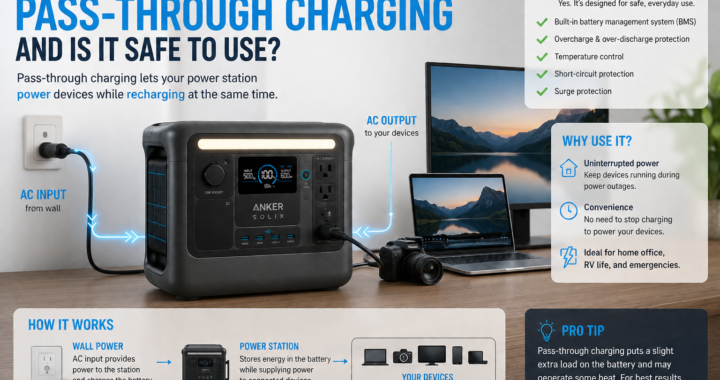
Many models support pass-through charging, allowing simultaneous charging and CPAP operation.
Is a 1000Wh power station enough for CPAP and a refrigerator?
Possibly for a short period. However, runtime will be significantly reduced compared to powering only the CPAP.
Which 1000Wh power station is best for CPAP backup?
Popular choices include the Anker Solix C1000, EcoFlow Delta 3 Classic, and Jackery Explorer 1000 v2.
Final Verdict
Knowing how to power a CPAP with a 1000Wh power station can make a huge difference during outages, camping trips, and emergency situations. For most users, a 1000Wh battery provides multiple nights of reliable CPAP operation, especially when using a DC connection and disabling high-power heating features.
Before relying on any backup system, test your setup, verify compatibility, and calculate your actual power consumption. With proper preparation, a 1000Wh power station can provide dependable CPAP backup when you need it most.