
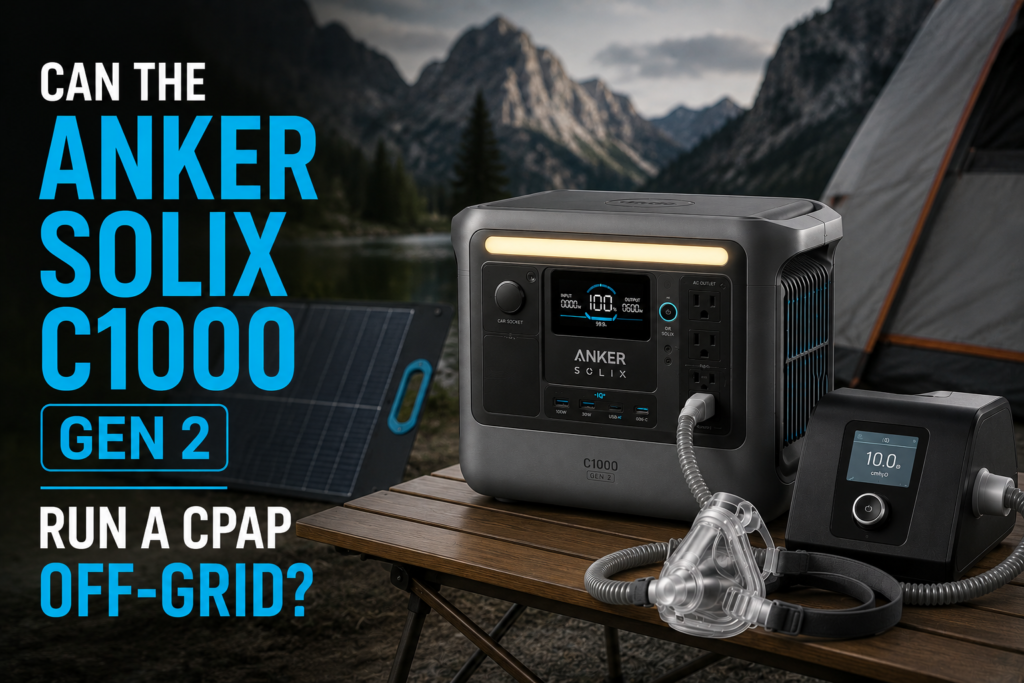
Can the Anker SOLIX C1000 Gen 2 CPAP off-grid setup keep your sleep therapy running every night without access to grid power? For many campers, RV owners, and emergency-preparedness enthusiasts, that question is critical. A CPAP machine is not optional. Therefore, reliable power becomes essential when traveling or living off-grid.
After reviewing real-world user experiences and long-term testing, the answer is encouraging. Many owners successfully power a CPAP every night while recharging the battery with solar panels during the day. In this guide, you’ll learn how long the battery lasts, how much solar power is needed, and whether the Anker SOLIX C1000 Gen 2 is a practical off-grid CPAP solution.
Quick Answer
Yes. The Anker SOLIX C1000 Gen 2 can run a CPAP every night off-grid when paired with a properly sized solar panel.
A typical CPAP session consumes around 15% to 17% of the battery capacity per night. Meanwhile, a 200W solar panel can often replace that energy in less than two hours of good sunlight.
As a result, many users report essentially unlimited CPAP operation during extended camping trips and off-grid stays.
Anker SOLIX C1000 Gen 2 CPAP Runtime
Real-world testing shows excellent performance for CPAP users.
One owner consistently recorded about 17% battery usage per night. Therefore, the battery still showed 83% remaining each morning.
Another user reported only 10% battery consumption when using a DC adapter instead of the AC inverter.
Several reviewers also reported:
- 3 to 4 days of CPAP operation on a single charge
- Multiple nights using a ResMed AirSense 10
- Weekend trips powering two CPAP machines with about 50% battery remaining
- Eight consecutive nights during a severe winter storm
Because CPAP machines typically draw relatively low power, the C1000 Gen 2 is well suited for overnight use.
How Solar Keeps the CPAP Running
The key advantage of the Anker SOLIX C1000 Gen 2 is fast solar recovery.
One user paired the unit with a 200W solar suitcase panel and observed approximately 154W of real-world solar input under clear skies.
Next, the system recovered an entire night’s CPAP usage in less than two hours.
This means:
- CPAP consumes about 15% to 17% overnight
- Solar replenishes that energy the next day
- Battery returns to full charge before bedtime
Therefore, daily solar charging can support continuous off-grid CPAP operation.
Why the Anker SOLIX C1000 Gen 2 Works Well for Off-Grid CPAP Use
Fast Charging
The battery can recharge from 83% to 100% in roughly 15 minutes from wall power.
Although solar charging is slower, recovery remains very fast for CPAP-sized loads.
Efficient Solar Input
The power station accepts up to 600W of solar input.
In addition, it supports pass-through charging while powering connected devices.
Reliable UPS Backup
The built-in UPS function switches in approximately 10 milliseconds.
As a result, CPAP therapy continues during unexpected outages.
Multiple Charging Options
Users can recharge through:
- Solar panels
- Vehicle charging
- AC wall power
- Portable generators
This flexibility is especially valuable for extended off-grid travel.
Common Problems and Solutions
Problem: App Connection Issues
A few users reported Bluetooth connection problems.
Solution: Update the firmware and reconnect the app.
Problem: Missing Carrying Case
Several owners wished Anker included a dedicated storage case.
Solution: Purchase a third-party carrying case for cables and adapters.
Problem: Heavy for Long Walks
The unit is portable but not ultralight.
Solution: Place it close to your sleeping area and use extension cords if needed.
Problem: Solar Adapter Not Included
Some users were surprised that certain solar accessories were sold separately.
Solution: Verify connector compatibility before purchasing solar panels.
Best Practices for Off-Grid CPAP Use
First, use a DC adapter whenever possible.
Next, reduce humidifier settings if maximum runtime is important.
In addition, keep the battery fully charged before leaving home.
Meanwhile, monitor solar input during the day to ensure adequate recovery.
Finally, update the firmware before any extended trip.
Pros and Cons
Pros
- Excellent CPAP runtime
- Fast solar recovery
- UPS protection
- Fast AC charging
- Multiple charging options
- Reliable off-grid performance
Cons
- Protective case sold separately
- Some app connectivity complaints
- Slightly heavy for long-distance carrying
- Solar accessories may require separate purchase
Frequently Asked Questions
Can the Anker SOLIX C1000 Gen 2 run a CPAP off-grid every night?
Yes. With adequate solar charging, many users successfully operate their CPAP every night indefinitely.
How much battery does a CPAP use on the Anker SOLIX C1000 Gen 2?
Most users report 10% to 17% battery consumption per night depending on settings.
Is a 200W solar panel enough for CPAP use?
For many users, yes. A 200W panel can often replace one night’s CPAP energy consumption in less than two hours of sunlight.
Does a humidifier reduce CPAP runtime?
Yes. Heated humidifiers consume additional energy and reduce battery life.
Is the Anker SOLIX C1000 Gen 2 CPAP setup good for camping?
Absolutely. Many owners specifically purchased the unit for camping and off-grid CPAP use.
Should I use AC or DC for CPAP power?
DC is generally more efficient because it avoids inverter conversion losses.
Final Verdict
The Anker SOLIX C1000 Gen 2 CPAP off-grid setup is one of the most practical solutions for users who need reliable sleep therapy away from the grid.
Real-world testing shows that a typical CPAP consumes only a small portion of the battery each night. Meanwhile, a modest solar setup can replace that energy quickly during the day.
Therefore, if your goal is continuous off-grid CPAP operation, the Anker SOLIX C1000 Gen 2 delivers impressive runtime, fast charging, and dependable performance.


