A decade ago, most campers were happy with a flashlight and a cooler. Today, many bring phones, laptops, drones, portable refrigerators, Starlink internet, CPAP machines, and camera gear. As camping becomes more connected, portable power stations have become essential equipment for many outdoor enthusiasts.
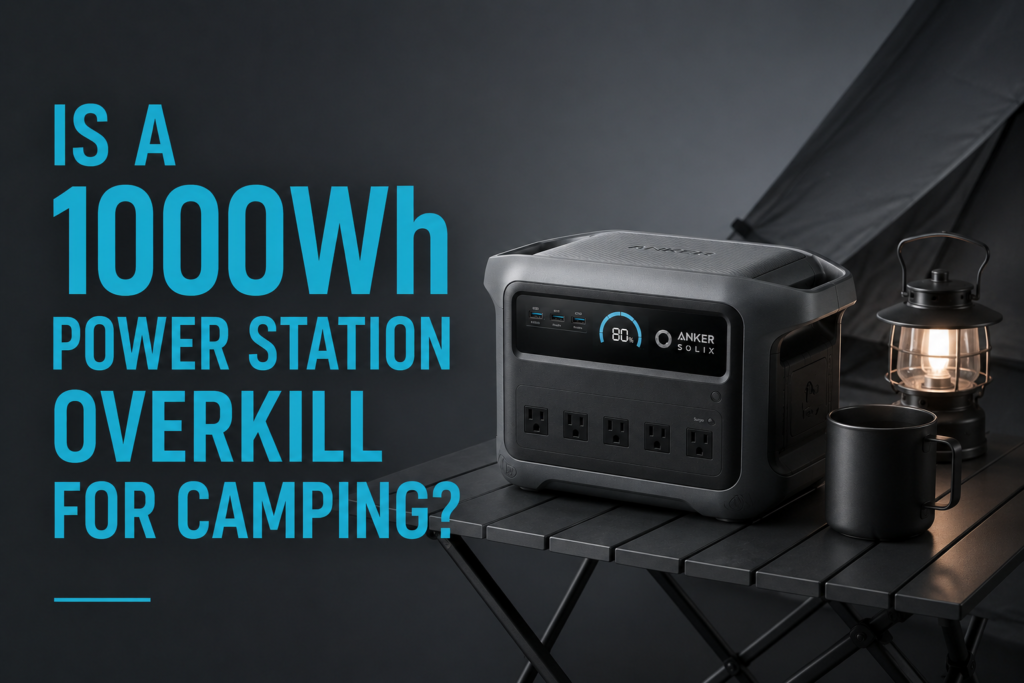
This raises a common question: Is a 1000Wh power station overkill for camping?
The answer depends on how you camp. For minimalist weekend campers, a 1000Wh battery may be more capacity than necessary. However, for RV travelers, overlanders, remote workers, CPAP users, and families, a 1000Wh power station often provides the ideal balance between portability and runtime.
In this guide, we’ll break down real-world camping power needs, compare common use cases, and help you decide whether a 1000Wh power station is the right size for your adventures.
Quick Answer
No, a 1000Wh power station is not overkill for most modern camping trips.
A 1000Wh battery is often ideal for:
- Weekend camping
- Family camping
- CPAP users
- Starlink users
- Portable refrigerators
- Drone charging
- Camera gear
- Laptop use
- Van life setups
However, it may be larger than necessary if you only need to charge phones and small electronics.
What Can a 1000Wh Power Station Run While Camping?
One reason 1000Wh power stations are so popular is their versatility.
Typical camping devices include:
- Smartphones
- Tablets
- Laptops
- LED lights
- Portable fans
- Drones
- Cameras
- Portable refrigerators
- Starlink Mini
- CPAP machines
For a complete appliance breakdown, see our guide on What Can a 1000Wh Power Station Run?
Why Campers Choose 1000Wh Power Stations
Enough Capacity for Multiple Days
A smaller 300Wh or 500Wh battery may work for basic charging.
However, many campers underestimate how much power they use.
A 1000Wh unit allows you to:
- Charge phones repeatedly
- Run lighting every night
- Power a refrigerator continuously
- Work remotely
- Operate medical equipment
As a result, many campers find that 1000Wh provides valuable flexibility.
Better for Unexpected Situations
Weather changes.
Trips get extended.
Additional devices appear.
A larger battery provides a safety margin that smaller power stations cannot offer.
Supports Higher-Power Devices
Many 1000Wh power stations deliver:
- 1500W–1800W continuous output
- Higher surge capacity
Therefore, they can operate appliances that smaller stations may struggle to handle.
When a 1000Wh Power Station Might Be Overkill
Although 1000Wh works well for many campers, it isn’t always necessary.
Minimalist Tent Camping
If your power needs include only:
- One smartphone
- A flashlight
- A power bank
A smaller battery may be sufficient.
For example:
- 250Wh–300Wh often handles weekend charging needs.
Weight Matters
One of the most common complaints about popular 1000Wh models is portability.
Units like the Anker Solix C1000, EcoFlow Delta 3 Classic, and Jackery Explorer 1000 v2 typically weigh around 25–30 pounds (11–14 kg).
Therefore, backpackers usually prefer smaller batteries.
Short Overnight Trips
For a single night of camping, carrying a 1000Wh power station may be unnecessary unless you’re powering high-demand equipment.
Real Camping Runtime Examples
Let’s look at practical camping scenarios.
Smartphone Charging
Typical phone battery:
- 15–20Wh
A 1000Wh power station can recharge most phones dozens of times.
Laptop Charging
Typical laptop:
- 50–80Wh
Expected charges:
- 10–15 full charges
Starlink Mini
Typical draw:
- 20–40W
Estimated runtime:
- 20–40 hours
This makes a 1000Wh power station attractive for remote work and off-grid internet access.
Portable Refrigerator
Typical draw:
- 30–60W average
Estimated runtime:
- 15–30 hours
For more details, see How Long Will a 1000Wh Power Station Run a Fridge?
CPAP Machine
Typical draw:
- 30–60W
Estimated runtime:
- 2–5 nights
Read our complete guide on How to Power a CPAP With a 1000Wh Power Station for optimization tips.
Best Camping Use Cases for a 1000Wh Power Station
Family Camping
Families often power:
- Multiple phones
- Tablets
- Lights
- Fans
- Refrigerators
A 1000Wh battery provides comfortable capacity for these situations.
Van Life
Van lifers frequently use:
- Laptops
- Starlink
- Cooking appliances
- Refrigerators
A 1000Wh power station serves as an excellent entry-level energy system.
Overlanding
Remote travel often requires reliable backup power.
A 1000Wh station can support communication devices, recovery equipment, and navigation systems.
CPAP Camping
Medical equipment users benefit from having multiple nights of backup power without needing recharging.
Comparing Popular 1000Wh Camping Power Stations
Anker Solix C1000
Strengths:
- Extremely fast charging
- Up to 600W solar input
- UPS functionality
- Strong camping performance
Potential drawbacks:
- Heavy for some campers
- Non-expandable battery
EcoFlow Delta 3 Classic
Strengths:
- Fast charging
- Quiet operation
- Excellent backup power
Potential drawbacks:
- No expansion battery support
Jackery Explorer 1000 v2
Strengths:
- Popular for camping and RV travel
- Easy operation
- Reliable performance
Potential drawbacks:
- Proprietary solar connectors
- Some accessories sold separately
How Solar Panels Change the Equation
Many campers pair a 1000Wh power station with solar panels.
Benefits include:
- Extended runtime
- Multi-day trips
- Reduced generator dependence
For example:
- A 200W solar panel can recover meaningful battery capacity during sunny conditions.
- Anker Solix C1000 supports up to 600W solar input.
- EcoFlow Delta 3 Classic supports up to 400W solar input.
As a result, a 1000Wh power station can support extended off-grid camping far beyond its initial charge.
Pros and Cons of a 1000Wh Power Station for Camping
Pros
- Excellent runtime
- Supports refrigerators
- Powers CPAP machines
- Handles remote work setups
- Fast charging
- Solar compatible
- Emergency backup at home
Cons
- Heavier than smaller batteries
- Higher purchase cost
- May be excessive for minimalist campers
- Takes up more vehicle space
Common Mistakes Campers Make
Buying Too Small
Many first-time buyers underestimate actual power usage.
Ignoring Solar Charging
Even a modest solar panel can dramatically increase trip duration.
Not Testing Devices Before the Trip
Always test:
- CPAP machines
- Refrigerators
- Starlink systems
- Drone chargers
before heading off-grid.
Focusing Only on Battery Capacity
Output wattage matters too.
Some appliances require high startup power even if overall energy consumption is low.
Frequently Asked Questions
Is a 1000Wh power station overkill for camping?
Not for most campers. It provides excellent flexibility and can power essential devices for multiple days.
How many days can a 1000Wh power station last while camping?
Depending on usage, it can last anywhere from one day with heavy loads to several days with light electronics.
Can a 1000Wh power station run a camping fridge?
Yes. Most portable refrigerators can run for 15–30 hours or more depending on efficiency and weather conditions.
Is 1000Wh enough for a weekend camping trip?
Absolutely. For most campers, 1000Wh easily covers a weekend of charging, lighting, refrigeration, and electronics.
Can a 1000Wh power station power a CPAP while camping?
Yes. Many users achieve multiple nights of operation from a single charge.
Should I buy a 500Wh or 1000Wh power station for camping?
Choose 500Wh for basic charging needs. Choose 1000Wh if you plan to power refrigerators, CPAP machines, Starlink, or laptops.
Final Verdict
So, is a 1000Wh power station overkill for camping?
For minimalist campers, perhaps. However, for modern campers who rely on electronics, refrigeration, remote work tools, or medical devices, a 1000Wh power station is often the sweet spot between portability and capability.
Models such as the Anker Solix C1000, EcoFlow Delta 3 Classic, and Jackery Explorer 1000 v2 provide enough capacity to comfortably power essential camping gear for several days while remaining portable enough for vehicle-based adventures.
If you’re unsure whether 1000Wh is the right size, start by calculating your actual power needs. Most campers discover that having extra capacity is far better than running out of power miles away from the nearest outlet.