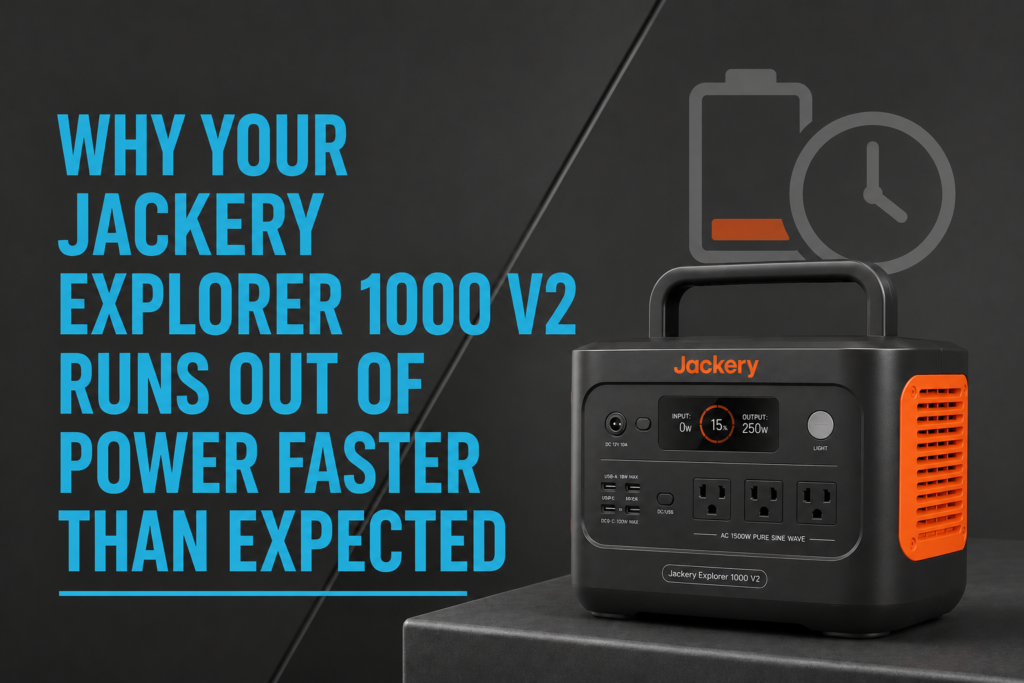
You bought the Jackery Explorer 1000 V2 expecting its advertised 1,070Wh battery to keep your appliances running for hours. But after powering a fridge, CPAP machine, or portable heater, the battery seems to drain much faster than expected. If you’re wondering why your Jackery Explorer 1000 V2 runs out of power faster than expected, you’re not alone. Several customer reviews mention disappointment that the real-world runtime didn’t match their expectations, especially when using higher-power appliances.
The good news is that this usually doesn’t mean your power station is defective. Instead, it’s the result of normal energy losses that affect every portable power station. In this guide, we’ll explain why the usable battery capacity is lower than the advertised rating, how to estimate real runtime accurately, and when upgrading to a larger model makes sense.
Quick Answer
The Jackery Explorer 1000 V2 is rated at 1,070Wh, but you won’t be able to use all of that energy. After accounting for inverter efficiency, battery management, and system overhead, the usable capacity is typically around 850–950Wh, depending on the type of appliance you’re powering.
If you frequently run high-wattage devices or need longer runtime, upgrading to the Jackery Explorer 2000 V2 or adding a second Explorer 1000 V2 is often the best solution.
Why Doesn’t 1,070Wh Mean 1,070Wh of Usable Power?
This is one of the biggest misunderstandings about portable power stations.
The battery stores approximately 1,070Wh, but not all of that energy reaches your appliances.
Some power is consumed by:
- The pure sine wave inverter
- Battery Management System (BMS)
- Internal cooling fans
- Voltage conversion
- Electronics inside the power station
These losses are completely normal and occur with virtually every portable power station on the market.
Understanding Inverter Losses
Whenever you plug an AC appliance into the Explorer 1000 V2, the stored DC battery power must be converted into household AC electricity.
That conversion isn’t 100% efficient.
Typical inverter efficiency ranges from 85% to 92%, meaning part of the stored energy is lost as heat.
For example:
- Advertised battery: 1,070Wh
- 90% inverter efficiency
- Usable energy: approximately 960Wh
Actual results vary depending on the connected appliance and operating conditions.
High-Power Appliances Drain the Battery Faster
Many buyers are surprised that devices like:
- Electric coolers
- Coffee makers
- Space heaters
- Hair dryers
- Air fryers
can drain the battery much faster than expected.
This isn’t because the battery is failing—it’s because these appliances consume hundreds or even thousands of watts every hour.
If you’re unsure how much power your devices require, check out our guide What Can a 1000Wh Power Station Run?
Startup Surges Also Reduce Runtime
Some appliances briefly draw much more power during startup than they do while running.
Common examples include:
- Refrigerators
- Freezers
- Power tools
- Portable air conditioners
Although these surge loads only last a few seconds, they still consume additional energy and can reduce overall runtime.
If you’re planning to power a refrigerator, our article How long will a 1000Wh power station run a fridge? explains realistic expectations.
Temperature Can Affect Battery Performance
Battery performance also changes with temperature.
Cold weather can temporarily reduce available battery capacity, while excessive heat may trigger protective systems that limit performance.
For the best results:
- Store the power station indoors.
- Avoid charging or discharging in extreme temperatures.
- Keep ventilation openings unobstructed.
Jackery recommends operating its portable power stations within the specified temperature ranges found in the official user documentation.
How to Get Longer Runtime
Fortunately, there are several ways to maximize battery life.
Use DC or USB Outputs When Possible
Using USB-C or DC outputs avoids inverter losses associated with AC power.
Avoid High-Wattage Appliances
Devices under 100 watts generally provide much longer runtimes than heating appliances.
Charge While Using
If you’re outdoors, combining solar charging with battery power can extend runtime. If you’ve had trouble with solar input, see Jackery Explorer 1000 V2 Not Charging From Solar? Panel Compatibility Fix.
Plan Your Energy Usage
Estimate your devices’ wattage before heading off-grid so you know approximately how long the battery will last.
When Should You Upgrade?
If you regularly run:
- Refrigerators
- CPAP machines overnight
- Portable heaters
- Multiple appliances simultaneously
you may simply need more battery capacity.
The Jackery Explorer 2000 V2 offers roughly twice the storage capacity of the Explorer 1000 V2, helping offset real-world energy losses while significantly extending runtime.
Ideal for:
- Extended camping trips
- RV travel
- Home backup
- Emergency preparedness
- Full-day off-grid use
Jackery Explorer 1000 V2
If your energy needs fit within its capabilities, the Jackery Explorer 1000 V2 remains an excellent portable power station thanks to its fast charging, LiFePO₄ battery, and compact design. However, if you already own an Explorer 1000 V2 and only need more runtime, purchasing a second Explorer 1000 V2 can be a practical alternative to upgrading to a larger unit.
Using two Explorer 1000 V2 power stations gives you:
- Double the available battery capacity
- More flexibility when powering multiple devices
- The ability to keep one unit charging while using the other
- Easier portability compared with carrying a much larger power station
For users who value portability and modular backup power, adding a second Explorer 1000 V2 can be a better solution than replacing your existing unit.
Common Mistakes to Avoid
Avoid these common misconceptions:
- Assuming the full 1,070Wh is usable.
- Ignoring inverter efficiency losses.
- Running high-power heating appliances continuously.
- Expecting identical runtime for AC and USB devices.
- Overlooking appliance startup surges.
- Forgetting that ambient temperature affects battery performance.
Frequently Asked Questions
Why does my Jackery Explorer 1000 V2 run out of power so quickly?
The most common reason is that the advertised battery capacity includes energy that’s lost through inverter conversion and system overhead, leaving less usable energy for your devices.
How much usable capacity does the Jackery Explorer 1000 V2 actually have?
In real-world use, most users can expect approximately 850–950Wh of usable energy, depending on the appliance and output type.
Is my Explorer 1000 V2 defective if it doesn’t deliver 1,070Wh?
No. This is normal behavior for portable power stations and doesn’t necessarily indicate a battery problem.
Should I buy a larger power station?
If you frequently power high-wattage appliances or need all-day backup, the Jackery Explorer 2000 V2 is a better choice.
Can solar charging extend runtime?
Yes. Recharging while using the power station can significantly increase available energy. If you’re having compatibility issues, read Jackery Explorer 1000 V2 Not Charging From Solar? Panel Compatibility Fix.
Is the Explorer 1000 V2 still worth buying?
Absolutely. As long as you understand real-world battery capacity, it’s an excellent choice for camping, emergency backup, and portable power.
Final Verdict
If your Jackery Explorer 1000 V2 runs out of power faster than expected, it’s usually the result of normal inverter losses, battery management overhead, and the power demands of your appliances—not a faulty battery. Understanding that the real-world usable capacity is lower than the advertised 1,070Wh helps set realistic expectations and plan your energy usage more effectively. If your typical needs exceed what the Explorer 1000 V2 can provide, upgrading to the Jackery Explorer 2000 V2 or adding a second Explorer 1000 V2 is the most practical way to achieve longer runtimes and greater peace of mind.