You’ve packed everything for your camping trip or you’re preparing for an extended power outage. You plug your portable power station into your car’s 12V outlet, expecting it to recharge quickly during the drive. Hours later, the battery percentage has barely moved.
If you’ve experienced slow car charging, you’re not alone. Most vehicle accessory outlets provide very limited power, making them one of the slowest ways to recharge a portable power station. The good news is that there are much faster alternatives.
In this guide, you’ll learn why car charging is slow, what charging speeds you should realistically expect, and the fastest ways to recharge your power station whether you’re camping, traveling, or preparing for emergencies.
Quick Answer: Why Is Car Charging So Slow?
The standard 12V cigarette lighter socket in most vehicles delivers relatively low power.
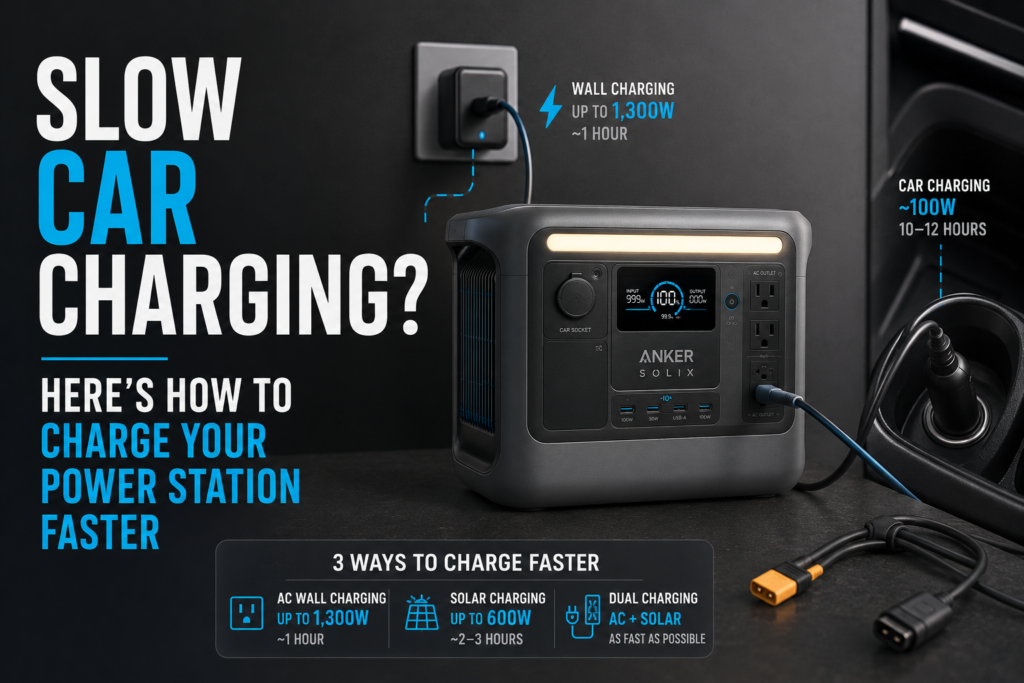
Most portable power stations receive only 80–120 watts through this connection. As a result, charging a 1000Wh battery from nearly empty can easily take 8–12 hours or longer, depending on the model.
Meanwhile:
| Charging Method | Typical Speed |
|---|---|
| Vehicle 12V outlet | Slow |
| AC wall outlet | Very Fast |
| Solar panels | Moderate to Fast |
| Generator | Very Fast |
If speed matters, vehicle charging should be considered a backup option rather than your primary charging method.
Why Your Car Charges So Slowly
Several factors limit charging speed.
Limited Output from the Vehicle
Most cigarette lighter outlets are protected by a 10A or 15A fuse.
That limits how much power your power station can safely draw.
Even if your portable power station supports extremely fast charging, your vehicle simply cannot supply enough power.
Battery Protection
Manufacturers intentionally limit vehicle charging.
Drawing too much power could drain your starter battery, leaving you unable to start the engine.
Therefore, charging rates are intentionally conservative.
Cable and Connector Limitations
Long cables, poor-quality adapters, or loose connections can reduce charging efficiency even further.
Some users have reported charging cables loosening while driving, causing intermittent charging.
Real-World Example: Anker SOLIX C1000 Gen 2
Customer testing provides a good illustration.
When charging through a standard vehicle outlet:
- Recovering about 17% battery capacity takes nearly two hours
- AC charging restores that same amount in roughly 15 minutes
- A full recharge from low battery can take around 49 minutes using wall power
That’s an enormous difference.
If you’re considering this model, check out our Anker SOLIX C1000 Gen 2 Review: Is It Worth Buying in 2026? for a complete breakdown.
The Fastest Ways to Charge a Power Station
1. Use AC Wall Charging
This is almost always the fastest option.
Modern LiFePO4 power stations often support charging speeds between 600W and 1800W, depending on the model.
For example, the Anker SOLIX C1000 Gen 2 can recharge dramatically faster from a household outlet than from a vehicle.
Best for:
- Home
- Hotels
- RV parks
- Campgrounds
- Public buildings
2. Use Solar Panels
If you’re camping for several days, solar becomes one of the best long-term solutions.
However, your charging speed depends on:
- Panel wattage
- Sun angle
- Weather
- Temperature
- Controller limits
For example, users pairing a 200W solar panel with the Anker SOLIX recovered approximately 17% battery capacity in under two hours under clear skies.
3. Recharge at Public Locations
Many travelers simply stop at:
- Libraries
- Coffee shops
- Campground utility stations
- RV hookups
Even a short stop can restore more energy than several hours of driving.
4. Use a Small Generator
For long blackouts or remote camping, many experienced users pair a portable generator with a power station.
The generator runs briefly while the power station rapidly recharges.
Afterward, the generator can be turned off while the battery powers your equipment quietly.
Can You Make Car Charging Faster?
Sometimes—but only within the limits of your vehicle.
You can improve performance by:
- Keeping the engine running while charging
- Using the manufacturer’s original charging cable
- Ensuring tight cable connections
- Avoiding damaged adapters
- Charging while driving instead of idling
However, you cannot bypass the vehicle’s built-in power limits safely.
Common Mistakes That Slow Charging
Using Undersized Solar Panels
A small panel may only generate enough power to offset part of your daily usage.
Choose panels that match your power station’s maximum solar input whenever practical.
Charging Through the Wrong Port
Some users accidentally connect accessories to lower-power inputs.
Always verify you’re using the recommended charging input.
Ignoring Firmware Updates
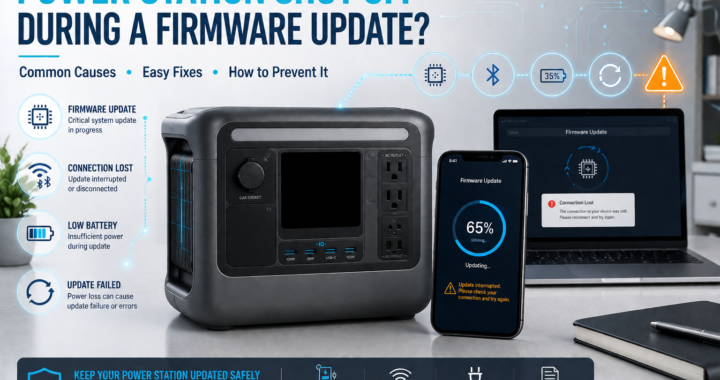
Several users reported charging-related bugs that were resolved after updating firmware.
Always check for firmware updates before assuming a hardware problem.
Expecting Vehicle Charging to Replace AC Charging
Vehicle charging works best for maintaining battery levels during travel—not rapidly refilling a large battery.
When Car Charging Makes Sense
Although slow, vehicle charging is still useful for:
- Road trips
- Emergency backup
- Daily top-offs
- Keeping a battery maintained while traveling
- Supplementing solar charging
It’s simply not ideal if you need a full recharge quickly.
Which Charging Method Is Best?
| Situation | Best Choice |
|---|---|
| Home | AC wall outlet |
| Camping (multi-day) | Solar panels |
| Road trip | Vehicle charging |
| Emergency outage | Generator + AC charging |
| RV campground | Shore power |
Related Guides
If you’re comparing portable power stations for medical backup, read Anker SOLIX C1000 Gen 2 vs Jackery Explorer 1000 V2 for CPAP Backup.
Planning your next camping setup? You may also like Is a 1000Wh Power Station Overkill for Camping?
Frequently Asked Questions
Why is my power station charging so slowly from my car?
Most vehicles only provide around 80–120W through the 12V outlet, which is much lower than what modern portable power stations can accept through AC charging.
Can I charge my power station faster while driving?
Only slightly. Using the proper cable and keeping the engine running helps, but the vehicle’s electrical system remains the limiting factor.
Is slow car charging normal?
Yes. It’s expected for nearly all portable power stations.
Is AC charging safe for portable power stations?
Yes. Using the manufacturer’s recommended charger is both safe and significantly faster than vehicle charging.
Can solar charge faster than a car?
Yes. A properly sized solar array can outperform vehicle charging under good sunlight conditions.
Should I use car charging during camping?
Yes, but think of it as supplemental charging rather than your primary charging source.
Final Verdict
If you’re frustrated by slow car charging, the issue is usually your vehicle—not your power station. Standard 12V outlets simply don’t deliver enough power to recharge large batteries quickly.
For the fastest results, use AC wall charging whenever possible, followed by properly sized solar panels or a small generator during extended off-grid use. Vehicle charging remains useful for topping off your battery during travel, but it shouldn’t be your primary charging strategy if time matters.
Choosing the right charging method can dramatically reduce downtime and ensure your portable power station is ready when you need it most.