
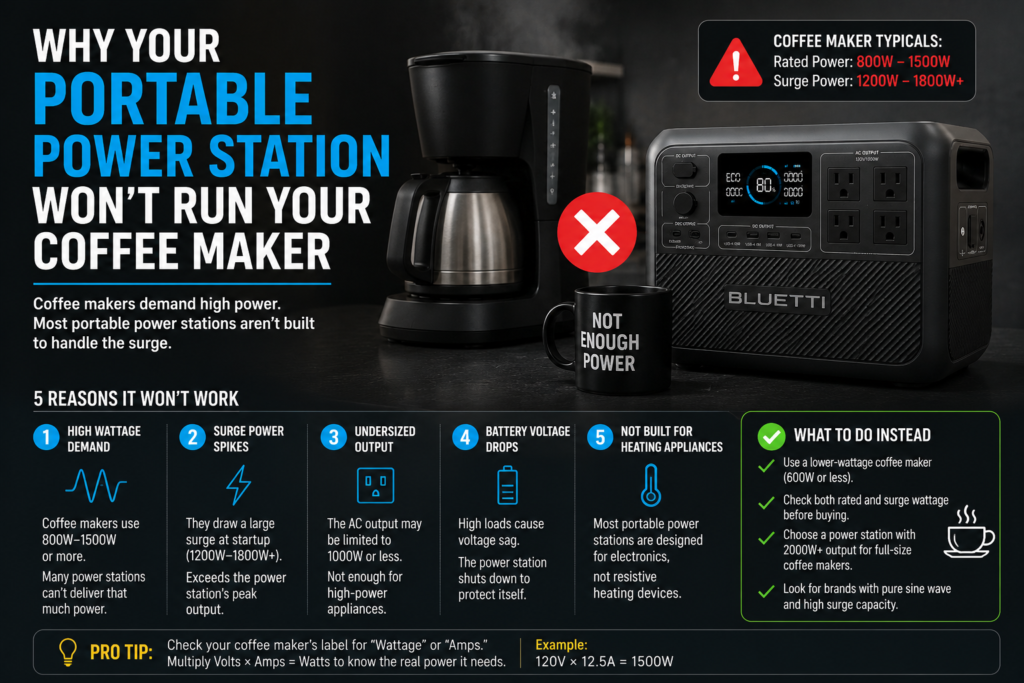
You finally bought a portable power station, plugged in your coffee maker, pressed the power button—and nothing happened. If you’re wondering why your portable power station won’t run your coffee maker, you’re not alone. Thousands of campers, RV owners, and emergency preparedness enthusiasts run into this exact problem.
The good news is that your power station may not actually be defective. In most cases, the issue comes down to startup wattage, inverter limits, battery capacity, or the type of coffee maker you’re using. In this guide, you’ll learn why this happens, how to troubleshoot it, and what to look for before buying a power station for kitchen appliances.
Quick Answer: Why Your Portable Power Station Won’t Run Your Coffee Maker
Most coffee makers require 800–1,800 watts while brewing. Some also have a very high startup surge.
Your portable power station may not run your coffee maker because:
- The coffee maker exceeds the inverter’s continuous output.
- Startup surge is too high.
- The inverter automatically shuts down for protection.
- The battery voltage drops under heavy load.
- The power station simply isn’t designed for high-wattage heating appliances.
As a result, the unit may beep, shut off, display an overload warning, or refuse to start the appliance.
Why Your Portable Power Station Won’t Run Your Coffee Maker
Heating appliances are among the hardest devices for portable batteries to power.
Unlike laptops or TVs that use relatively little electricity, coffee makers convert electricity directly into heat. That process demands a large amount of power in a short time.
For example:
| Coffee Maker Type | Typical Power Draw |
|---|---|
| Single-serve brewer | 900–1,500W |
| Drip coffee maker | 700–1,200W |
| Espresso machine | 1,200–1,800W |
| Percolator | 600–1,000W |
Even if your battery has plenty of energy remaining, the inverter must be capable of supplying that power instantly.
Common Reasons Your Portable Power Station Won’t Run Your Coffee Maker
The Coffee Maker Needs More Power Than the Inverter Can Supply
This is the most common reason.
For example, some users reported that a portable power station could not operate certain coffee machines despite having over 50% battery remaining. High-power heating elements pushed the inverter beyond its continuous output limit, triggering overload protection.
Always compare:
- Coffee maker wattage
- Continuous inverter rating
- Surge rating (if applicable)
Startup Surge Is Too High
Some appliances briefly draw significantly more power when first switched on.
If your coffee maker starts at 1,700W but your inverter only supports 1,300W continuously, the protection system may immediately shut the unit down.
Battery Capacity Isn’t the Same as Output Power
Many buyers confuse battery capacity (Wh) with inverter output (W).
For example:
- 1024Wh tells you how long the battery can run.
- 1800W tells you what appliances it can power.
A large battery cannot compensate for an undersized inverter.
The Battery Is Nearly Empty
Lithium batteries deliver less usable voltage as they become depleted.
Consequently, a coffee maker that worked at 90% battery may trigger overload warnings at 10–15% remaining charge.
Keeping the battery well charged improves reliability with high-power appliances.
Can the Anker SOLIX C1000 Gen 2 Run a Coffee Maker?
In many situations, yes—but not every coffee maker.
Real-world customer testing showed:
- Microwaves successfully operated for short periods.
- High-power pizza ovens ran but drained roughly 50% of capacity in about 20 minutes.
- Some coffee machines exceeded the available inverter output and would not operate.
Therefore, compatibility depends more on the coffee maker’s actual wattage than the battery size.
If you’re considering this model, read Anker SOLIX C1000 Gen 2 Review: Is It Worth Buying in 2026? for a complete breakdown of real-world performance.
How to Check if Your Coffee Maker Will Work
Follow these steps before purchasing a power station.
Step 1: Find the Appliance Wattage
Look at:
- Bottom label
- Owner’s manual
- Manufacturer specifications
Step 2: Compare With Continuous Output
Choose a power station whose continuous AC output comfortably exceeds the appliance requirement.
Leaving some headroom improves reliability.
Step 3: Estimate Runtime
Runtime depends on battery size.
A simplified estimate:
Usable battery capacity ÷ Coffee maker watts = Approximate runtime
Because inverter losses occur, expect usable capacity to be around 80–90% of the advertised battery capacity.
Best Practices for Running Coffee Makers
To maximize success:
- Fully charge the power station first.
- Avoid powering several high-wattage appliances simultaneously.
- Disable unnecessary AC loads.
- Use short, heavy-duty extension cords if needed.
- Verify the coffee maker’s actual wattage before purchase.
Meanwhile, if vehicle charging feels painfully slow before your trip, see Slow Car Charging? Here’s How to Charge Your Power Station Faster for practical ways to reduce recharge times.
Mistakes to Avoid
Many buyers assume:
❌ Bigger battery = powers every appliance
Actually, inverter output matters just as much.
Avoid these mistakes:
- Ignoring startup surge
- Running multiple heating appliances together
- Buying based only on battery capacity
- Assuming every “1000W” power station behaves the same
Is a 1000Wh Power Station Enough?
For camping, emergency backup, and general electronics, absolutely.
However, if your main goal is operating multiple heating appliances, a larger inverter becomes more important than simply adding battery capacity.
If you’re debating battery size for outdoor trips, check Is a 1000Wh Power Station Overkill for Camping? for a detailed comparison.
Frequently Asked Questions
Why won’t my portable power station run my coffee maker?
Usually because the coffee maker requires more power than the inverter can continuously deliver or its startup surge exceeds the inverter’s limits.
Can a 1000Wh portable power station run a coffee maker?
Yes, if its inverter output is high enough and the coffee maker stays within that limit.
Does battery percentage affect coffee maker performance?
Yes. Lower battery levels can reduce the ability to sustain heavy electrical loads.
Why does my power station shut off immediately?
Most likely, overload protection activated because the appliance demanded more power than the inverter supports.
Are espresso machines harder to run than drip coffee makers?
Generally yes. Espresso machines often consume between 1,200W and 1,800W.
Should I buy a larger battery or a larger inverter?
If your goal is running heating appliances like coffee makers, prioritize a higher continuous inverter rating.
Final Verdict
If you’re asking why your portable power station won’t run your coffee maker, the answer usually isn’t a defective battery. Instead, it’s a mismatch between the appliance’s power requirements and the power station’s inverter capabilities.
Before buying, compare the coffee maker’s wattage with the inverter’s continuous output, allow for startup surge, and estimate realistic runtime using usable battery capacity. Taking a few minutes to verify compatibility can save frustration whether you’re camping, traveling in an RV, or preparing for a power outage.


