
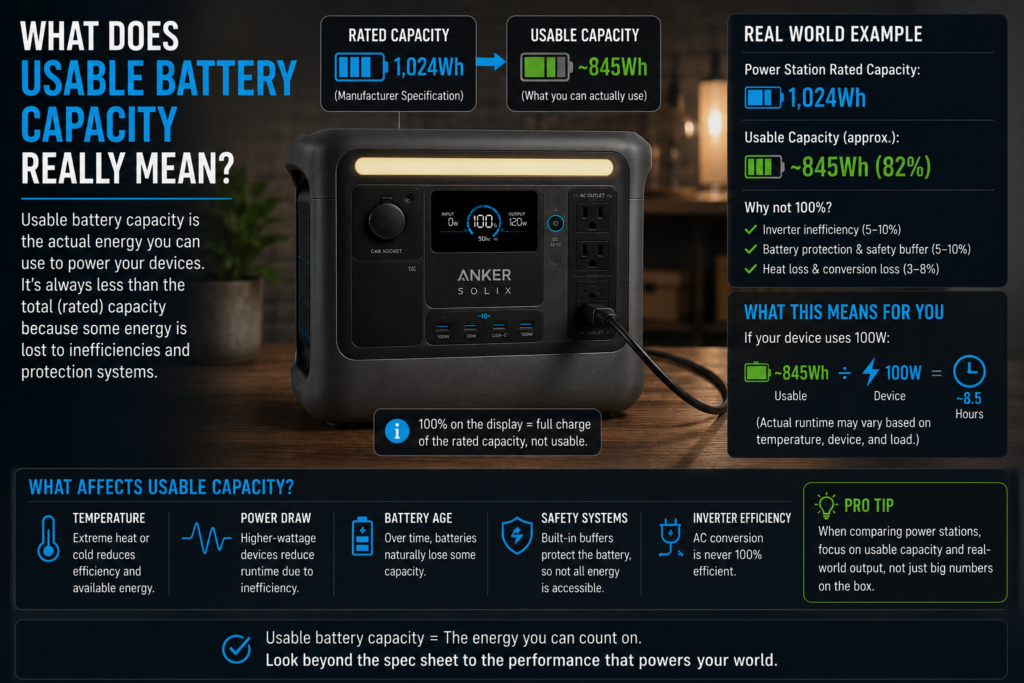
Have you ever wondered why a 1000Wh portable power station rarely delivers a full 1000Wh of usable energy? If you’ve checked the runtime of your devices and noticed they shut down sooner than expected, you’re not alone. Usable battery capacity is one of the most misunderstood specifications when buying a portable power station, yet it has one of the biggest impacts on real-world performance.
Understanding this number helps you estimate how long your refrigerator, CPAP machine, Starlink, laptop, or camping equipment will actually run. It also prevents unrealistic expectations and makes comparing different power stations much easier. In this guide, you’ll learn what usable battery capacity really means, why manufacturers advertise larger numbers, what causes energy loss, and how to calculate realistic runtimes before you buy.
Quick Answer
Usable battery capacity is the actual amount of electricity a portable power station can deliver to your devices after accounting for inverter losses, battery management protections, voltage conversion, and safety reserves.
For example, a power station advertised as 1024Wh usually provides around 800–900Wh of usable AC energy under typical conditions—not the full 1024Wh.
The exact amount depends on:
- Battery chemistry
- Inverter efficiency
- Device power draw
- Ambient temperature
- Output type (AC vs. DC)
- Battery management system (BMS)
What Does Usable Battery Capacity Really Mean?
Battery capacity is measured in watt-hours (Wh). This tells you how much energy the battery stores under ideal laboratory conditions.
However, stored energy is not the same as usable energy.
Before electricity reaches your appliance, several processes consume a small percentage of the battery’s stored power. Every portable power station has built-in electronics that manage charging, battery protection, voltage conversion, and inverter operation. These components improve safety and reliability but also reduce the amount of energy available to your devices.
Think of it like a fuel tank in a car. The tank may hold 50 liters, but you can’t use every last drop because the vehicle reserves some fuel to protect the engine. Portable power stations work in a similar way.
Why Usable Battery Capacity Matters
Knowing the usable capacity helps you answer practical questions, such as:
- Will my refrigerator survive a power outage?
- Can my CPAP machine last all night?
- How long will Starlink operate while camping?
- Will my laptop make it through an entire workday?
- Can this unit power my router during an internet outage?
If you only compare advertised battery capacity, you may overestimate runtime by 10% to 25% depending on the model.
For anyone relying on backup power during emergencies, remote work, or camping trips, this difference can be significant.
How Manufacturers Calculate Battery Capacity
Manufacturers advertise the total chemical energy stored inside the battery cells.
That number is accurate—but it isn’t the same as the electricity your appliance receives.
Between the battery cells and your device, power passes through several components:
- Battery Management System (BMS)
- DC voltage regulation
- Inverter (for AC appliances)
- Cooling electronics
- Internal circuitry
- Output ports
Each stage introduces small efficiency losses.
Typical efficiency ranges are:
| Component | Typical Efficiency |
|---|---|
| Battery discharge | 97–99% |
| Battery Management System | 98–99% |
| DC Output | 95–99% |
| Pure Sine Wave Inverter | 85–93% |
When combined, these losses explain why a portable power station seldom delivers its full advertised capacity through its AC outlets.
Why You Never Get the Full Advertised Capacity
Several factors reduce usable battery capacity in everyday use.
Inverter Losses
AC appliances require the battery’s DC power to be converted into AC electricity. This conversion always wastes some energy as heat.
For most quality power stations, inverter efficiency falls between 85% and 93%.
If your battery stores 1000Wh and the inverter operates at 90% efficiency, only about 900Wh reaches your appliance.
Battery Protection Reserve
Manufacturers intentionally prevent the battery from charging to an absolute 100% or discharging to a true 0%.
This protected reserve extends battery lifespan and helps prevent permanent damage to lithium cells.
Although invisible to users, it slightly reduces usable energy.
Internal Electronics
Even when powering devices, the display, cooling fans, control board, and monitoring systems consume electricity.
The larger and more powerful the station, the more noticeable this background power usage becomes.
Temperature
Cold weather temporarily reduces lithium battery performance.
Hot environments can also decrease efficiency because cooling fans operate more frequently, consuming additional power.
High-Power Appliances
Large resistive appliances—including space heaters, coffee makers, hair dryers, and microwaves—draw substantial current.
Higher current increases inverter losses and battery heating, reducing the percentage of usable energy compared with smaller electronics.
Real-World Examples of Usable Battery Capacity
The difference between advertised capacity and usable capacity becomes much clearer when you look at how people actually use portable power stations.
Based on the customer experiences and technical information you provided, several usage patterns stand out.
CPAP Machine
One of the most common uses for a portable power station is overnight CPAP backup during a power outage.
In real-world use, one customer reported that a CPAP machine consumed about 17% of the battery overnight, leaving roughly 83% remaining by morning. This demonstrates why low-power medical devices often achieve runtimes close to manufacturer estimates.
If CPAP backup is your primary goal, choosing a power station based on usable battery capacity rather than advertised watt-hours gives you a much more realistic expectation.
For a detailed comparison, read our guide on Anker SOLIX C1000 Gen 2 Review: Is It Worth Buying in 2026?
Home Refrigerator
Refrigerators don’t run continuously. Instead, the compressor cycles on and off throughout the day.
According to shared customer experiences:
- Average power draw: 60–80W
- Approximately 50% battery usage over seven hours
Because the compressor rests between cooling cycles, refrigerators often last much longer than people expect.
Starlink Mini
Starlink is becoming increasingly popular among RV owners, campers, and remote workers.
One customer reported:
- Battery dropped from 85% to 50% in roughly three hours
However, this shouldn’t be treated as the expected runtime for every user. Factors such as firmware version, cable selection, ambient temperature, and connected accessories can all affect power consumption.
The takeaway is simple: always estimate runtime using your own equipment instead of relying on a single review.
Laptop for Remote Work
Modern laptops are surprisingly efficient.
A high-performance development laptop drawing approximately 60W can operate for many hours on a 1000Wh-class power station.
For remote workers, photographers, and digital nomads, inverter losses become much less noticeable than when powering high-wattage household appliances.
Space Heater
High-power heating devices quickly reveal the difference between advertised and usable capacity.
One customer reported that a 1500W electric heater used about 50% of the battery in only 30 minutes.
Although this may seem disappointing, it’s exactly what physics predicts.
Heating appliances convert nearly all electricity into heat, making them some of the fastest ways to drain any battery.
Estimated Usable Capacity by Advertised Battery Size
The following table shows typical real-world AC output assuming inverter efficiencies between 85% and 90%.
| Advertised Capacity | Typical Usable Capacity | Typical AC Output |
|---|---|---|
| 300Wh | 250–270Wh | Small electronics |
| 500Wh | 420–450Wh | Laptops, routers |
| 768Wh | 650–700Wh | CPAP, TV, lighting |
| 1000Wh | 850–900Wh | Refrigerator, Starlink, computers |
| 1500Wh | 1275–1350Wh | Larger appliances |
| 2000Wh | 1700–1800Wh | Extended home backup |
These values are estimates. Actual results depend on inverter efficiency, battery chemistry, operating temperature, and load characteristics.
How to Calculate Real Runtime
Instead of relying on marketing claims, use this simple formula:
Runtime (hours) = Usable Battery Capacity ÷ Device Power Draw
Example 1
Power Station:
- Advertised capacity: 1024Wh
- Estimated usable capacity: 870Wh
Laptop:
- Power consumption: 60W
Runtime:
870 ÷ 60 = approximately 14.5 hours
Example 2
Portable Refrigerator
Usable capacity:
870Wh
Average refrigerator draw:
70W
Runtime:
870 ÷ 70 = approximately 12.4 hours
Since refrigerators cycle on and off, actual runtime may be considerably longer.
Example 3
Space Heater
Usable capacity:
870Wh
Power draw:
1500W
Runtime:
870 ÷ 1500 = approximately 35 minutes
This closely matches customer reports showing that high-wattage heaters can consume half the battery in around 30 minutes.
Common Myths About Usable Battery Capacity
Myth #1: A 1000Wh Battery Delivers 1000Wh
False.
Every portable power station loses some energy through voltage conversion, inverter operation, and battery protection systems.
Myth #2: Every Brand Has the Same Efficiency
False.
Premium models often use more efficient inverters and battery management systems, allowing them to deliver more usable energy from the same advertised capacity.
Myth #3: DC Outputs Always Deliver More Runtime
Mostly true.
Because DC devices don’t require DC-to-AC conversion, they usually avoid inverter losses and can achieve higher overall efficiency.
Myth #4: Battery Capacity Is the Only Number That Matters
False.
Also consider:
- Inverter efficiency
- Battery chemistry
- Solar charging capability
- Continuous output rating
- Peak output
- UPS functionality
- Expandability
- Warranty
- Manufacturer support
A slightly smaller battery with higher efficiency can outperform a larger battery with a less efficient inverter.
Buying Tips
Before purchasing a portable power station, don’t focus solely on the advertised watt-hour rating.
Instead, compare:
- Real-world usable battery capacity
- Inverter efficiency
- Continuous output power
- Battery chemistry (LiFePO₄ vs. NMC)
- Charging speed
- Warranty length
- Customer reliability reports
- Independent runtime testing
If runtime is your biggest concern, you’ll also find practical advice in Portable Power Station Battery Drains Too Fast? 9 Ways to Make It Last Longer, including ways to maximize every watt-hour during camping trips and emergency outages.
Why Usable Battery Capacity Is Lower Than the Advertised Capacity
This is where many buyers get confused. A portable power station labeled 1024Wh does not mean you’ll always receive 1,024Wh of usable energy.
Instead, several unavoidable factors reduce the amount of electricity that actually reaches your devices.
1. Inverter Conversion Losses
Most household appliances use AC power, while the battery inside a portable power station stores DC power.
To run an AC appliance, the inverter converts DC into AC. That conversion isn’t perfect.
Typical inverter efficiency ranges between 85% and 95%, depending on:
- Load size
- Inverter quality
- Temperature
- Battery voltage
For example:
- Battery capacity: 1024Wh
- Inverter efficiency: 90%
Usable energy:
1024 × 0.90 = 922Wh
You’ve already lost around 102Wh before accounting for anything else.
2. Battery Protection Systems
Manufacturers intentionally prevent batteries from charging or discharging completely.
Instead of allowing:
- 100% → 0%
the battery management system (BMS) may actually use something closer to:
- 95% → 5%
This protects lithium batteries from:
- Premature aging
- Voltage damage
- Reduced cycle life
- Safety risks
Although you lose a small amount of available energy, the battery lasts much longer over its lifetime.
3. Standby Power Consumption
Even when your devices use very little electricity, the power station itself still consumes power to operate:
- Cooling fans
- Battery management electronics
- LCD display
- Wi-Fi or Bluetooth
- Internal monitoring circuits
These background loads slightly reduce usable battery capacity, especially during long runtimes with low-power devices.
4. High-Power Appliances Are Less Efficient
Running demanding appliances increases inverter losses.
For example:
- Electric heaters
- Microwaves
- Coffee makers
- Hair dryers
These appliances often draw 1,000–2,000W, causing:
- Higher heat generation
- Increased inverter losses
- Faster battery depletion
In real-world testing, users reported that a 1,500W space heater consumed roughly 50% of a 1024Wh battery in only about 30 minutes, illustrating how quickly high-wattage loads reduce available runtime.
5. Temperature Affects Capacity
Lithium batteries perform best around room temperature.
Cold weather can temporarily reduce usable battery capacity because chemical reactions inside the cells slow down.
Very hot conditions may also cause the system to limit output to protect the battery.
Therefore, if you’re camping in winter or storing your power station in a hot vehicle, expect shorter runtimes than the official specifications suggest.
Real-World Example: 1024Wh Doesn’t Mean 1024Wh of Runtime
Let’s look at a practical example.
Imagine you buy a 1024Wh portable power station.
Here’s how the available energy can change:
| Factor | Remaining Energy |
|---|---|
| Advertised battery capacity | 1024Wh |
| 90% inverter efficiency | ~922Wh |
| Battery reserve and protection | ~890Wh |
| System electronics and standby use | ~870Wh |
| Real-world usable capacity | 850–900Wh (typical) |
This explains why runtime calculators based only on the advertised capacity often overestimate how long your devices will run.
Some manufacturers even state that users should expect around 80% of the advertised capacity under real operating conditions once inverter losses and battery protection are considered.
Frequently Asked Questions
What does usable battery capacity really mean?
Usable battery capacity is the amount of energy a portable power station can actually deliver to your devices after accounting for inverter losses, battery protection systems, and normal operating overhead. It is always lower than the advertised battery capacity.
Why is usable battery capacity lower than the advertised capacity?
Manufacturers rate battery capacity based on the energy stored in the battery cells. However, some energy is lost when converting DC power to AC power, while a small reserve is kept to protect the battery and extend its lifespan.
Is 80% usable battery capacity normal?
Yes. Many portable power stations provide 80% to 90% of their advertised capacity under real-world conditions, depending on inverter efficiency, load type, and operating temperature. This is considered normal across the industry.
Does usable battery capacity affect runtime?
Absolutely. Runtime depends on usable battery capacity, not the advertised battery size. Using the usable capacity in your calculations provides much more accurate estimates of how long your appliances will run.
Does UPS mode reduce usable battery capacity?
Not directly. UPS mode itself doesn’t reduce battery capacity. However, when operating as an uninterruptible power supply, the unit continuously powers internal electronics and monitoring systems, which may have a very small impact on overall efficiency. For a deeper explanation, read What Does UPS Mode Mean on a Portable Power Station?
Does pass-through charging affect usable battery capacity?
Pass-through charging doesn’t change the battery’s usable capacity. Instead, it allows the power station to supply power to connected devices while simultaneously recharging the battery. In many models, AC input can even bypass the battery during normal operation, reducing unnecessary battery cycling. Learn more in What Is Pass-Through Charging on a Portable Power Station?
How can I maximize usable battery capacity?
You can improve real-world runtime by:
- Using USB-C or DC outputs when available.
- Avoiding unnecessary high-power appliances.
- Keeping the battery within moderate temperatures.
- Updating firmware regularly.
- Turning off unused outputs to reduce standby power consumption.
Final Verdict
Usable battery capacity is the number that truly matters when estimating how long a portable power station will power your devices. While a battery may be advertised as 1024Wh, real-world usable energy is typically closer to 850–900Wh, depending on inverter efficiency, battery protection, temperature, and the type of load you’re running.
Understanding this difference helps you make better buying decisions, compare models more accurately, and set realistic expectations for runtime. It also explains why two power stations with the same advertised capacity can deliver noticeably different real-world performance.
Before purchasing your next portable power station, look beyond the headline watt-hour rating. Consider inverter efficiency, battery management, UPS capabilities, and pass-through charging features, as these factors often have a greater impact on everyday usability than the advertised capacity alone.


