Nothing ruins a warm summer camping trip faster than a hot, stuffy tent. That’s why camping fans have become one of the most popular comfort upgrades for tent campers, RV travelers, van lifers, and overlanders. However, before buying a battery or portable power station, many campers ask the same question: What size power station do you need for a camping fan?
The good news is that most camping fans use surprisingly little electricity. In many cases, even a small power station can run a fan for an entire weekend. However, fan size, speed settings, runtime goals, and whether you’re powering other devices all affect the battery capacity you’ll need.
In this guide, we’ll calculate real-world runtimes, compare common battery sizes, and help you choose the right power station for your next camping adventure.
Quick Answer
For most campers:
- 200Wh–300Wh = One to two nights of fan use
- 500Wh = Multiple nights plus phone charging
- 1000Wh = Fan, lights, laptops, CPAP machines, and refrigerators
- 2000Wh+ = Extended off-grid camping and multiple devices
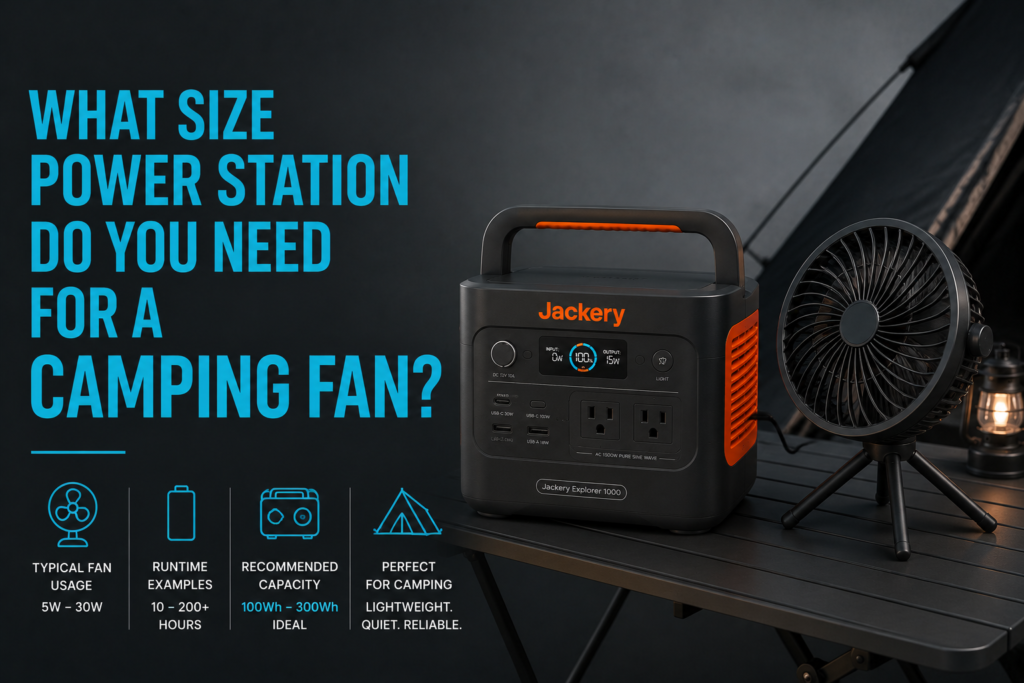
Most camping fans consume only 5–50 watts, meaning a relatively small power station can provide long runtimes.
How Much Power Does a Camping Fan Use?
Before choosing a battery, determine your fan’s actual wattage.
Typical camping fan power consumption:
| Fan Type | Power Draw |
|---|---|
| Small USB Fan | 3–10W |
| Rechargeable Camping Fan | 5–15W |
| Medium Tent Fan | 15–30W |
| Large High-Speed Fan | 30–50W |
| Box Fan | 40–75W |
Because wattage varies significantly, checking the fan label is always recommended.
How to Calculate Camping Fan Runtime
A simple formula can estimate runtime:
Runtime (hours) = Battery Capacity (Wh) ÷ Fan Wattage
For example:
300Wh Power Station
20W fan:
300 ÷ 20 = 15 hours
Real-world runtime:
Approximately 12–14 hours after efficiency losses.
500Wh Power Station
20W fan:
500 ÷ 20 = 25 hours
Real-world runtime:
20–23 hours.
1000Wh Power Station
20W fan:
1000 ÷ 20 = 50 hours
Real-world runtime:
40–45 hours.
As a result, even a modest power station can keep a tent comfortable for several nights.
What Size Power Station Is Best for a Camping Fan?
200Wh–300Wh: Best for Basic Camping
Ideal for:
- Weekend camping
- Solo campers
- Phone charging
- Small USB fans
Pros:
- Lightweight
- Affordable
- Easy to carry
Cons:
- Limited for other devices
500Wh: Best Overall Value
For many campers, 500Wh is the sweet spot.
Supports:
- Camping fan
- Phones
- Tablets
- Lights
- Small electronics
Meanwhile, it remains portable enough for most camping trips.
1000Wh: Best for Multi-Device Camping
A 1000Wh power station may seem large for a fan alone.
However, it becomes useful when powering:
- CPAP machines
- Portable refrigerators
- Starlink Mini
- Laptops
- Drone chargers
- Multiple fans
For a detailed breakdown, see What Can a 1000Wh Power Station Run?
2000Wh+: Best for Extended Off-Grid Trips
Larger batteries are useful when:
- Camping for a week or more
- Running multiple appliances
- Supporting family camping setups
Learn more in What Can a 2000Wh Power Station Run? Real Uses.
Is a 1000Wh Power Station Overkill for a Camping Fan?
If the fan is your only device, yes.
A 20W fan may run for roughly 40–45 hours on a 1000Wh power station.
However, many campers also power:
- Refrigerators
- Lights
- Phones
- Laptops
- CPAP machines
- Starlink systems
Therefore, a 1000Wh power station often makes sense for modern camping setups.
For a deeper analysis, read Is a 1000Wh Power Station Overkill for Camping?
Real Camping Fan Runtime Examples
Small USB Fan (5W)
| Battery Size | Estimated Runtime |
|---|---|
| 200Wh | 30–35 Hours |
| 500Wh | 80–90 Hours |
| 1000Wh | 160–180 Hours |
Medium Camping Fan (20W)
| Battery Size | Estimated Runtime |
|---|---|
| 200Wh | 8–9 Hours |
| 500Wh | 20–23 Hours |
| 1000Wh | 40–45 Hours |
High-Speed Tent Fan (40W)
| Battery Size | Estimated Runtime |
|---|---|
| 200Wh | 4–5 Hours |
| 500Wh | 10–12 Hours |
| 1000Wh | 20–22 Hours |
Best Practices for Maximizing Fan Runtime
First, Use Lower Speed Settings
Many fans consume significantly less power at lower speeds.
Next, Use DC or USB Power
DC-powered devices avoid inverter losses.
As a result, runtime increases.
Charge During the Day
Solar panels can replenish battery capacity while camping.
Turn Off Unused Outputs
Many power stations consume energy when AC outputs remain enabled.
Monitor Power Consumption
Most modern power stations display real-time wattage, making runtime estimates more accurate.
Common Mistakes to Avoid
Buying Too Much Battery
Many campers only need enough capacity for a fan and phone charging.
Ignoring Actual Fan Wattage
Never assume power consumption.
Check specifications before purchasing.
Forgetting About Other Devices
A fan may use little energy, but refrigerators, laptops, and CPAP machines consume significantly more.
Not Considering Solar Charging
Even a small solar panel can extend camping runtime substantially.
Frequently Asked Questions
What size power station do you need for a camping fan?
Most campers only need 200Wh–500Wh for fan operation and basic electronics.
Can a 200Wh power station run a camping fan all night?
Yes. Most camping fans can run 8–12 hours or longer on a 200Wh battery.
Is a 1000Wh power station too much for a camping fan?
For fan-only use, usually yes. However, it becomes useful when powering multiple camping devices.
How long will a 500Wh power station run a camping fan?
Depending on fan wattage, roughly 10–90 hours.
Can solar panels recharge a camping fan power station?
Yes. Solar charging is popular for extended camping and off-grid travel.
What is the best battery size for weekend camping?
A 300Wh–500Wh power station is often ideal for fans, lights, phones, and tablets.
Final Verdict
So, what size power station do you need for a camping fan?
For most campers, a 200Wh to 500Wh power station is more than enough. These battery sizes can power a camping fan throughout the night while still providing energy for phones, lights, and small electronics.
A 1000Wh power station is usually unnecessary if you’re only running a fan. However, it becomes an excellent choice when adding refrigerators, CPAP machines, laptops, Starlink systems, and other camping essentials.
The best approach is simple: calculate your fan’s actual wattage, estimate your nightly runtime needs, and choose a battery that provides enough reserve capacity for unexpected situations.