
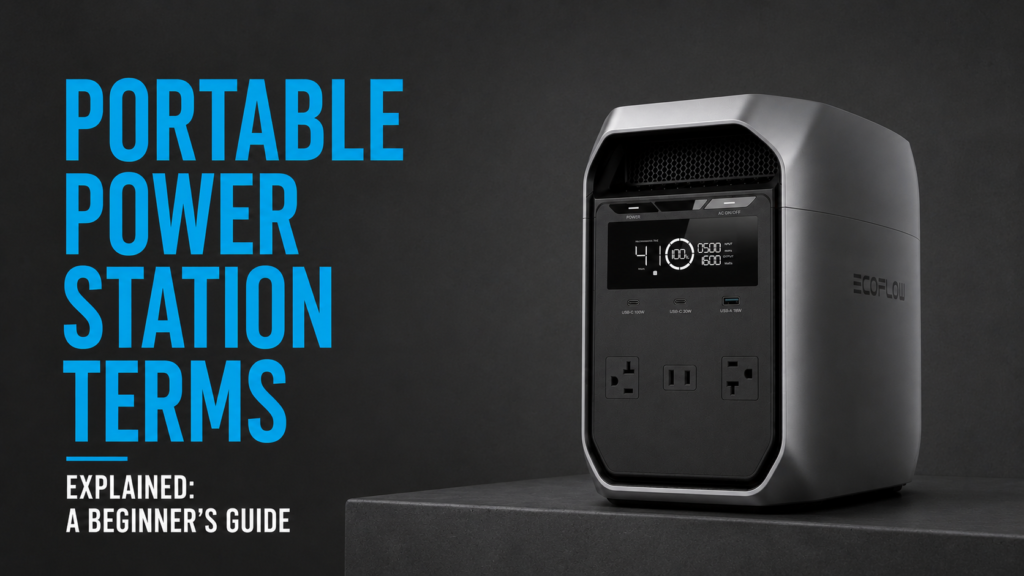
Shopping for a portable power station can feel overwhelming when every product page is filled with technical jargon. Terms like Wh, surge power, LiFePO4, MPPT, pure sine wave inverter, and UPS often appear in specifications, yet many first-time buyers aren’t sure what they actually mean. Understanding these portable power station terms is essential because they determine how long your battery lasts, what appliances it can safely run, and how quickly it recharges.
Whether you’re buying backup power for your home, preparing for emergencies, camping off-grid, or comparing different models, learning the language behind these specifications will help you make smarter decisions. In this guide, we’ll explain the most important portable power station terms in plain English, so you can confidently compare products without getting lost in technical details.
Quick Answer
A portable power station stores electricity in a rechargeable battery and delivers power through AC outlets, USB ports, and DC outputs. The specifications listed on each model describe its battery capacity, power output, charging speed, safety features, and compatibility with appliances and solar panels.
Understanding these terms allows you to:
- Compare different models accurately
- Estimate appliance runtime
- Avoid buying a power station that’s too small—or larger than you actually need
- Choose compatible solar panels and accessories
- Understand manufacturer specifications with confidence
If you’re still deciding which model fits your needs, our Ultimate EcoFlow DELTA 3 Classic Buying Guide provides a detailed overview of one of today’s most popular portable power stations.
Essential Portable Power Station Terms Explained
Watt (W)
A watt measures how much electricity an appliance uses or how much power a portable power station can deliver at any given moment.
For example:
- Phone charger: 20W
- Laptop: 60W
- Refrigerator: 80–200W
- Coffee maker: 1,000W
- Hair dryer: 1,500W
If your appliance requires more watts than your power station can continuously supply, it simply won’t operate correctly.
Think of watts as the speed at which electricity is being used.
Watt-Hour (Wh)
One of the most important portable power station terms is watt-hour (Wh).
This measures the battery’s energy storage capacity.
For example:
- 500Wh battery stores about 500 watts for one hour
- 1,000Wh battery stores roughly twice as much energy
- 2,000Wh battery lasts significantly longer under similar loads
A larger Wh rating generally means longer runtime.
However, actual runtime also depends on inverter efficiency, battery reserve settings, and the appliance’s power consumption.
If you want to learn how these calculations work in real-world situations, see our guide on Understanding Portable Power Station Runtime.
Continuous Power
Continuous power refers to the maximum amount of electricity a power station can safely provide for an extended period.
For example:
- 1,800W continuous output means the unit can consistently run appliances drawing up to 1,800 watts.
Common appliances within this range include:
- Refrigerators
- TVs
- CPAP machines
- Fans
- Computers
- Coffee makers
Always compare your appliance’s running wattage—not just its startup requirements—to the power station’s continuous output.
Surge Power
Many appliances require extra electricity when they first start.
This temporary spike is called surge power or starting watts.
Examples include:
- Refrigerators
- Air compressors
- Power tools
- Pumps
- Microwaves
A power station rated at:
- 1,800W continuous
- 3,600W surge
can briefly supply up to 3,600 watts during startup before returning to its continuous rating.
This is why checking surge capacity is just as important as checking continuous power.
LiFePO4 Battery
Most premium portable power stations now use Lithium Iron Phosphate (LiFePO4) batteries.
Compared with older lithium-ion chemistries, LiFePO4 offers several advantages:
- Longer lifespan
- Better thermal stability
- Improved safety
- Higher cycle life
- Better long-term value
Many modern LiFePO4 batteries are rated for 3,000 to 6,000 charge cycles before their capacity declines to around 80%.
Although they tend to weigh slightly more, they generally last much longer, making them ideal for emergency backup, RV travel, and daily use.
Inverter
The battery inside a portable power station stores DC (direct current) electricity.
However, most household appliances require AC (alternating current) power.
The inverter converts DC electricity into usable AC power.
A higher-quality inverter typically delivers:
- Cleaner electricity
- Better efficiency
- Lower heat generation
- Improved reliability
- Stable voltage for sensitive electronics
This component largely determines which household appliances your portable power station can safely operate.
Pure Sine Wave Inverter
Not all AC power is created equal. A pure sine wave inverter produces electricity that closely matches the power supplied by your home’s electrical outlets.
This is important because many sensitive electronics rely on clean, stable power, including:
- Desktop computers
- Laptops
- Medical equipment
- CPAP machines
- Televisions
- Gaming consoles
- Audio equipment
Fortunately, nearly all modern premium portable power stations—including the EcoFlow DELTA 3 Classic—use pure sine wave inverters.
Battery Cycle Life
Every rechargeable battery slowly loses capacity over time. Battery cycle life tells you approximately how many complete charge-and-discharge cycles a battery can deliver before its capacity drops to a specified level, usually 80% of its original capacity.
For example:
- 500 cycles = older lithium battery
- 2,000 cycles = good quality battery
- 3,000–6,000 cycles = modern LiFePO4 battery
A higher cycle life generally means better long-term value, especially if you plan to use your portable power station frequently rather than only during emergencies.
State of Charge (SOC)
State of Charge (SOC) simply shows how much battery energy remains.
It’s displayed as a percentage:
- 100% = fully charged
- 50% = half charged
- 10% = nearly empty
Many portable power stations also allow you to reserve a minimum SOC using their companion app. This feature helps ensure backup power is available during unexpected outages instead of completely draining the battery.
Depth of Discharge (DoD)
Depth of Discharge (DoD) measures how much of the battery’s capacity has been used.
Examples:
- Battery discharged from 100% to 80% = 20% DoD
- Battery discharged from 100% to 10% = 90% DoD
Modern LiFePO4 batteries are designed to handle deep discharge much better than older battery chemistries. Even so, avoiding unnecessary full discharges can help maximize battery longevity.
MPPT Charge Controller
One of the most valuable features for solar charging is an MPPT (Maximum Power Point Tracking) charge controller.
Its job is to maximize the amount of power collected from solar panels by constantly adjusting to changing sunlight conditions.
Compared with older PWM controllers, MPPT systems typically provide:
- Faster solar charging
- Better efficiency
- Improved performance on cloudy days
- More energy harvested throughout the day
If you plan to rely on solar power during camping or emergencies, an MPPT controller is an essential feature.
Solar Input
Every portable power station has a maximum solar input rating.
For example:
- 400W solar input
- 500W solar input
- 800W solar input
This rating tells you the maximum amount of solar power the unit can accept.
Connecting larger solar panels won’t necessarily charge the battery faster if the power station has already reached its input limit. Always check both the maximum wattage and the maximum input voltage listed by the manufacturer before purchasing solar panels.
AC Output vs. DC Output
Portable power stations usually include both AC and DC outputs.
AC Output
Used for household appliances such as:
- Refrigerators
- TVs
- Microwaves
- Coffee makers
- Power tools
DC Output
Used for lower-voltage devices, including:
- Car refrigerators
- LED lights
- Routers
- Portable fans
- 12V accessories
Many units also include USB-A and USB-C ports, allowing you to charge phones, tablets, cameras, and laptops without using the inverter. This is often more energy efficient.
UPS (Uninterruptible Power Supply)
Some premium portable power stations can function as a UPS, automatically supplying battery power when the grid fails.
Models with transfer times under 10 milliseconds can help keep devices like:
- Desktop computers
- Internet routers
- NAS systems
- Medical equipment
- Home office equipment
running with little or no interruption during a blackout.
This feature has become one of the most appreciated capabilities among homeowners, remote workers, and families preparing for severe weather or unexpected outages.
Common Beginner Mistakes
Understanding these terms can help you avoid several common buying mistakes.
Many first-time buyers:
- Focus only on battery capacity while ignoring output power.
- Assume higher watts always mean longer runtime.
- Forget to check surge power for appliances with electric motors.
- Buy solar panels that exceed the power station’s voltage limits.
- Confuse battery capacity (Wh) with output power (W).
- Ignore cycle life when comparing long-term value.
- Overestimate how long a battery will run high-power appliances.
Taking a few minutes to understand the specifications before buying can save money and prevent disappointment later.
Frequently Asked Questions
What are the most important portable power station terms to understand?
The most important terms are watt (W), watt-hour (Wh), continuous power, surge power, LiFePO4 battery, pure sine wave inverter, MPPT, cycle life, and UPS. Together, these specifications determine how much energy a power station stores, what appliances it can run, and how efficiently it charges.
What is the difference between watts and watt-hours?
Watts (W) measure power output or power consumption at a given moment, while watt-hours (Wh) measure how much energy the battery can store. In simple terms, watts tell you what it can run, and watt-hours tell you how long it can run it.
Why is a LiFePO4 battery better?
LiFePO4 batteries typically last much longer than traditional lithium-ion batteries. They also offer improved safety, better thermal stability, and often provide 3,000 to 6,000 charge cycles, making them an excellent choice for emergency backup, RV travel, and everyday use.
What does surge power mean?
Surge power is the temporary burst of electricity needed when certain appliances start. Devices such as refrigerators, pumps, compressors, and power tools may briefly require much more power than their normal running wattage. A power station must support this surge to start these appliances successfully.
Do all portable power stations have a pure sine wave inverter?
No. While most modern mid-range and premium models include a pure sine wave inverter, some entry-level units use modified sine wave output. If you plan to power sensitive electronics, medical devices, or modern appliances, choosing a pure sine wave model is strongly recommended.
What is MPPT, and why does it matter?
MPPT (Maximum Power Point Tracking) is a solar charging technology that maximizes the energy collected from solar panels. It improves charging efficiency, especially when sunlight changes throughout the day, helping your portable power station recharge faster.
Is a portable power station the same as a UPS?
Not always. Only models with fast automatic transfer capability can function as a UPS. If uninterrupted backup for computers, networking equipment, or medical devices is important, verify the manufacturer’s transfer time specification before purchasing.
Conclusion
Understanding portable power station terms doesn’t require an engineering degree. Once you know the difference between watts and watt-hours, understand continuous versus surge power, and recognize the value of LiFePO4 batteries, MPPT solar charging, and pure sine wave inverters, comparing different models becomes much easier.
Rather than focusing on a single specification, consider the complete picture: battery capacity, output power, charging speed, cycle life, safety features, and intended use. This approach will help you choose a power station that meets your needs today and continues to perform reliably for years to come.
If you’re ready to compare a real-world example, our Ultimate EcoFlow DELTA 3 Classic Buying Guide explains who this popular model is best suited for. And if you’re wondering how long a battery will actually power your devices, be sure to read Understanding Portable Power Station Runtime before making your final decision.
Authoritative Sources
- U.S. Department of Energy – Battery Storage Basics: https://www.energy.gov/
- National Renewable Energy Laboratory (NREL): https://www.nrel.gov/
- Battery University – Battery Fundamentals: https://batteryuniversity.com/
- EcoFlow Official Specifications & User Manuals: https://www.ecoflow.com/
- U.S. Environmental Protection Agency – Energy Information: https://www.epa.gov/energy


