
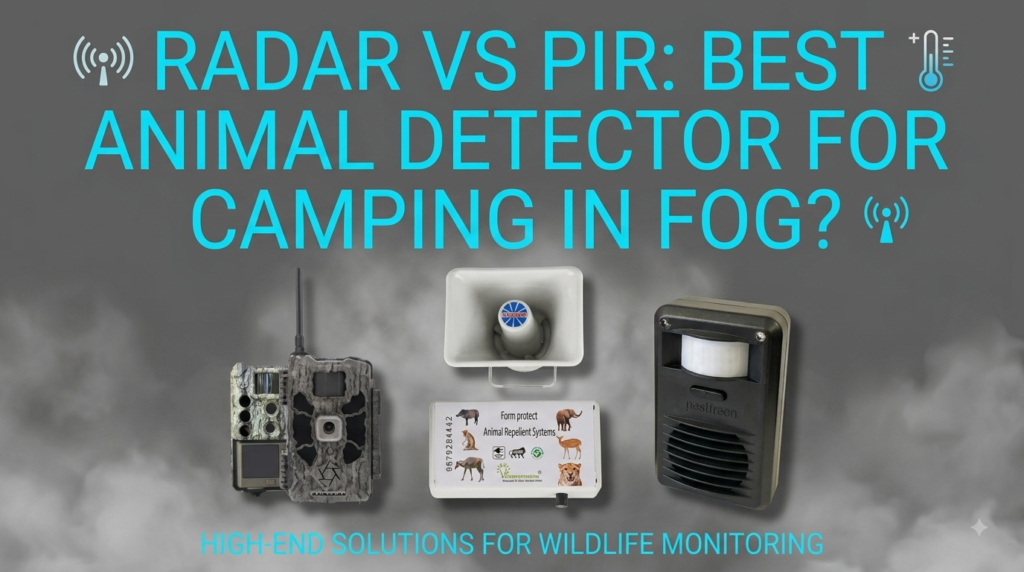
If you’re looking for the best animal detector for camping in fog, the problem is bigger than simply finding a sensitive motion sensor. Fog can make it difficult to see what’s happening around your campsite, especially at night when wildlife is most active. A camera may show very little, while a traditional sensor can behave differently depending on its technology and surroundings.
That creates an unusual security problem: how do you detect movement when you cannot clearly see the area you’re trying to monitor?
The LETWESAF portable radar perimeter alarm is particularly interesting here because customer testing specifically reported that it continued working during very foggy mornings near the ocean. Other reviewers also highlighted its radar detection and ability to operate without conventional line of sight.
For campers dealing with fog, darkness, and outdoor obstacles, that makes radar worth considering.
Quick Answer: What Is the Best Animal Detector for Camping in Fog?
If you regularly camp in foggy or low-visibility conditions, a radar-based perimeter detector is worth considering over relying exclusively on a camera.
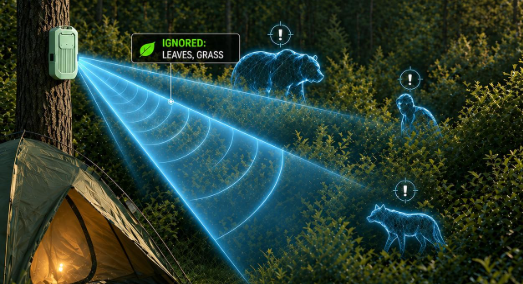
The LETWESAF radar perimeter alarm uses 24GHz millimeter-wave radar rather than depending on a visible image. The manufacturer says it is designed for outdoor movement detection and can operate through light obstacles. Customer reviews also specifically report successful operation in foggy conditions.
That makes it particularly interesting if your goal isn’t to identify an animal visually, but simply to know that something has entered your campsite perimeter.
Why Fog Makes Campsite Animal Detection More Difficult
Fog changes the environment in a way that is easy to underestimate.
During a clear night, you might be able to use a flashlight, camera, or other visual method to see what’s moving around your campsite. When dense fog settles in, that visibility can disappear quickly.
This matters because many campers aren’t trying to monitor a perfectly controlled environment.
You may have:
- Trees and bushes around the campsite
- Darkness
- Fog or mist
- Wildlife approaching from different directions
- Camping equipment blocking parts of your view
- No Wi-Fi or cellular connection
Now imagine waking up because you hear movement outside your tent or RV.
You look outside and see almost nothing.
The problem isn’t necessarily that your detector needs to tell you whether the animal is a raccoon, deer, or coyote. The first thing you need is an early warning that something is moving nearby.
That’s where non-visual detection becomes interesting.
What a Good Animal Detector Needs to Do in Fog
If you camp in areas where fog is common, look beyond the sensitivity specification.
A useful detector should ideally provide three things.
It shouldn’t depend entirely on visibility
A camera needs a usable scene to provide useful visual information.
Fog can reduce that information considerably.
Radar works differently because it detects movement using radio waves rather than relying on a visible picture.
It should work at night
Wildlife doesn’t stop moving because the sun goes down.
A radar-based system can continue monitoring when there is little or no visible light.
It should survive outdoor conditions
Fog often comes with moisture, drizzle, dew, and changing weather.
The LETWESAF detector is advertised as IP66-rated for outdoor use, which is appropriate for the type of environment where campers may deploy it.
How Radar Changes the Detection Problem
This is the part that makes the product especially relevant.
A conventional camera asks:
“Can I see what’s happening?”
A radar detector asks:
“Is something moving in the monitored area?”
Those are different questions.
For campsite security, the second question can sometimes be more important.
The LETWESAF system uses 24GHz millimeter-wave radar. According to the manufacturer, the radar can detect movement through light obstacles such as bushes and tents, while customer feedback describes useful detection even when conventional visibility is poor.
One reviewer specifically described camping near the ocean where mornings could become very foggy and said the system continued working well in those conditions.
That is a valuable real-world observation because fog isn’t something you can simply remove from the environment.
Instead, you need a detection technology that is less dependent on what your eyes can see.
What About Traditional PIR Motion Sensors?
PIR sensors are popular because they’re inexpensive and useful for many applications.
They detect changes in infrared radiation, generally associated with warm objects moving through their field of view.
But that doesn’t mean every PIR sensor is ideal for every outdoor campsite.
Your campsite may contain moving vegetation, changing temperatures, animals of different sizes, and other environmental variables.
More importantly, a PIR sensor and a radar detector are simply using different methods to identify movement.
Radar is attractive in this scenario because it doesn’t require you to see the animal.
That doesn’t make radar universally better.
Instead, the technology becomes particularly interesting when your environment includes fog, darkness, partial obstruction, or poor visibility.
What Using the LETWESAF in Fog Could Look Like

Imagine you’re camping near the coast.
During the afternoon, everything is clear. You position the radar detector toward the edge of your campsite and test its detection zone.
Later that night, fog rolls in.
By morning, visibility has dropped dramatically.
If you were depending entirely on a camera, you might have difficulty seeing much beyond the immediate area.
The radar detector, however, isn’t trying to give you a picture.
It is monitoring the configured zone for movement.
If an animal enters that area, the receiver can alert you.
This is the important distinction:
You don’t necessarily need to see the animal to know something is there.
That can be useful when the campsite is surrounded by vegetation or visibility changes rapidly.
Radar Without Conventional Line of Sight
Another interesting point from the customer feedback is the observation that the radar can operate without conventional line of sight.
Several reviewers described testing the system around objects and outdoor obstacles, while the manufacturer says its radar can detect movement through light non-metallic obstacles.
For camping, this can be practical.
Your detector doesn’t always have a perfect view of the entire perimeter.
There could be a tent, bush, chair, or other camping equipment between the detector and the area you’re monitoring.
However, “works through obstacles” should not be interpreted as “works through everything.”
Placement still matters.
Dense vegetation, moving branches, and poor positioning can affect performance. Several reviewers reported false triggers when the detector was placed near vegetation moving in wind.
Therefore, the best setup is still a deliberate one: choose a relatively clear detection zone and test it before relying on it overnight.
Is Radar Worth Using for Foggy Camping?
If you’re camping in areas where fog, darkness, or poor visibility are normal, this is where the LETWESAF system starts to make more sense.
Its main advantage isn’t simply that it is a camping alarm.
It’s that radar gives you another way to detect movement when visual monitoring becomes difficult.
The system also works offline, so you don’t have to depend on Wi-Fi to receive an alert. The manufacturer lists a rechargeable battery and outdoor-rated construction, making it designed for portable campsite use.
Who Should Consider a Radar Animal Detector for Fog?
This product is particularly interesting for:
- Campers in coastal areas with frequent fog
- Backpackers camping in low-visibility environments
- RV campers who want perimeter awareness
- People camping without reliable internet
- Families who want an early-warning layer around a tent
- Campers dealing with nighttime wildlife
However, it may be unnecessary if you mostly camp in developed campgrounds with good lighting and clear visibility.
A camera may also be preferable if your main goal is identifying exactly what triggered the alert.
Radar tells you that movement occurred. A camera can potentially show you what caused it.
Therefore, these technologies solve different problems.
Important Things to Check Before Buying
Test it in your actual environment
Don’t wait until the middle of the night to discover that your sensor is pointed toward a moving branch.
Set it up during daylight and walk through the detection zone yourself.
Watch vegetation
Wind-blown leaves and branches can cause unwanted triggers. Several reviewers specifically mentioned this limitation.
Consider your coverage area
The standard configuration includes one detector. The system can be expanded with additional sensors, which may be useful for larger campsites.
Decide whether you need identification or detection
If you want to know “something is moving over there,” radar is useful.
If you need to know “that is a raccoon,” a camera may be more useful.
For early warning in fog, however, radar has a particularly compelling advantage.
FAQs
What is the best animal detector for camping in fog?
A radar-based perimeter detector is worth considering because it can detect movement without relying on a visible image. The LETWESAF system uses 24GHz radar and is designed for outdoor movement detection.
How do I detect animals around a campsite in fog?
Use a movement detector that does not depend entirely on visible light. Radar can provide an early warning when an animal enters a defined detection area, even when fog makes visual observation difficult.
Does fog affect radar motion detection?
Radar generally operates differently from optical systems because it uses radio waves rather than relying on a visible image. A LETWESAF customer specifically reported successful operation during very foggy mornings near the ocean.
Is radar better than PIR for camping?
Neither technology is automatically better for every situation. PIR can work very well, but radar becomes particularly interesting for outdoor environments involving darkness, fog, and partial obstacles.
Can radar detect animals at night?
Yes. Radar does not require visible light in the way a conventional camera does. The LETWESAF system is designed for movement detection around outdoor environments.
Can the LETWESAF radar work without line of sight?
The manufacturer says its radar can detect through light non-metallic obstacles, and customer reviews report successful detection when objects partially obstruct the sensor. However, placement still matters.
Can fog cause false alarms?
Fog itself is not necessarily the same problem as movement from vegetation or other environmental factors. Reviewers reported that moving branches and plants can sometimes trigger the system, so careful positioning is important.
Final Verdict
If you’re searching for the best animal detector for camping in fog, the most important question isn’t simply how sensitive the device is.
It’s what technology does it use to detect movement?
When fog rolls into a campsite, a camera can lose much of its usefulness because you may no longer have a clear visual picture. Traditional sensors can also have limitations depending on their detection method and environment.
The LETWESAF radar perimeter alarm takes a different approach.
Its 24GHz radar detects movement rather than depending on a visible image. The product is designed for outdoor use, works without Wi-Fi, and customer feedback includes a particularly relevant real-world report of successful operation during very foggy mornings near the ocean.
That doesn’t make it a magic wildlife detector.
You still need to position it correctly. Moving vegetation can produce false triggers, one sensor may not cover a large campsite, and the system tells you that movement was detected rather than giving you a detailed visual identification.
But if your specific problem is detecting animals around a campsite when fog, darkness, or poor visibility makes visual monitoring difficult, radar is exactly the type of technology worth considering.
Instead of asking whether you can see through the fog, you can use a system designed to detect movement without depending on your eyes or a camera image.
For campers who regularly deal with foggy, dark, or partially obstructed environments, this is a strong reason to check the LETWESAF radar perimeter alarm.


