
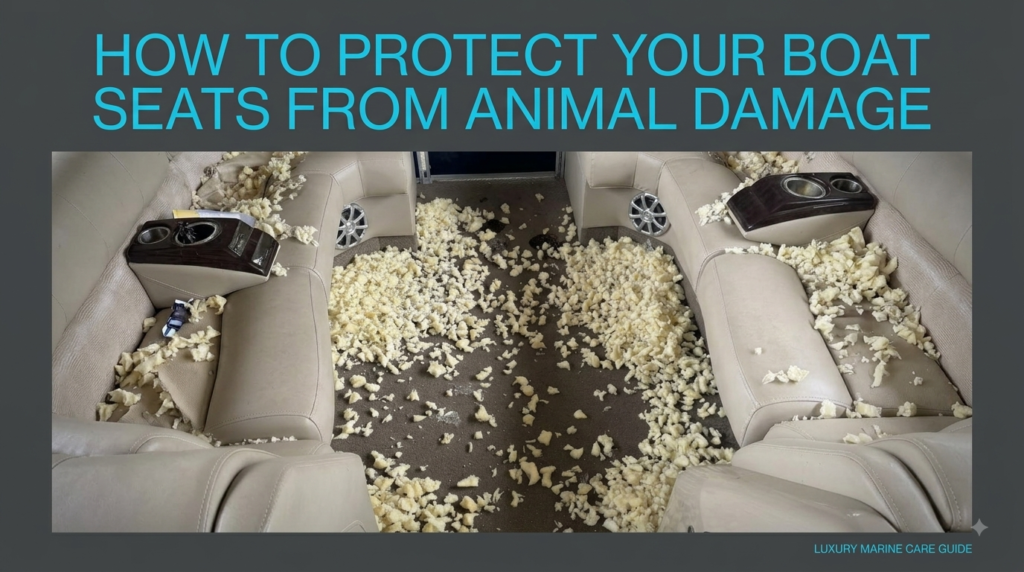
If you are trying to figure out how to keep animals from damaging boat seats, the frustrating part is that you may not know there is a problem until the damage is already done. A boat can sit quietly outside for days or weeks while squirrels, raccoons, mice, or other animals investigate the cover, climb aboard, and eventually damage upholstery.
And the cost can be surprisingly high. One boat owner reported that animals destroyed all the seats on a Bennington pontoon, requiring expensive upholstery recovery. That kind of experience changes the question from “How do I cover my boat?” to “How do I know when something is getting near it?”
A good boat cover remains an important first layer. Bennington itself recommends covers to help keep animals and bugs away while protecting upholstery from the elements. But if animals are repeatedly getting onto or around your boat, adding movement detection can give you another layer of protection.
Quick Answer: How Do You Keep Animals From Damaging Boat Seats?

The best approach is to combine physical protection with early detection.
Start by thoroughly cleaning the boat, removing food and debris, using a properly fitted cover, and checking likely entry points. Then, if animals continue approaching the boat, consider placing a motion-detection device around the perimeter.
The LETWESAF portable radar perimeter alarm is particularly interesting for this problem because it detects movement around an area rather than relying on a camera image. The system operates without Wi-Fi, is designed for outdoor use, and can send an alert to its receiver when movement enters the detection zone.
That makes it worth considering if your boat is stored somewhere you cannot constantly monitor.
The Problem You’re Actually Trying to Solve
When an animal damages boat seats, the upholstery itself is not always the real problem.
The bigger problem is undetected access.
A boat sitting outdoors can look perfectly secure while an animal is climbing underneath the cover or moving around the deck. By the time you discover torn vinyl, scratches, nesting material, or other damage, prevention is already too late.
Boat owners also face different types of animals depending on where the boat is stored. Rodents may seek shelter, while squirrels can chew materials and raccoons may climb aboard. Boaters have reported finding animals inside covered boats and even damage to pontoon seating.
Therefore, simply checking the boat occasionally may not be enough.
The goal is to create several layers:
- Make the boat less attractive to animals.
- Make physical access more difficult.
- Detect movement around the boat.
- Give yourself enough warning to investigate.
What a Good Solution Needs to Do
If you are serious about how to keep animals from damaging boat seats, start with the basics.
First, clean the boat thoroughly. Food crumbs and residue can encourage animals to investigate. Boaters discussing winter storage commonly recommend cleaning the boat and removing anything that could attract rodents.
Next, use a properly fitted cover. A cover protects against weather while making access more difficult. However, a cover should not be treated as an animal-detection system.
Finally, consider monitoring the area around the boat.
This is where a perimeter alarm becomes interesting. Instead of waiting until you inspect the boat, you can potentially know when something enters the area you are trying to protect.
How the LETWESAF Radar Alarm Solves the Problem
The unusual advantage of this product is that it approaches the problem from the detection side.
The LETWESAF system uses 24GHz millimeter-wave radar rather than a conventional heat-based PIR motion sensor. According to the manufacturer, its radar can detect movement through light obstacles such as tents, bushes, and foliage, and it can operate without Wi-Fi.
That matters around a stored boat because you may not have a perfectly clear view of the entire perimeter.
Imagine your pontoon sitting on a trailer beside the house, at a campsite, or on another property. You have already covered the seats, but you cannot watch the boat continuously.
Instead of discovering damage days later, you could position a radar detector near an approach path. When movement enters its detection zone, the receiver can alert you.
That does not guarantee an animal will never reach the boat. However, it changes the strategy from discovering damage after the fact to detecting activity before it becomes a bigger problem.
The manufacturer currently lists adjustable detection zones and support for multiple sensors, allowing larger areas to be monitored when needed.
What Using It Around a Stored Boat Could Look Like
Consider a simple scenario.
Your boat is covered and parked outside. In previous years, animals have managed to get underneath or around the cover. You cannot realistically inspect it every hour, especially overnight.
You install the radar detector so that its detection area covers the side where animals are most likely to approach.
Now imagine something moving into that zone during the night.
Instead of finding damaged seats the following weekend, you receive an alert and know that something has entered the monitored area.
That is the important distinction.
The radar alarm is not replacing the boat cover. It is adding awareness around the cover.
This approach also explains why the product’s offline operation is useful. You do not necessarily need Wi-Fi at the boat’s location. The detector and receiver communicate directly, which makes the concept practical for remote outdoor locations.
Why Radar Can Make More Sense Than a Basic Motion Sensor
Traditional motion sensors can work well, but placement becomes particularly important outdoors.
Wind-blown branches, vegetation, changing conditions, and other movement can create unwanted triggers. Several product reviewers also reported that the LETWESAF system can become overly sensitive when placed in areas with moving vegetation.
Radar does not magically eliminate false alarms. Placement still matters.
However, reviewers specifically praised the system for detecting animals and people while remaining relatively resistant to some common outdoor triggers. Other users reported successful detection of rabbits, raccoons, deer, dogs, and other movement during testing.
The practical takeaway is simple: test the detection zone before relying on it.
Keep moving branches outside the monitored area where possible, adjust the range, and spend some time finding a position that gives you useful coverage without constant alerts.
Who Should Consider It — And Who Shouldn’t
This product makes the most sense if your boat is stored outdoors and you have already experienced animal problems—or if the potential cost of upholstery damage makes prevention worthwhile.
It is particularly interesting for:
- Pontoon and recreational boat owners
- Boats stored outside for long periods
- Remote or poorly monitored storage locations
- Owners who have already experienced animal damage
- People who want detection without Wi-Fi or an app
However, it is not a complete animal-proofing solution.
If your boat is already stored in a secure indoor building, or if you have never experienced animal activity, a radar alarm may be unnecessary.
Likewise, if you need silent smartphone notifications, this particular style of audible receiver may not be ideal. Reviewers also mention that the instructions can take some time to understand and that the standard package includes only one detector.
Important Things to Check Before Buying
Before using a radar alarm to protect a boat, pay attention to four things.
Coverage: One detector may not protect every side of a large boat. The system is expandable, but additional sensors cost extra.
Placement: Keep the detection zone away from branches and vegetation that move constantly in the wind.
Power: Check the battery before leaving the system operating overnight or for several days. The manufacturer lists up to 48 hours of battery operation under its stated conditions.
Your expectations: This is an early-warning system, not a physical barrier. You should still use a proper boat cover and remove anything that attracts animals.
FAQs
How to keep animals from damaging boat seats?
Use a properly fitted boat cover, keep the boat clean and free of food, reduce animal access, and consider a perimeter motion alarm to detect activity around the boat.
Can a radar alarm help protect boat seats?
Yes. A radar perimeter alarm can provide early warning when movement occurs around the boat. It does not physically stop animals, but it can alert you before prolonged access results in damage.
How do I keep animals from damaging boat seats when the boat is stored outside?
Start with physical protection and cleanliness. Then add monitoring if animals continue to approach the boat. A perimeter detector can provide another layer of awareness when you cannot watch the boat continuously.
Can the LETWESAF radar alarm detect animals?
Customer reviews report detecting animals including rabbits, raccoons, deer, coyotes, and dogs. Detection will depend on the animal, distance, positioning, and environmental conditions.
Does the LETWESAF radar alarm need Wi-Fi?
No. The product is designed to operate offline, with the detector communicating directly with its receiver.
Can one sensor cover an entire boat?
Not necessarily. Coverage depends on the boat, placement, and detection zone. The system can be expanded with additional sensors, which may make sense for larger boats or multiple approach directions.
Is a radar alarm better than a boat cover?
They solve different problems. A cover provides physical protection from weather and helps keep animals away, while a radar alarm provides movement detection. For a boat with a history of animal damage, using both can create a more complete strategy.
Final Verdict
If you are researching how to keep animals from damaging boat seats, the biggest mistake is thinking only about what happens after an animal gets inside the boat.
The more useful question is: Can you detect activity before the animal has time to cause expensive damage?
That is where the LETWESAF radar perimeter alarm becomes a surprisingly good fit.
A real customer reported using two sensors on a Bennington pontoon after animals destroyed its seats the previous winter. That is exactly the kind of real-world use case that makes this product more compelling than its usual “camping security” positioning.
The system is not a substitute for a good boat cover, cleaning, or sensible storage. It also has limitations: placement matters, false triggers are possible, one sensor may not cover a large boat completely, and some reviewers found setup instructions less intuitive than they expected.
But if your boat sits outdoors and you have already learned how expensive animal damage can be, adding an early-warning layer makes practical sense.
Instead of discovering torn seats when you finally uncover the boat, you have a chance to know that something is moving around it while the boat is unattended.
If animal damage is the specific problem you’re trying to prevent, this is the kind of product worth seriously considering.


