
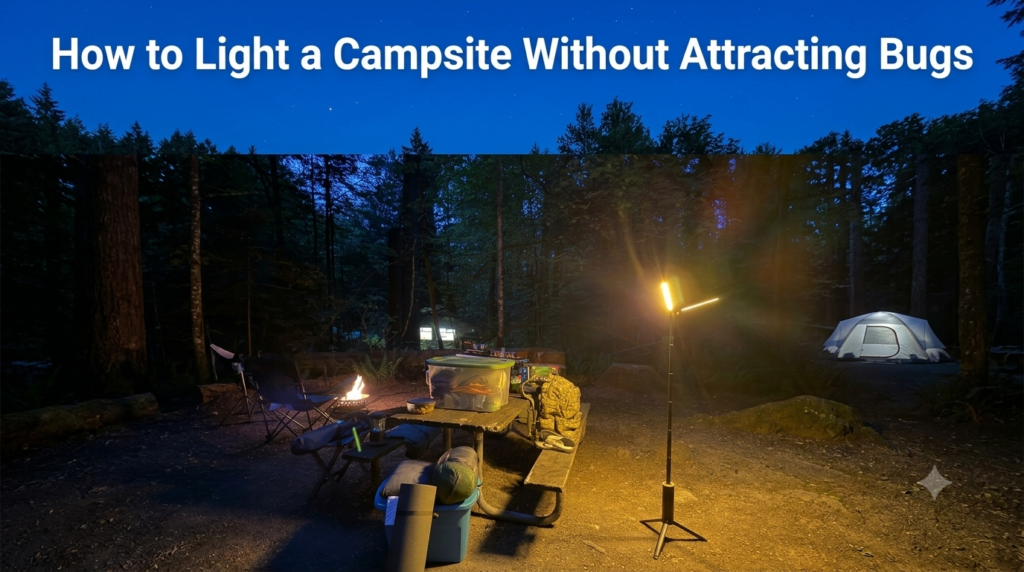
If you love camping but hate sitting underneath a harsh light surrounded by flying insects, the problem may not be that you need a brighter lantern. You may simply be using the wrong kind of light for the job.
When you are cooking dinner, finding gear, setting up a tent, or cleaning up after dark, you obviously need useful illumination. But once those jobs are finished, leaving a bright cool-white light running across the entire campsite can make the evening feel much less relaxing.
That raises a better question: how do you light a campsite without attracting bugs unnecessarily?
The answer isn’t to sit in complete darkness. Instead, it is to use the right light color, brightness, direction, and placement for the situation. That’s where a camping light such as the BougeRV T1 becomes interesting because it lets you switch between white, warm, and red lighting while adjusting the height and direction of three separate panels. BougeRV officially lists warm, white, and red modes, along with adjustable positioning and a telescoping pole.
Quick Answer: Is the BougeRV T1 Right for This Problem?
Yes, if your goal is to have useful campsite lighting without relying on harsh white light all evening.
The BougeRV T1 is particularly useful because you don’t have to choose between bright lighting and a more comfortable nighttime setup. You can use brighter white light when cooking or setting up camp, then switch to its warmer mode when you want less intense illumination. Red light provides another lower-impact option when preserving night vision matters.
The T1 also raises the light up to roughly 66 inches and lets you adjust the individual panels, so you can illuminate the areas that actually need light instead of simply blasting the entire campsite from table height.
The Problem You’re Actually Trying to Solve
The frustrating part of campsite lighting is that the brightest setting isn’t necessarily the best setting for the entire night.
Imagine arriving at camp after sunset. You need strong light to unload the vehicle, find cooking equipment, connect gear, and get organized. Bright white light makes those jobs much easier.
But once everything is ready, you probably don’t need that same intensity.
This is where many camping setups go wrong. The main lantern stays on its brightest white setting because nobody wants to keep getting up to change lights. The result can be an unnecessarily bright campsite that feels harsh and attracts insects toward the illuminated area.
The goal, therefore, isn’t to find a magical lamp that repels bugs. A camping light cannot make that promise simply because it has an amber or red setting.
The more realistic goal is to avoid using bright, blue-rich white light when maximum visibility isn’t necessary.
Research supports the general idea behind this approach. A 2026 study comparing outdoor lighting found that amber LEDs with low blue-light content attracted significantly fewer insects than conventional cool-white LEDs.
That doesn’t mean every warm camping light will produce exactly the same result. It means the color and spectral characteristics of outdoor lighting can matter.
What a Good Solution Needs to Do
A useful camping light for this problem needs to do more than simply offer a “bug” color.
First, it needs multiple light colors. You want bright illumination when you actually need to see clearly, but a warmer or red option for less demanding nighttime activities.
Second, brightness control matters. There is little reason to use maximum output when you’re sitting around the campsite talking.
Third, direction matters. If the light shines everywhere, you’re illuminating more of the surrounding environment than necessary. A light that can be aimed toward your cooking area, table, tent, or gear lets you concentrate illumination where you need it.
Finally, height makes a surprising difference. Raising a light above the campsite can spread illumination more evenly, reducing the temptation to place an extremely bright lantern directly on the table.
How the BougeRV T1 Solves the Problem
The T1’s biggest advantage for this particular problem is that it gives you several ways to change the lighting rather than forcing you to use one setting all night.
Use White Light When You Actually Need It
When you’re setting up camp or preparing food, visibility is important.
This is when the T1’s bright white mode makes sense. User reviews repeatedly praise its brightness, including reports of using it to illuminate large campsite areas and cooking tables.
One reviewer described using it to light an entire 20-by-40-foot campsite, while another said the elevated light made it easier to cook and organize gear.
BougeRV states that the T1 can produce up to 3,000 lumens and illuminate an area of up to 1,076 square feet.
The important point isn’t simply the lumen number.
It’s that you can use strong illumination for the tasks that actually require it.
Switch to Warm Light After Camp Is Set Up
Once dinner is finished and you’re sitting around camp, maximum brightness becomes less important.
This is where the warmer setting becomes especially relevant.
One reviewer specifically said they were picky about lighting because they disliked harsh, bug-attracting glare and reported using the amber mode most often at night.
Another review specifically praised the ability to change the light to a “non-bug mode.”
Those comments don’t prove that the T1 prevents insects from approaching. They do show that the warm mode solves a real user preference: having a less harsh nighttime light instead of leaving bright white illumination running continuously.
That’s a much more credible reason to use it.
Use Red Light When You Need Even Less Visual Impact
The T1 also includes a red mode.
This is particularly useful for situations where you want some illumination without flooding the campsite with bright white light. One reviewer who is also an amateur astronomer specifically liked the red setting for maintaining dark adaptation while setting up a telescope.
Another reviewer bought the light primarily for camping because of its red-light capability.
So the T1 isn’t limited to one “bug-friendly” trick. It gives you a progression:
Bright white → warm light → red light
depending on what you’re doing.
Why Height and Direction Matter More Than You Might Think
Color is only part of the equation.
The T1’s telescoping design allows the light source to be raised above the campsite, while its three adjustable panels can be directed independently. BougeRV says the pole extends to about 66 inches and the panels can rotate and tilt.
That creates a useful setup strategy.
During dinner, you could raise the light and aim the panels toward the cooking and eating areas. Afterward, you could lower the brightness and switch to warm light.
Instead of one extremely bright lantern sitting in the middle of the table, you get more control over where the light goes and how intense it needs to be.
One reviewer specifically liked that the adjustable panels made it possible to illuminate their own campsite without blasting neighboring campsites.
That is a meaningful advantage when you’re trying to create a comfortable nighttime environment rather than simply maximizing brightness.
What Using It Could Look Like
Picture a typical evening.
You arrive after sunset and need to finish setting up. The T1 goes up, the panels are opened, and you use white light to see what you’re doing.
You prepare dinner under bright illumination. You can see the cooking surface, ingredients, table, and equipment clearly.
Then the work is finished.
Instead of switching the light off completely and stumbling around in darkness, you reduce the brightness and change to the warmer mode.
Now you still have enough light to see the table, talk with your family, check on the dogs, or move around camp, but you’re no longer relying on maximum-intensity white light for an activity that doesn’t require it.
Later, if you’re stargazing or want a more subdued setup, red light becomes another option.
That flexibility is the real reason the T1 fits this problem.
Is This Better Than Just Using a Basic Lantern?
A basic lantern can certainly illuminate a campsite.
The difference is control.
With a conventional lantern, you’re often dealing with one light source sitting at one height. You can move the lantern, but you don’t have the same combination of height adjustment, individual panel positioning, and multiple colors.
The T1 essentially lets you change the lighting strategy as the evening changes.
That makes more sense for car campers, families, group campsites, and people who spend several nights outdoors than for someone who only needs a tiny light for occasional backpacking.
There is also a practical portability advantage. The T1 folds down to roughly 11.5 inches and weighs about 2.43 pounds, according to BougeRV.
Who Should Buy It — And Who Shouldn’t
The BougeRV T1 makes the most sense for car campers, SUV campers, families, overlanders, group campers, and anyone who wants one primary light for a campsite.
It is especially appealing if you dislike harsh lighting and want the ability to switch between bright task lighting and more subdued nighttime illumination.
It may be excessive if you’re a minimalist backpacker who only wants the lightest possible headlamp or lantern.
There are also a few trade-offs in the reviews. Some users found the controls less intuitive at first, while others wished the pole were taller. One reviewer also reported a battery problem, although the unit was replaced by customer service.
So this isn’t a claim that the T1 is perfect.
Its advantage is that the combination of height, brightness adjustment, three panels, and multiple colors gives you considerably more control than a basic lantern.
Important Things to Check Before Buying
Before buying the T1 specifically for reducing bug-attracting glare, keep one distinction in mind:
It is not an insect repellent.
Warm or amber lighting may attract fewer insects than some cooler white lighting, but it will not create an invisible barrier around your campsite.
Also consider the size and weight. At about 2.43 pounds, the T1 is much more suited to vehicle-based camping than ultralight backpacking.
Finally, think about whether you actually need its flexibility. If you only need a small light inside a tent, this may be more equipment than necessary. But if you want one light that can illuminate cooking, campsite setup, outdoor work, and relaxed nighttime activities, the additional control becomes much more useful.
FAQs
How do you light a campsite without attracting bugs?
Use the lowest practical brightness and consider warmer or red lighting instead of leaving bright cool-white light running continuously. Research indicates that amber, low-blue lighting can attract fewer insects than conventional cool-white lighting.
Does amber camping light keep bugs away?
No. Amber light should not be described as an insect repellent. However, research suggests certain amber, low-blue lighting can attract fewer insects than conventional cool-white lighting.
What color light attracts fewer bugs while camping?
Warmer amber/yellow light generally attracts fewer insects than blue-rich cool-white lighting, although the exact result depends on the light’s spectrum and the insects involved.
Is red light good for camping?
Red light is useful when you want subdued illumination and want to preserve night vision, particularly for activities such as stargazing.
Is the BougeRV T1 good for camping?
The T1 is particularly well suited to car camping and campsite use because it combines a telescoping height, adjustable light panels, multiple colors, brightness control, and a large rechargeable battery. BougeRV lists a 15,600mAh battery and up to 90 hours of maximum stated runtime depending on use.
Can the BougeRV T1 replace a normal camping lantern?
For many car-camping setups, yes. It can function as a bright area light, a table lantern, a directional work light, and a lower-intensity nighttime light. However, its size and weight make it less attractive for ultralight camping.
Can you use the T1 without the bright white setting?
Yes. The T1 includes warm and red modes in addition to white light, allowing you to choose a less intense lighting option when maximum visibility isn’t necessary.
Final Verdict
If your problem is simply “I need a light for camping,” there are plenty of cheaper and simpler options.
But if your real problem is “I need enough light to cook, organize camp, and move around, but I don’t want harsh white lighting dominating the campsite all night,” the BougeRV T1 makes considerably more sense.
Its strongest advantage isn’t that it “keeps bugs away.” It doesn’t.
The advantage is control.
You can use bright white light when visibility matters, switch to warm light when the campsite settles down, and use red when you want an even more subdued option. Meanwhile, the telescoping height and independently adjustable panels let you direct the light rather than simply flooding everything around you.
That combination directly addresses the problem behind this search.
Instead of choosing between “bright enough to see” and “comfortable enough to sit under,” the T1 gives you more ways to adjust the setup as the night changes.
For car campers, families, overlanders, and frequent campers who are particularly sensitive to harsh, bug-attracting glare, this is the type of camping light worth seriously considering.
If that’s the problem you’re trying to solve, checking the T1’s current price and specifications is the logical next step.


