
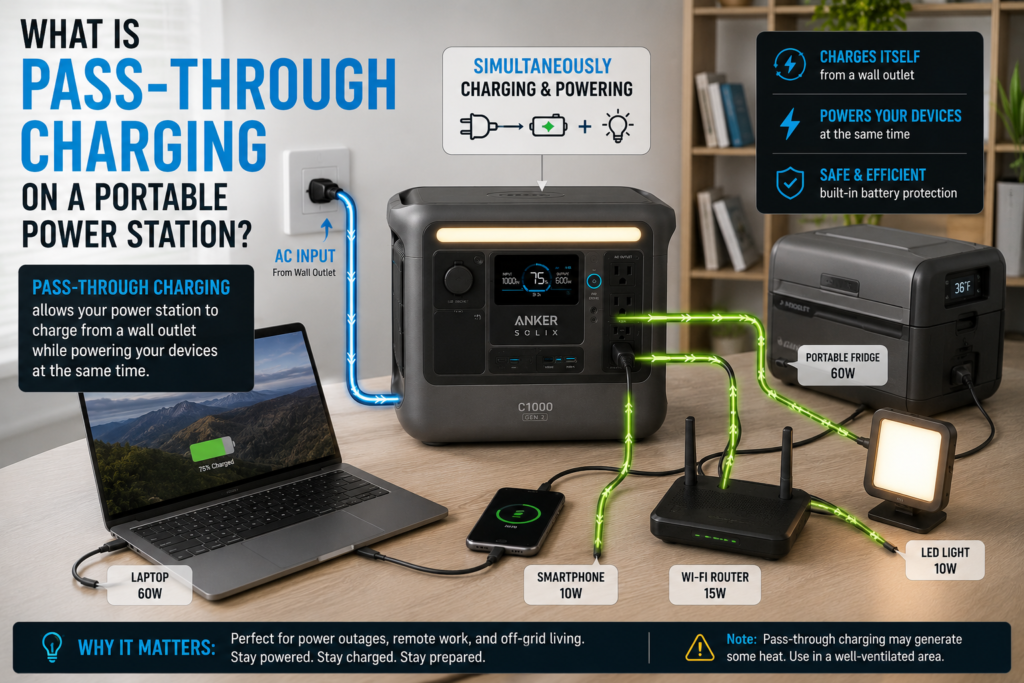
Imagine the power goes out while you’re working from home. Your portable power station is plugged into the wall, your laptop stays on, your Wi-Fi never disconnects, and your phone keeps charging—all without you moving a single cable.
That’s exactly what pass-through charging on a portable power station is designed to do.
Instead of choosing between charging the battery or powering your devices, pass-through charging lets the power station do both simultaneously. This feature has become increasingly common on modern portable power stations because it offers greater convenience during emergencies, camping trips, remote work, and everyday home backup.
In this guide, you’ll learn how pass-through charging works, when you should use it, its advantages and limitations, and whether it affects battery lifespan.
Quick Answer
Pass-through charging allows a portable power station to recharge its battery while simultaneously supplying power to connected devices.
Modern units intelligently distribute incoming electricity between the connected appliances and the internal battery. In many premium models, wall power is supplied directly to the connected devices first, while any remaining power recharges the battery. This improves efficiency and reduces unnecessary battery cycling.
What Is Pass-Through Charging on a Portable Power Station?
Pass-through charging is a feature that lets a portable power station receive power from an external source while delivering electricity through its AC outlets, USB ports, or DC outputs at the same time.
Think of it as acting like a power strip and a battery charger simultaneously.
For example:
- You plug the power station into a household outlet.
- Your refrigerator is connected to the AC outlet.
- Your laptop uses one USB-C port.
- Your router is connected for internet backup.
The power station powers every connected device while also maintaining or charging its battery.
Many newer models automatically manage this process without requiring any manual settings.
Why Pass-Through Charging Matters
Without pass-through charging, you would need to disconnect your devices every time you wanted to recharge the power station.
That becomes inconvenient during:
- Power outages
- Remote work
- Camping
- RV travel
- Van life
- CPAP overnight use
- Home office backup
Instead, pass-through charging creates a continuous source of power.
For example, many users rely on this feature to keep a modem, router, desktop computer, and monitor running all day. If utility power fails unexpectedly, the battery immediately takes over with minimal interruption.
If you’re evaluating whether a specific model is suitable for continuous home backup, our guide on Anker SOLIX C1000 Gen 2 Review: Is It Worth Buying in 2026? explains its UPS performance, charging speed, and real-world experience.
How Does Pass-Through Charging Work?
Although the exact design varies by manufacturer, most modern power stations follow the same basic process.
Incoming Power
Electricity enters the power station through:
- AC wall outlet
- Solar panels
- Vehicle charger
- Generator
Power Distribution
The internal power management system determines where electricity should go.
Typically it:
- Powers connected appliances first
- Sends excess power to recharge the battery
- Protects against overloads
- Manages charging speed
Battery Management
If incoming power exceeds device demand, the battery charges.
If device demand suddenly exceeds incoming power, the battery instantly supplies the difference.
Premium models can switch between these states automatically in milliseconds.
Pass-Through Charging vs Traditional Charging
| Feature | Traditional Charging | Pass-Through Charging |
|---|---|---|
| Charge battery while using outputs | ❌ No | ✅ Yes |
| Continuous device operation | ❌ No | ✅ Yes |
| Home backup friendly | Limited | Excellent |
| Suitable for routers and computers | Poor | Excellent |
| Solar charging while powering devices | Usually No | Yes (supported models) |
Benefits of Pass-Through Charging
1. Continuous Backup Power
The biggest benefit is uninterrupted operation.
Instead of shutting devices down while recharging the power station, everything continues running.
This is especially useful for:
- Wi-Fi routers
- Home networking equipment
- Security cameras
- Refrigerators
- Medical equipment
- Desktop computers
2. Better Emergency Preparedness
Many portable power stations now include UPS (Uninterruptible Power Supply) functionality.
For example, the Anker SOLIX C1000 Gen 2 offers an automatic transfer time of approximately 10 milliseconds, allowing connected electronics to continue operating during short power interruptions.
This makes pass-through charging valuable for home offices and essential household equipment.
If reliable medical backup is important, you may also want to compare models in Anker SOLIX C1000 Gen 2 vs Jackery Explorer 1000 V2 for CPAP Backup, where battery runtime and emergency performance are discussed in detail.
3. Ideal for Solar Charging
Pass-through charging is especially useful with solar panels.
During daylight hours:
- Solar panels charge the battery.
- The battery powers your devices.
- Excess solar energy recharges the battery.
- Grid electricity may not be needed.
According to customer experiences included in the supplied data, a 200W solar setup commonly restored around 17% battery capacity in under two hours under good sunlight while the power station continued supporting connected devices.
4. Reduced Cable Swapping
Instead of unplugging appliances every time the battery needs charging, everything stays connected.
This simplifies:
- Home backup systems
- RV installations
- Camper vans
- Outdoor workstations
- Remote offices
Are There Any Downsides to Pass-Through Charging?
Pass-through charging is extremely useful, but it isn’t perfect. Understanding its limitations helps you get the best performance and extend the life of your portable power station.
Increased Heat
Charging a battery while simultaneously powering devices generates more heat than doing either task alone.
Most modern portable power stations automatically increase fan speed to keep internal temperatures within a safe operating range. However, you should always place the unit in a well-ventilated area and avoid covering the air vents.
Slower Battery Charging Under Heavy Loads
Incoming power is shared between your connected devices and the battery.
For example, if your power station is receiving 600W from a wall outlet and your appliances are using 350W, only the remaining power is available to recharge the battery. As a result, charging takes longer than when no devices are connected.
Not Every Model Works the Same Way
Manufacturers implement pass-through charging differently.
Some portable power stations prioritize powering connected devices before charging the battery, while others continuously cycle energy through the battery. Premium models generally use smarter power management systems that improve efficiency and reduce battery wear.
Always check the manufacturer’s documentation to understand how your specific model handles pass-through charging.
Is Pass-Through Charging Safe?
Yes—when supported by the manufacturer.
Modern portable power stations include multiple protection systems, such as:
- Overload protection
- Over-temperature protection
- Over-voltage protection
- Short-circuit protection
- Battery Management System (BMS)
- Automatic cooling fans
These systems monitor battery temperature, charging current, and output power to keep the unit operating safely.
However, you should still follow a few best practices:
- Use only the manufacturer’s recommended charging cable.
- Avoid blocking cooling vents.
- Keep the unit dry.
- Do not exceed the maximum continuous output rating.
- Keep firmware updated if your model supports software updates.
Can You Use Pass-Through Charging With Solar Panels?
Absolutely.
In fact, solar charging is one of the biggest reasons people choose a portable power station with pass-through charging.
A typical setup looks like this:
- Solar panels generate electricity.
- The portable power station powers your appliances.
- Any excess solar energy charges the internal battery.
- If sunlight decreases, the battery automatically supplies the remaining power.
This makes pass-through charging ideal for:
- Camping
- RV travel
- Van life
- Off-grid cabins
- Outdoor events
- Emergency preparedness
According to the customer experiences provided, users successfully powered laptops, Starlink Mini systems, Wi-Fi equipment, LED lighting, and other low-to-medium power devices while simultaneously charging from 200W solar panel arrays.
Real-World Uses for Pass-Through Charging
One of the strengths of pass-through charging is its versatility. Based on customer experiences, people regularly use it in several everyday situations.
Home Backup
During power outages, users keep essential devices running without interruption, including:
- Refrigerators
- Internet modems
- Wi-Fi routers
- LED lighting
- Phone chargers
- Laptop computers
Remote Work
Many remote professionals leave the power station plugged into wall power throughout the workday while simultaneously powering:
- Desktop computers
- High-performance laptops
- Monitors
- Networking equipment
If utility power fails, the battery immediately takes over, reducing downtime.
Camping and RV Travel
Campers often connect solar panels during the day while continuously running:
- Portable refrigerators
- Electric coolers
- CPAP machines
- Fans
- Lights
- Camera battery chargers
If you’re deciding whether a larger battery is worthwhile for camping, see Is a 1000Wh Power Station Overkill for Camping? for a detailed comparison of runtime and portability.
Common Mistakes to Avoid
Running High-Wattage Appliances Continuously
Pass-through charging does not increase the maximum output of your power station.
High-power appliances such as:
- Electric heaters
- Hair dryers
- Coffee makers
- Portable air conditioners
can quickly drain the battery if they consume more power than the charging source provides.
If you’re wondering why certain kitchen appliances fail to operate correctly, our guide on Why Your Portable Power Station Won’t Run Your Coffee Maker explains how inverter limits and startup wattage affect compatibility.
Blocking Airflow
Cooling fans require adequate ventilation.
Always leave several inches of space around the unit and avoid placing it inside enclosed cabinets while charging.
Ignoring Firmware Updates
Several customer reports noted that firmware updates improved charging behavior, Bluetooth connectivity, and USB-C compatibility.
However, a few users also experienced temporary interruptions when updating firmware while powering important devices. Whenever possible, perform firmware updates with non-essential equipment disconnected.
Assuming Every Battery Charges at Full Speed
Charging speed depends on:
- Incoming power source
- Device power consumption
- Battery temperature
- Manufacturer charging limits
Heavy loads naturally reduce the amount of power available for battery charging.
Is Pass-Through Charging Bad for Battery Life?
For most modern portable power stations, normal pass-through charging does not significantly reduce battery life when used as intended.
Manufacturers design lithium iron phosphate (LiFePO₄) batteries and modern battery management systems to handle regular charging cycles safely.
However, battery longevity can improve if you:
- Avoid exposing the unit to excessive heat.
- Don’t leave it at 100% charge for months without use.
- Keep firmware updated.
- Use quality charging cables.
- Store the battery between roughly 30% and 80% for long-term storage.
If you’ve noticed your battery percentage dropping faster than expected, our guide Portable Power Station Battery Drains Too Fast? 9 Ways to Make It Last Longer covers common causes and practical solutions.
Frequently Asked Questions
What is pass-through charging on a portable power station?
Pass-through charging allows a portable power station to charge its internal battery while simultaneously powering connected devices.
Is pass-through charging safe to use every day?
Yes. As long as your manufacturer officially supports the feature and you stay within the unit’s power limits, daily use is generally considered safe.
Can pass-through charging damage the battery?
Modern portable power stations include battery management systems that regulate charging and help minimize battery wear. Normal use should not noticeably shorten battery life.
Can I use pass-through charging with solar panels?
Yes. Many portable power stations support pass-through charging from compatible solar panels, making them ideal for camping and off-grid applications.
Does pass-through charging slow down battery charging?
Usually, yes. Because incoming power is shared between your connected devices and the battery, recharge times increase when you’re powering larger loads.
Is pass-through charging the same as UPS mode?
Not exactly.
Pass-through charging refers to charging and powering devices simultaneously. UPS functionality refers to how quickly the power station switches to battery power when utility electricity fails. Some premium power stations support both features together.
Final Verdict
Pass-through charging on a portable power station is one of the most valuable features for home backup, remote work, camping, and emergency preparedness. It lets you recharge the battery while continuously powering your essential devices, reducing interruptions and making the system far more convenient to use.
While charging may be slower under heavy loads and proper ventilation remains important, modern power stations are designed to manage pass-through charging safely through intelligent battery management systems and built-in protections.
If uninterrupted power is a priority, choosing a portable power station with reliable pass-through charging and fast UPS switching can make a significant difference during outages or off-grid adventures.


